Hire
Hire by role
Hire Front-end developers
Hire Back-end developers
Hire Full-stack developers
Hire Android developers
Hire iOS developers
Hire Mobile developers
Hire AI engineers
Hire by skill
Hire JavaScript developers
Hire React Native developers
Hire React.js developers
Hire .NET developers
Hire TypeScript developers
Hire Flutter developers
Hire Golang developers
Hire by country
Devs in Ukraine
Expirienced engineers with strong product focus and fast integration.
Devs in Poland
EU-based developers with reliable delivery and high standards.
Devs in Argentina
Senior engineers with strong technical depth and timezone alignment.
Hire TensorFlow engineers
Build a repeatable path from model training to deployment
Hire TensorFlow engineers to develop neural networks, improve data pipelines, and integrate models into your applications.
Companies that rely on Devico’s talent:
Devico in numbers
3-7
years average project lifetime
We build long-term relationships and deliver consistent, high-quality work for your projects.
3000+
engineers drive Devico’s tech community

Access a vast pool of highly skilled developers with diverse expertise.
8+
years of average developer experience
Benefit from senior professionals who bring years of expertise to every project.
4.4%
turnover rate
Retain the best talent with our low turnover rate, ensuring project stability and continuity.
100+
technologies covered
From front-end to back-end, we specialize in over 100 technologies to meet your unique project needs.
14
engineers locations worldwide
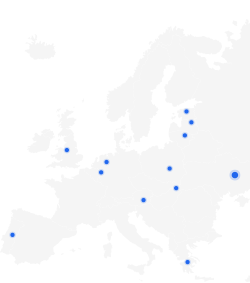
With 14 locations globally, ensuring efficient, seamless project delivery across time zones.
Here is what our customers say
View all



- E-learning
“You guys have always been genuine, flexible and personable.”

- Healthcare
“I know that we can rely on you 24/7 almost, which is way over and beyond what we've contracted.”

- Cybersecurity
“It was so easy to integrate your people with us and we didn't have any problems.”






How to hire TensorFlow engineers
with Devico
Submit a free request
Describe your modeling task and current development stage. We'll help you find TensorFlow engineers for hire with experience relevant to your data and deployment requirements.
Share your needs
Join a 30-minute call to discuss your codebase, datasets, compute environment, and expected outcomes. We'll clarify the role and provide a budget estimate.
Interview the best
Meet shortlisted candidates and review their approach to model development, training diagnostics, and evaluation. Discuss how they investigate data bottlenecks, validate exported models, and measure performance improvements.
Onboard your engineer
Once you select your engineer, we handle contracts and payment arrangements. Your engineer reviews the existing setup, establishes a baseline, and starts work against agreed priorities.
100+ TensorFlow developers for hire waiting for you

Natali S.

Viktor B.

Roman M.

Roman C.

Kateryna K.

Daniel I.

Ted S.
Goal 1
Develop a scalable web platform
Create a responsive and scalable web application that can handle high traffic while ensuring smooth performance.
Goal 2
Stability issues
As the user base grew, the number of reported bugs and complaints increased, further restricting scalability.
Goal 3
Implement secure payment integration
Integrate a secure payment system to facilitate seamless transactions while ensuring data protection and compliance.
Roman M.
Senior TensorFlow developer
Roman C.
Senior TensorFlow developer
Kateryna K.
Senior TensorFlow developer
Roman C.
Senior TensorFlow developer
Departure:
Development
Position:
TensorFlow developer
Task:
ROLE
Manager:
 John Brown
Start Date:
Immediate
Our TensorFlow
development toolkit
Programming and numerical computing
Python, NumPy, SQL
Model development
TensorFlow, Keras APIs, custom layers
Data pipelines
tf.data, batching, caching, prefetching
Data preparation
Preprocessing, augmentation, dataset validation
Training logic
Built-in training workflows, custom training loops, automatic differentiation
Model adaptation
Transfer learning, fine-tuning, layer freezing
Training optimization
Learning rate schedules, regularization, mixed precision
Distributed training
TensorFlow distribution strategies, multi-GPU training
Diagnostics
TensorBoard, profiling, gradient and numerical checks
Evaluation
Task-specific metrics, held-out testing, error analysis
Model export
SavedModel, input signatures, export validation
Serving and integration
TensorFlow Serving, REST APIs, batch inference
Reproducibility
Git, environment specifications, dataset and artifact versioning
Deployment and monitoring
Docker, CI/CD pipelines, latency and resource monitoring
TensorFlow engineers
hiring models
Staff augmentation
Add TensorFlow expertise to your existing data science and engineering team.
Fill gaps in model development, data pipelines, or deployment.
Get focused support for a training issue or performance bottleneck.
Keep control over architecture, priorities, and delivery.
Adjust capacity as implementation requirements change.
Dedicated team
Hire dedicated TensorFlow developers for ongoing model development and maintenance.
Maintain context across datasets, training configurations, and model versions.
Establish shared practices for evaluation and release validation.
Add data engineering, ML infrastructure, and QA expertise as needed.
Plan delivery around an agreed team structure and monthly budget.
FAQ about hiring TensorFlow engineers
What does a TensorFlow engineer do?
A TensorFlow engineer builds and maintains machine learning models and the pipelines used to train and run them.
Typical responsibilities include:
• Implementing model architectures and training logic.
• Preparing and validating input data.
• Running experiments and analyzing errors.
• Diagnosing compute and memory bottlenecks.
• Exporting models and validating inference behavior.
• Integrating models with applications and deployment infrastructure.
When should I hire TensorFlow engineers?
Hire TensorFlow engineers when your project uses TensorFlow and needs support with model development, training reliability, or deployment.
Common needs include adapting a pretrained model, improving a slow data pipeline, maintaining an existing codebase, or preparing a model for a new serving environment. Define the problem and baseline performance before selecting the required expertise.
What skills should I assess when I hire TensorFlow developers?
When you hire TensorFlow developers, assess their understanding of machine learning and their ability to maintain reliable software.
Core skills include:
• Python and tensor operations.
• TensorFlow and Keras model development.
• Data pipelines and preprocessing.
• Automatic differentiation and optimization.
• Model evaluation and training diagnostics.
• Export, serving, and deployment validation.
For specialized work, assess experience with the relevant domain, hardware, and infrastructure.
How should I evaluate TensorFlow engineers for hire?
Evaluate TensorFlow engineers for hire with a bounded task involving implementation, debugging, or deployment.
Ask candidates to:
• Review a model and its input pipeline.
• Identify shape, label, or preprocessing issues.
• Explain the training and validation setup.
• Propose a targeted improvement.
• Verify the result against a baseline.
• Describe how the model would be exported and tested.
Review their reasoning, code quality, and validation process alongside the final result.
Can I hire TensorFlow experts to improve training performance?
Yes. Hire TensorFlow experts to profile the workload and identify where training time is spent.
The investigation may cover:
• Data loading and preprocessing.
• CPU-to-device transfers.
• Batch size and device utilization.
• Repeated tracing or unnecessary computation.
• Memory pressure.
• Distributed training overhead.
Measure proposed changes using comparable workloads and check that model quality remains acceptable.
Can TensorFlow developers fine-tune pretrained models?
Yes. TensorFlow developers can adapt compatible pretrained models to a defined task.
The work should include checking preprocessing requirements, establishing a baseline, selecting trainable layers, and evaluating the adapted model on held-out data. Training behavior also needs attention when layers behave differently during training and inference.
Fine-tuning should address a measured gap, with documented data and compute requirements.
Can I hire dedicated TensorFlow developers for long-term projects?
Yes. You can hire dedicated TensorFlow developers for continuous model improvement, pipeline maintenance, and deployment support.
Define ownership of training code, datasets, evaluation procedures, and model artifacts. Clear documentation and versioning help the team reproduce previous results and assess whether each change improves the system.
How do TensorFlow engineers investigate unstable training?
TensorFlow engineers first check the data and training implementation before changing the architecture.
Typical checks include:
• Input ranges, labels, and missing values.
• Compatibility between predictions and the loss function.
• Gradient values and parameter updates.
• Learning rate and optimizer settings.
• Numerical issues such as non-finite values.
• Training-specific behavior in relevant layers.
A small, controlled experiment can help isolate the cause before another full training run.
Can TensorFlow specialists for hire maintain or upgrade an existing codebase?
Yes. TensorFlow specialists for hire can assess an existing application and plan maintenance or dependency upgrades.
The review should document the current environment, custom components, saved artifacts, and deployment dependencies. Establish working tests before making changes, then compare training behavior, exported models, and inference outputs.
Compatibility should be verified against the specific versions and components involved.
How do TensorFlow engineers prevent differences between training and production?
TensorFlow engineers keep preprocessing, model configuration, and inference behavior consistent across environments.
The release process should verify:
• Input names, shapes, and data types.
• Normalization, tokenization, or other transformations.
• The intended model weights and configuration.
• Inference behavior after export.
• Predictions on shared reference inputs.
• Compatibility with the serving environment.
Testing the exported artifact helps catch problems that are not visible when evaluating the model inside the training process.
Can I find TensorFlow developers for hire to deploy models on different platforms?
Yes. TensorFlow developers for hire can assess deployment options for servers, browsers, or edge devices.
Feasibility depends on the model's operations, target runtime, hardware limits, and performance requirements. Some deployments require conversion or optimization.
Validate prediction quality, latency, and memory usage on the target platform before committing to a deployment approach.
When do I need TensorFlow engineers with distributed training experience?
Look for distributed training experience when a workload needs multiple devices to meet training capacity or runtime requirements.
When you hire TensorFlow engineers for this work, assess their understanding of data distribution, gradient aggregation, batch sizing, checkpointing, and recovery. Ask how they measure scaling efficiency and verify that distributed execution preserves the intended training behavior.
What affects the cost to hire TensorFlow developers?
The cost to hire TensorFlow developers depends on specialization, engagement length, and technical scope.
Key factors include:
• Architecture complexity and custom components.
• Data preparation and pipeline requirements.
• Training scale and experiment volume.
• Existing codebase and dependency constraints.
• Export, optimization, and deployment work.
• Maintenance and monitoring responsibilities.
Budget separately for compute, storage, annotation, and third-party services.
How do I hire TensorFlow engineers through Devico?
To hire TensorFlow engineers through Devico, share your use case, current codebase, available data, deployment environment, and target timeline.
We clarify the role, recommend an engagement model, and arrange interviews with suitable candidates. You select your engineer or team, then agree on onboarding, initial deliverables, and evaluation criteria.
Still have a question?
Talk to usRequest free quote
With a pan European talent pool, Devico brings together the continents best talent and makes them available for you