Hire
Hire by role
Hire Front-end developers
Hire Back-end developers
Hire Full-stack developers
Hire Android developers
Hire iOS developers
Hire Mobile developers
Hire AI engineers
Hire by skill
Hire JavaScript developers
Hire React Native developers
Hire React.js developers
Hire .NET developers
Hire TypeScript developers
Hire Flutter developers
Hire Golang developers
Hire by country
Devs in Ukraine
Expirienced engineers with strong product focus and fast integration.
Devs in Poland
EU-based developers with reliable delivery and high standards.
Devs in Argentina
Senior engineers with strong technical depth and timezone alignment.
Hire RAG engineers
Connect AI answers to the information your business relies on
Hire RAG engineers to build retrieval-augmented generation systems around your documents, knowledge bases, and application data.
Companies that rely on Devico’s talent:
Devico in numbers
3-7
years average project lifetime
We build long-term relationships and deliver consistent, high-quality work for your projects.
3000+
engineers drive Devico’s tech community

Access a vast pool of highly skilled developers with diverse expertise.
8+
years of average developer experience
Benefit from senior professionals who bring years of expertise to every project.
4.4%
turnover rate
Retain the best talent with our low turnover rate, ensuring project stability and continuity.
100+
technologies covered
From front-end to back-end, we specialize in over 100 technologies to meet your unique project needs.
14
engineers locations worldwide
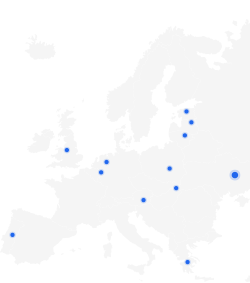
With 14 locations globally, ensuring efficient, seamless project delivery across time zones.
Here is what our customers say
View all



- E-learning
“You guys have always been genuine, flexible and personable.”

- Healthcare
“I know that we can rely on you 24/7 almost, which is way over and beyond what we've contracted.”

- Cybersecurity
“It was so easy to integrate your people with us and we didn't have any problems.”






How to hire RAG engineers
with Devico
Submit a free request
Describe the questions your application needs to answer and the sources it should use. We'll help you find RAG engineers for hire with experience relevant to your content and technical requirements.
Share your needs
Join a 30-minute call to discuss your data sources, permissions, existing stack, and expected results. We'll clarify the role and provide a budget estimate.
Interview the best
Meet shortlisted candidates and review their approach to document processing, retrieval, and evaluation. Discuss how they diagnose missing evidence, enforce access permissions, and handle questions the sources cannot answer.
Onboard your engineer
Once you select your engineer, we handle contracts and payment arrangements. Your engineer reviews the available content, establishes a baseline, and starts work against agreed priorities.
100+ RAG developers for hire waiting for you

Natali S.

Viktor B.

Roman M.

Roman C.

Kateryna K.

Daniel I.

Ted S.
Goal 1
Develop a scalable web platform
Create a responsive and scalable web application that can handle high traffic while ensuring smooth performance.
Goal 2
Stability issues
As the user base grew, the number of reported bugs and complaints increased, further restricting scalability.
Goal 3
Implement secure payment integration
Integrate a secure payment system to facilitate seamless transactions while ensuring data protection and compliance.
Roman M.
Senior RAG developer
Roman C.
Senior RAG developer
Kateryna K.
Senior RAG developer
Roman C.
Senior RAG developer
Departure:
Development
Position:
RAG developer
Task:
ROLE
Manager:
 John Brown
Start Date:
Immediate
Our RAG
development toolkit
Programming and APIs
Python, TypeScript, FastAPI, Node.js
Content ingestion
Source connectors, scheduled imports, change detection
Document processing
Text extraction, OCR integration, structure-aware parsing
Content preparation
Chunking, deduplication, metadata enrichment
Text representations
Embeddings, embedding model evaluation
Search infrastructure
PostgreSQL with pgvector, Elasticsearch, vector indexes
Retrieval strategies
Keyword search, vector search, hybrid retrieval, metadata filtering
Relevance improvement
Reranking, query reformulation, context selection
Generation
Model APIs, prompt templates, structured outputs
Source attribution
Document identifiers, passage references, citation validation
Access controls
User identity, permission-aware retrieval, tenant isolation
Evaluation
Retrieval test sets, ranking metrics, answer correctness, groundedness
Index maintenance
Incremental updates, deletion handling, reindexing
Deployment and monitoring
Docker, CI/CD, request traces, latency and cost tracking
RAG engineers
hiring models
Staff augmentation
Add retrieval and generation expertise to your existing product and engineering team.
Fill gaps in ingestion, search, evaluation, or application integration.
Get focused support for a prototype or an existing RAG system.
Keep control over architecture, priorities, and delivery.
Adjust capacity as content and implementation requirements change.
Dedicated team
Build a team focused on your RAG application, from source assessment through deployment and maintenance.
Maintain context across content processing, retrieval, and answer generation.
Coordinate changes with data owners and application teams.
Add backend, data engineering, and QA expertise as needed.
Plan delivery around an agreed team structure and monthly budget.
FAQ about hiring RAG engineers
What does a RAG engineer do?
A RAG engineer builds systems that retrieve relevant information and supply it to a generative model when processing a request.
Typical responsibilities include:
• Connecting and processing content sources.
• Designing document chunking and metadata.
• Implementing search and ranking.
• Assembling context for generation.
• Enforcing source access permissions.
• Evaluating retrieved evidence and generated answers.
• Maintaining indexes as content changes.
When should I hire RAG engineers?
Hire RAG engineers when your AI application needs answers based on private, specialized, or frequently updated information.
Common projects include internal knowledge assistants, document question answering, and customer support tools. RAG is most useful when relevant source material exists and the application needs to find and use it reliably.
What skills should I assess when I hire retrieval augmented generation developers?
When you hire retrieval augmented generation developers, assess their search engineering skills alongside their experience with language models.
Core skills include:
• Document parsing and data pipelines.
• Embeddings, keyword search, and ranking.
• Metadata design and access filtering.
• Model integration and context management.
• Retrieval and answer evaluation.
• Backend development and production monitoring.
Ask candidates to explain how they distinguish a retrieval failure from a generation failure.
How should I evaluate RAG engineers for hire?
Evaluate RAG engineers for hire using a small document collection and representative questions.
Ask candidates to:
• Establish a retrieval baseline.
• Identify parsing and content quality issues.
• Retrieve supporting passages.
• Generate an answer with traceable references.
• Handle a question the documents cannot answer.
• Explain how they would enforce document permissions.
Include ambiguous questions and conflicting sources. Review the evidence returned by search, not just the fluency of the final response.
When should I hire RAG pipeline developers instead of RAG application developers?
Hire RAG pipeline developers when the main work involves ingestion, parsing, indexing, retrieval, and content updates.
Hire RAG application developers when the scope also includes user interfaces, authentication, conversation state, backend workflows, and deployment.
Responsibilities can overlap. Define whether the engineer will own the retrieval service, the user-facing application, or both.
Do we need a vector database before we hire RAG developers?
No. Hire RAG developers to assess your retrieval requirements before selecting infrastructure.
The decision should account for:
• Content volume and update frequency.
• Keyword and semantic search needs.
• Metadata and permission filtering.
• Latency and availability requirements.
• Existing database capabilities.
• Maintenance and operating costs.
Some projects can use an existing search platform or database. A separate vector database is not a universal requirement.
How do RAG engineers choose a chunking strategy?
RAG engineers choose chunk boundaries based on document structure and the information needed to answer representative questions.
Headings, paragraphs, tables, and section relationships can affect whether a passage remains understandable after extraction. Chunk size and overlap should be tested for their effect on retrieval quality, context completeness, and cost.
There is no single chunk size that works best for every collection.
Can RAG developers work with PDFs, tables, and scanned documents?
Yes. RAG developers can build processing pipelines for these sources, but extraction quality must be evaluated before indexing.
Scanned documents may require OCR. Tables need processing that preserves relationships between headers and values. Complex layouts may require document-specific handling.
When selecting RAG developers for hire, ask how they detect extraction failures and preserve references to the original content.
How do RAG engineers enforce document permissions?
RAG engineers implement access checks so retrieval returns only content the requesting user is allowed to access.
The design should cover:
• Mapping source permissions to indexed content.
• Filtering results using authenticated identity.
• Updating access rules when permissions change.
• Preventing shared caches from exposing restricted answers.
• Testing isolation between users and tenants.
Permissions must be enforced in the application and retrieval infrastructure. Instructions to the model are insufficient.
How do RAG engineers keep knowledge sources up to date?
RAG engineers define update workflows for added, modified, and deleted content.
A maintenance plan should include change detection, processing status, index updates, and recovery from failed imports. Source identifiers and version metadata help trace answers to the content used.
Deletion and permission changes need explicit handling so outdated or restricted information does not remain retrievable.
How do RAG engineers evaluate system quality?
RAG engineers evaluate retrieval and generation separately, then test the complete workflow.
Key measures include:
• Retrieval coverage: Did search find the evidence needed?
• Ranking quality: Were useful passages placed high enough to be used?
• Answer correctness: Did the response answer the question accurately?
• Groundedness: Are claims supported by retrieved sources?
• Citation accuracy: Do references support the associated statements?
• Abstention: Did the system recognize insufficient evidence?
• Efficiency: Were latency and cost acceptable?
Use reviewed questions and expected evidence to make comparisons repeatable.
Can I hire RAG experts to reduce incorrect answers?
Yes. Hire RAG experts to investigate where the system loses or misuses information.
Common causes include poor extraction, missing content, unsuitable chunking, weak ranking, and incomplete context. The model may also generate claims that the retrieved evidence does not support.
Improvements should target the identified cause. RAG can reduce unsupported answers, but it does not guarantee factual accuracy.
What affects the cost to hire RAG developers?
The cost to hire RAG developers depends on experience, engagement length, and technical scope.
Key factors include:
• Number and complexity of source integrations.
• Document parsing and cleanup requirements.
• Access control and tenant isolation.
• Content volume and update frequency.
• Evaluation dataset preparation.
• Application integration and maintenance.
Budget separately for model usage, embeddings, search infrastructure, storage, and document processing services.
How do I hire RAG engineers through Devico?
To hire RAG engineers through Devico, share your use case, sample sources, access requirements, and target timeline.
We clarify the role, recommend an engagement model, and arrange interviews with suitable candidates. You select your engineer or team, then agree on onboarding, initial deliverables, and evaluation criteria.
Still have a question?
Talk to usRequest free quote
With a pan European talent pool, Devico brings together the continents best talent and makes them available for you