Hire
Hire by role
Hire Front-end developers
Hire Back-end developers
Hire Full-stack developers
Hire Android developers
Hire iOS developers
Hire Mobile developers
Hire AI engineers
Hire by skill
Hire JavaScript developers
Hire React Native developers
Hire React.js developers
Hire .NET developers
Hire TypeScript developers
Hire Flutter developers
Hire Golang developers
Hire by country
Devs in Ukraine
Expirienced engineers with strong product focus and fast integration.
Devs in Poland
EU-based developers with reliable delivery and high standards.
Devs in Argentina
Senior engineers with strong technical depth and timezone alignment.
Hire MLOps and AIOps engineers
Deploy models reliably. Make operational signals actionable.
Hire MLOps and AIOps engineers to automate model delivery, monitor production performance, and improve incident detection.
Companies that rely on Devico’s talent:
Devico in numbers
3-7
years average project lifetime
We build long-term relationships and deliver consistent, high-quality work for your projects.
3000+
engineers drive Devico’s tech community

Access a vast pool of highly skilled developers with diverse expertise.
8+
years of average developer experience
Benefit from senior professionals who bring years of expertise to every project.
4.4%
turnover rate
Retain the best talent with our low turnover rate, ensuring project stability and continuity.
100+
technologies covered
From front-end to back-end, we specialize in over 100 technologies to meet your unique project needs.
14
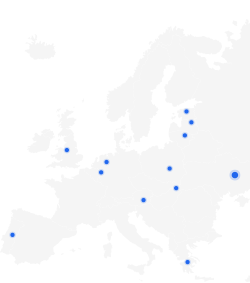
engineers locations worldwide
With 14 locations globally, ensuring efficient, seamless project delivery across time zones.
Here is what our customers say
View all



- E-learning
“You guys have always been genuine, flexible and personable.”

- Healthcare
“I know that we can rely on you 24/7 almost, which is way over and beyond what we've contracted.”

- Cybersecurity
“It was so easy to integrate your people with us and we didn't have any problems.”






How to hire MLOps and AIOps engineers
with Devico
Submit a free request
Describe your model deployment or IT operations challenge. We'll help you find MLOps and AIOps engineers for hire with experience relevant to your infrastructure and operating requirements.
Share your needs
Join a 30-minute call to discuss your pipelines, monitoring tools, incident workflows, and delivery goals. We'll clarify whether you need MLOps expertise, AIOps expertise, or a combination, then provide a budget estimate.
Interview the best
Meet shortlisted candidates and review their approach to deployment, observability, and failure recovery. Discuss how they validate changes, investigate incidents, and control automated actions.
Onboard your engineer
Once you select your engineer, we handle contracts and payment arrangements. Your engineer reviews the environment, establishes priorities, and agrees on the first deliverables.
100+ MLOps and AIOps developers for hire waiting for you

Natali S.

Viktor B.

Roman M.

Roman C.

Kateryna K.

Daniel I.

Ted S.
Goal 1
Develop a scalable web platform
Create a responsive and scalable web application that can handle high traffic while ensuring smooth performance.
Goal 2
Stability issues
As the user base grew, the number of reported bugs and complaints increased, further restricting scalability.
Goal 3
Implement secure payment integration
Integrate a secure payment system to facilitate seamless transactions while ensuring data protection and compliance.
Roman M.
Senior MLOps and AIOps engineer
Roman C.
Senior MLOps and AIOps engineer
Kateryna K.
Senior MLOps and AIOps engineer
Roman C.
Senior MLOps and AIOps engineer
Departure:
Development
Position:
MLOps and AIOps engineer
Task:
ROLE
Manager:
 John Brown
Start Date:
Immediate
Our MLOps and AIOps
engineering toolkit
Programming and automation
Python, Bash, SQL
ML workflow orchestration
Apache Airflow, Kubeflow Pipelines
Experiment tracking and model management
MLflow, model registries, artifact versioning
Data and model validation
Schema checks, data quality tests, evaluation gates
Model deployment
Batch inference, model APIs, staged releases, rollback
Containers and infrastructure
Docker, Kubernetes, Terraform
CI/CD
GitHub Actions, GitLab CI/CD, Jenkins
Cloud platforms
AWS, Microsoft Azure, Google Cloud
Observability
Prometheus, Grafana, OpenTelemetry
Operational data processing
Log aggregation, metric pipelines, event normalization
AIOps analysis
Anomaly detection, alert grouping, event correlation
Incident workflows
Alert routing, ticketing integrations, runbook automation
Production ML monitoring
Data drift, prediction quality, latency, resource usage
Execution controls
Scoped permissions, approval gates, audit logs, bounded retries
MLOps and AIOps engineers
hiring models
Staff augmentation
Add specialist expertise to your existing data, platform, or IT operations team.
Fill gaps in ML delivery, observability, or incident automation.
Get focused support for a pipeline, deployment, or monitoring initiative.
Keep control over infrastructure, priorities, and access policies.
Adjust capacity as implementation and maintenance needs change.
Dedicated team
Build a team focused on model operations, AI-assisted IT operations, or both.
Maintain context across pipelines, infrastructure, and operational workflows.
Coordinate changes with data science, platform engineering, and support teams.
Add data engineering, DevOps, or reliability expertise as needed.
Plan delivery around an agreed team structure and monthly budget.
FAQ about hiring MLOps and AIOps engineers
What is the difference between MLOps and AIOps?
MLOps focuses on operating machine learning systems. It covers model pipelines, deployment, versioning, monitoring, and retraining workflows.
AIOps applies AI and analytical methods to IT operations. It can support anomaly detection, event correlation, alert prioritization, and incident investigation.
Hire MLOps and AIOps engineers according to the problem you need to solve. The disciplines overlap, but experience in one does not automatically establish expertise in the other.
When should I hire MLOps and AIOps engineers?
Hire MLOps and AIOps engineers when manual processes or gaps in operational visibility affect your ability to run systems reliably.
Typical needs include:
• Replacing manual model deployments with repeatable pipelines.
• Tracking which data, code, and model versions are in production.
• Detecting changes in model quality.
• Reducing duplicate or unhelpful alerts.
• Connecting related operational events.
• Automating defined incident response steps.
Clarify which outcomes belong to model operations and which belong to IT operations before defining the role.
What skills should I assess when I hire MLOps and AIOps engineers?
Assess shared infrastructure skills alongside experience in the relevant discipline.
For MLOps, look for:
• ML pipelines and artifact management.
• Data and model validation.
• Inference deployment and monitoring.
• Reproducibility and rollback.
For AIOps, look for:
• Logs, metrics, traces, and event processing.
• Anomaly detection and alert correlation.
• Incident management integrations.
• Controlled runbook automation.
Both roles require programming, cloud infrastructure, access control, and production debugging skills.
How should I evaluate MLOps and AIOps engineers for hire?
Evaluate MLOps and AIOps engineers for hire using a practical scenario that matches the responsibilities of the role.
For MLOps, ask candidates to design a model release process with validation, version tracking, and rollback.
For AIOps, provide sample operational events and ask how they would group alerts, investigate a suspected incident, and validate an automated response.
Review failure handling, observability, and trade-offs alongside the proposed implementation.
Can I hire MLOps engineers to productionize existing models?
Yes. MLOps engineers can build the deployment and maintenance workflows around models developed by your data science team.
The initial assessment should cover:
• Model artifacts and dependencies.
• Training and inference preprocessing.
• Data access and validation.
• Batch or real-time serving requirements.
• Release acceptance criteria.
• Monitoring and recovery procedures.
The resulting pipeline should make releases reproducible and identify exactly which version is running.
When should I hire AIOps engineers instead of adding more monitoring tools?
Hire AIOps engineers when the challenge involves interpreting and acting on operational data across your existing systems.
Examples include repeated alerts for the same incident, limited context during investigation, or manual correlation of logs and metrics. An engineer should first assess telemetry quality and current alert rules. Better instrumentation or simpler rules may resolve some problems without an additional AI component.
Can AIOps engineers for hire work with our existing monitoring stack?
Yes. AIOps engineers for hire can connect to existing monitoring, logging, and incident management systems through supported integrations.
The assessment should establish:
• Which signals are available and reliable.
• Whether timestamps and service identifiers are consistent.
• How events map to services and dependencies.
• How alerts reach the responsible team.
• Which historical incidents can support evaluation.
Useful analysis depends on the quality and context of the underlying telemetry.
How do MLOps engineers monitor model performance?
MLOps engineers monitor both service health and model behavior.
Typical monitoring covers:
• Service health: Latency, errors, throughput, and resource usage.
• Input quality: Missing values, schema changes, and unexpected ranges.
• Distribution changes: Differences between current and reference data.
• Prediction quality: Performance against observed outcomes when available.
• Business impact: Metrics tied to the model's intended use.
Data drift is a signal to investigate. It does not, by itself, prove that prediction quality has declined.
Can AIOps engineers automate incident resolution?
AIOps engineers can automate defined response steps when the trigger, permitted action, and success criteria are clear.
Examples include collecting diagnostic information, opening a ticket, or executing an approved recovery procedure. Automation should include scoped permissions, execution limits, audit logs, and escalation when a step fails.
Higher-impact actions may require human approval. Start with bounded workflows and validate their behavior before expanding automation.
How do AIOps engineers measure whether an implementation works?
When you hire AIOps engineers, establish a baseline and measure operational outcomes.
Useful measures include:
• Actionable alerts as a proportion of total alerts.
• Missed incidents and false positives.
• Time to detect and acknowledge incidents.
• Time spent investigating.
• Recovery time for comparable incident types.
• Success and failure rates of automated actions.
Reducing alert volume is only useful if important incidents remain visible. Evaluate results against reviewed incident records and operator feedback.
Can MLOps engineers automate model retraining?
Yes. MLOps engineers can build scheduled or condition-based retraining workflows.
A retraining pipeline should validate the incoming data, track the training configuration, and compare the candidate model with the current version. Deployment should depend on agreed evaluation gates and approval requirements.
A drift alert can trigger investigation or a training run. It should not automatically justify replacing the production model.
What affects the cost to hire MLOps and AIOps engineers?
The cost to hire MLOps and AIOps engineers depends on specialization, engagement length, and operational scope.
Key factors include:
• Number of models, services, and environments.
• Existing infrastructure and pipeline maturity.
• Telemetry volume and integration requirements.
• Availability and incident response expectations.
• Access restrictions and approval processes.
• Maintenance and support responsibilities.
Budget separately for cloud resources, observability platforms, storage, and third-party services.
How do I hire MLOps and AIOps engineers through Devico?
To hire MLOps and AIOps engineers through Devico, share your current stack, operational challenges, expected responsibilities, and timeline.
We clarify whether you need MLOps specialists, AIOps specialists, or a team covering both disciplines. You interview suitable candidates, select your engineer or team, and agree on onboarding, initial deliverables, and acceptance criteria.
Still have a question?
Talk to usRequest free quote
With a pan European talent pool, Devico brings together the continents best talent and makes them available for you