Hire
Hire by role
Hire Front-end developers
Hire Back-end developers
Hire Full-stack developers
Hire Android developers
Hire iOS developers
Hire Mobile developers
Hire AI engineers
Hire by skill
Hire JavaScript developers
Hire React Native developers
Hire React.js developers
Hire .NET developers
Hire TypeScript developers
Hire Flutter developers
Hire Golang developers
Hire by country
Devs in Ukraine
Expirienced engineers with strong product focus and fast integration.
Devs in Poland
EU-based developers with reliable delivery and high standards.
Devs in Argentina
Senior engineers with strong technical depth and timezone alignment.
Hire computer vision engineers
Turn image and video data into working product features
Hire computer vision engineers to build systems that detect objects, inspect images, and interpret video.
Companies that rely on Devico’s talent:
Devico in numbers
3-7
years average project lifetime
We build long-term relationships and deliver consistent, high-quality work for your projects.
3000+
engineers drive Devico’s tech community

Access a vast pool of highly skilled developers with diverse expertise.
8+
years of average developer experience
Benefit from senior professionals who bring years of expertise to every project.
4.4%
turnover rate
Retain the best talent with our low turnover rate, ensuring project stability and continuity.
100+
technologies covered
From front-end to back-end, we specialize in over 100 technologies to meet your unique project needs.
14
engineers locations worldwide
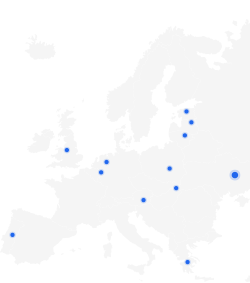
With 14 locations globally, ensuring efficient, seamless project delivery across time zones.
Here is what our customers say
View all



- E-learning
“You guys have always been genuine, flexible and personable.”

- Healthcare
“I know that we can rely on you 24/7 almost, which is way over and beyond what we've contracted.”

- Cybersecurity
“It was so easy to integrate your people with us and we didn't have any problems.”






How to hire computer vision engineers
with Devico
Submit a free request
Describe what your system needs to recognize and how the results will be used. We'll help you find computer vision engineers for hire with experience relevant to your task and deployment environment.
Share your needs
Join a 30-minute call to discuss your image or video data, accuracy requirements, hardware, and timeline. We'll clarify the expertise required and provide a budget estimate.
Interview the best
Meet shortlisted candidates and review their approach to dataset quality, model selection, and error analysis. Discuss how they balance recognition quality with processing speed and hardware limits.
Onboard your engineer
Once you select your engineer, we handle contracts and payment arrangements. Your engineer reviews the available data and infrastructure, then establishes the first deliverables and evaluation criteria.
100+ Computer vision developers for hire waiting for you

Natali S.

Viktor B.

Roman M.

Roman C.

Kateryna K.

Daniel I.

Ted S.
Goal 1
Develop a scalable web platform
Create a responsive and scalable web application that can handle high traffic while ensuring smooth performance.
Goal 2
Stability issues
As the user base grew, the number of reported bugs and complaints increased, further restricting scalability.
Goal 3
Implement secure payment integration
Integrate a secure payment system to facilitate seamless transactions while ensuring data protection and compliance.
Roman M.
Senior computer vision developer
Roman C.
Senior computer vision developer
Kateryna K.
Senior computer vision developer
Roman C.
Senior computer vision developer
Departure:
Development
Position:
Computer vision developer
Task:
ROLE
Manager:
 John Brown
Start Date:
Immediate
Our computer vision
development toolkit
Programming languages
Python, C++
Image processing
OpenCV, Pillow, scikit-image
Deep learning
PyTorch, TensorFlow
Image classification
Transfer learning, fine-tuning, class imbalance handling
Object detection and tracking
Bounding box detection, multi-object tracking, object counting
Image segmentation
Semantic segmentation, instance segmentation
Text recognition
OCR, document preprocessing, text detection and extraction
Data preparation
Annotation workflows, augmentation, dataset versioning
Model evaluation
Precision, recall, mAP, IoU, error analysis
Inference optimization
ONNX Runtime, TensorRT, quantization
Video processing
FFmpeg, GStreamer, frame sampling
Deployment
Model APIs, batch processing, edge inference, Docker
Experiment tracking
MLflow, Git, DVC
Production monitoring
Input quality checks, latency tracking, performance sampling
Computer vision engineers
hiring models
Staff augmentation
Add computer vision expertise to your existing product and engineering team.
Fill gaps in image processing, model development, or inference optimization.
Get focused support for a prototype or an existing system.
Keep control over architecture, priorities, and delivery.
Adjust capacity as data and deployment requirements change.
Dedicated team
Build a team focused on your computer vision system, from dataset assessment through deployment and maintenance.
Maintain context across annotation, experiments, and model iterations.
Coordinate model development with application and hardware requirements.
Add data engineering, backend, and QA expertise as needed.
Plan delivery around an agreed team structure and monthly budget.
FAQ about hiring computer vision engineers
What does a computer vision engineer do?
A computer vision engineer builds software that extracts information from images or video.
Typical responsibilities include:
• Assessing image quality and dataset coverage.
• Defining annotation requirements.
• Developing and evaluating recognition models.
• Analyzing missed detections and incorrect predictions.
• Optimizing inference for target hardware.
• Integrating model outputs into applications and workflows.
When should I hire computer vision engineers?
Hire computer vision engineers when your product needs to interpret visual information automatically.
Common applications include defect inspection, object counting, document processing, image classification, and video analysis. Define what the system must recognize, what action follows a prediction, and which errors are acceptable before starting development.
What skills should I assess when I hire computer vision developers?
When you hire computer vision developers, assess their modeling skills and ability to work with real image data.
Core skills include:
• Python and relevant deep learning frameworks.
• Image processing and data preparation.
• Detection, classification, or segmentation methods.
• Dataset design and annotation quality control.
• Model evaluation and error analysis.
• Inference optimization and deployment.
For edge or real-time applications, assess experience with the target hardware and processing constraints.
How should I evaluate computer vision engineers for hire?
Evaluate computer vision engineers for hire with a practical exercise using representative images and a clear task.
Ask candidates to:
• Identify data quality and labeling issues.
• Propose a baseline approach.
• Choose evaluation metrics.
• Prevent leakage between training and test data.
• Analyze errors across different conditions.
• Explain deployment trade-offs.
Review their reasoning alongside model performance. A high score on a narrow test set does not establish readiness for production.
Do we need labeled images before hiring computer vision developers?
No. You can hire computer vision developers to assess your data and define an annotation process.
The initial assessment should establish:
• Which objects, regions, or categories need labels.
• Whether existing images represent production conditions.
• How ambiguous examples should be annotated.
• How annotation quality will be checked.
• Which data should be reserved for evaluation.
Depending on the task, pretrained models or other approaches may reduce labeling requirements. They still need validation on representative data.
How much data does a computer vision project need?
There is no universal minimum. Data requirements depend on the task, visual variability, error tolerance, and modeling approach.
A controlled inspection setup may need different coverage from an outdoor system exposed to changing weather, lighting, and camera angles. Computer vision engineers for hire should assess both dataset size and diversity before estimating feasibility or promising an accuracy target.
Should we use a pretrained model or train a custom model?
Start by testing whether an existing model can meet your requirements. Fine-tuning may help when your images, objects, or labels differ from its original training domain.
Training from scratch generally requires more data and compute. When you hire computer vision engineers, ask them to compare approaches using representative evaluation data, deployment constraints, and maintenance costs.
Can I hire computer vision developers for real-time video processing?
Yes. Hire computer vision developers to design and optimize a pipeline around a defined latency and throughput target.
Requirements should specify:
• Number of simultaneous video streams.
• Input resolution and frame rate.
• Maximum acceptable processing delay.
• Available CPU, GPU, or edge hardware.
• Whether every frame needs analysis.
• How the system handles dropped frames or interrupted streams.
Measure the complete pipeline, including decoding and preprocessing, rather than model inference alone.
Can computer vision models run on edge devices?
Yes, provided the model and processing pipeline fit the device's compute, memory, and power limits.
Edge deployment may require resizing inputs, choosing a smaller model, or applying quantization. Each optimization should be tested for its effect on recognition quality and latency. Hardware compatibility, update delivery, and monitoring also need to be included in the deployment plan.
How do computer vision engineers measure model quality?
Computer vision engineers select metrics that match the task and the consequences of errors.
Common measures include:
• Classification: Precision, recall, F1 score, and confusion matrices.
• Detection: Precision, recall, and mean average precision.
• Segmentation: Intersection over Union and Dice score.
• Tracking: Identity consistency and tracking accuracy.
• Deployment: Latency, throughput, and resource usage.
Results should also be reviewed by relevant conditions, such as lighting, camera type, object size, or location. Overall averages can hide important failures.
Can I find computer vision developers for hire to improve an existing model?
Yes. Computer vision developers for hire can investigate accuracy, speed, or reliability problems in an existing system.
Provide model artifacts, evaluation code, dataset documentation, and examples of failed predictions. The review can examine annotation errors, missed conditions, preprocessing differences, threshold settings, and hardware bottlenecks.
Agree on a baseline and acceptance criteria before implementing changes.
What affects the cost to hire computer vision engineers?
The cost to hire computer vision engineers depends on specialization, engagement length, and project scope.
Key factors include:
• Data collection and annotation requirements.
• Complexity of the recognition task.
• Number of environments or camera configurations.
• Real-time processing requirements.
• Hardware and deployment constraints.
• Evaluation and maintenance responsibilities.
Budget separately for annotation services, compute, storage, cameras, and deployment hardware.
How do I hire computer vision engineers through Devico?
To hire computer vision engineers through Devico, share your use case, available image or video data, target hardware, and expected timeline.
We clarify the role, recommend an engagement model, and arrange interviews with suitable candidates. You select your engineer or team, then agree on onboarding, initial deliverables, and evaluation criteria.
Still have a question?
Talk to usRequest free quote
With a pan European talent pool, Devico brings together the continents best talent and makes them available for you