Hire
Hire by role
Hire Front-end developers
Hire Back-end developers
Hire Full-stack developers
Hire Android developers
Hire iOS developers
Hire Mobile developers
Hire AI engineers
Hire by skill
Hire JavaScript developers
Hire React Native developers
Hire React.js developers
Hire .NET developers
Hire TypeScript developers
Hire Flutter developers
Hire Golang developers
Hire by country
Devs in Ukraine
Expirienced engineers with strong product focus and fast integration.
Devs in Poland
EU-based developers with reliable delivery and high standards.
Devs in Argentina
Senior engineers with strong technical depth and timezone alignment.
Hire AI solutions architects
Define how AI will work within your product and infrastructure
Hire AI solutions architects to turn business requirements into an implementation plan.
Companies that rely on Devico’s talent:
Devico in numbers
3-7
years average project lifetime
We build long-term relationships and deliver consistent, high-quality work for your projects.
3000+
engineers drive Devico’s tech community

Access a vast pool of highly skilled developers with diverse expertise.
8+
years of average developer experience
Benefit from senior professionals who bring years of expertise to every project.
4.4%
turnover rate
Retain the best talent with our low turnover rate, ensuring project stability and continuity.
100+
technologies covered
From front-end to back-end, we specialize in over 100 technologies to meet your unique project needs.
14
engineers locations worldwide
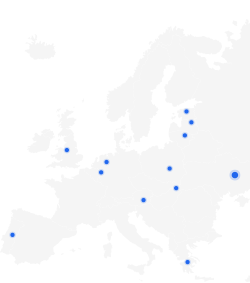
With 14 locations globally, ensuring efficient, seamless project delivery across time zones.
Here is what our customers say
View all



- E-learning
“You guys have always been genuine, flexible and personable.”

- Healthcare
“I know that we can rely on you 24/7 almost, which is way over and beyond what we've contracted.”

- Cybersecurity
“It was so easy to integrate your people with us and we didn't have any problems.”






How to hire AI solutions architects
with Devico
Submit a free request
Describe your use case and current environment. We'll help you find AI solutions architects for hire with experience relevant to your systems and delivery goals.
Share your needs
Join a 30-minute call to discuss your existing architecture, data access, technical constraints, and budget. We'll use these details to define the role and provide an estimate.
Interview the best
Meet shortlisted candidates and discuss their approach to model selection, integration, security, and deployment. Review how they explain trade-offs and translate architectural decisions into development tasks.
Onboard your architect
Once you select your architect, we handle contracts and payment arrangements. Your architect reviews the current setup, aligns with stakeholders, and establishes the first deliverables.
100+ AI solutions architecture developers for hire waiting for you

Natali S.

Viktor B.

Roman M.

Roman C.

Kateryna K.

Daniel I.

Ted S.
Goal 1
Develop a scalable web platform
Create a responsive and scalable web application that can handle high traffic while ensuring smooth performance.
Goal 2
Stability issues
As the user base grew, the number of reported bugs and complaints increased, further restricting scalability.
Goal 3
Implement secure payment integration
Integrate a secure payment system to facilitate seamless transactions while ensuring data protection and compliance.
Roman M.
Senior AI solutions architect
Roman C.
Senior AI solutions architect
Kateryna K.
Senior AI solutions architect
Roman C.
Senior AI solutions architect
Departure:
Development
Position:
AI solutions architect
Task:
ROLE
Manager:
 John Brown
Start Date:
Immediate
Our AI
solution architecture toolkit
Requirements and architecture
Use case assessment, system diagrams, architecture decision records
Model selection
Hosted model APIs, open-weight models, benchmark design, build-versus-buy analysis
Data architecture
Data pipelines, storage design, lineage, access patterns
Retrieval architecture
RAG, embeddings, vector search, source attribution
Agent architecture
Tool calling, workflow orchestration, state management, approval steps
System integration
REST APIs, event-driven architecture, queues, webhooks
Cloud infrastructure
AWS, Microsoft Azure, Google Cloud
Deployment patterns
Managed endpoints, containers, batch inference, real-time inference
Security and access
Identity management, scoped permissions, secrets management, network boundaries
Evaluation and observability
Evaluation datasets, execution traces, quality metrics, operational monitoring
Reliability and recovery
Timeouts, retries, fallbacks, rollback plans
Performance and cost
Capacity planning, caching, model routing, usage limits
Delivery planning
Technical roadmaps, proof-of-concept scope, acceptance criteria, engineering handoffs
AI solutions architects
hiring models
Staff augmentation
Add an AI solutions architect to your team for a specific initiative or architecture decision.
Assess an existing design or define a new AI component.
Get support with model, infrastructure, and integration choices.
Keep technical ownership within your organization.
Set the engagement scope around your delivery needs.
Dedicated team
Build a team with ongoing architecture support throughout AI development and deployment.
Maintain architectural context as requirements evolve.
Coordinate decisions across product, data, security, and engineering.
Add development and infrastructure expertise as needed.
Plan delivery around an agreed team structure and monthly budget.
FAQ about hiring AI solutions architects
What does an AI solutions architect do?
An AI solutions architect defines how AI components fit into a broader software system. The role connects business requirements with technical design and delivery planning.
Typical responsibilities include:
• Assessing whether a use case needs AI.
• Selecting model and deployment approaches.
• Defining data flows and integration boundaries.
• Establishing security, evaluation, and reliability requirements.
• Estimating infrastructure and model usage costs.
• Documenting decisions and guiding implementation.
When should I hire AI solutions architects?
Hire AI solutions architects when an AI initiative requires decisions across several systems, teams, or technical constraints.
Common situations include:
• Adding AI capabilities to an existing product.
• Moving a prototype into production.
• Choosing between hosted and self-hosted models.
• Connecting AI to internal data and business systems.
• Reviewing an implementation with quality, cost, or reliability problems.
Architecture support is most useful before these decisions create dependencies that are expensive to change.
What skills should I assess when I hire AI solution architects?
When you hire AI solution architects, assess their ability to design complete systems and explain technical trade-offs.
Core skills include:
• Software architecture and API design.
• AI model integration and evaluation.
• Data architecture and retrieval.
• Cloud infrastructure and deployment.
• Identity, permissions, and data protection.
• Reliability, monitoring, and cost estimation.
• Technical documentation and stakeholder communication.
Look for depth relevant to your use case rather than familiarity with every AI framework.
How should I evaluate AI solutions architects for hire?
Evaluate AI solutions architects for hire through a design exercise based on your actual constraints.
Give candidates a use case, a system overview, and requirements for data access, latency, and budget. Ask them to:
• Identify missing information.
• Propose a system design.
• Explain alternative approaches.
• Describe failure scenarios and recovery.
• Define how quality will be measured.
• Outline an implementation sequence.
Assess whether their decisions follow from the requirements and whether an engineering team could act on the design.
How does an AI solutions architect differ from an AI engineer?
An AI solutions architect focuses on system design, technical boundaries, and decisions that affect multiple components. An AI engineer focuses on implementing and testing those components.
Responsibilities can overlap, particularly in smaller teams. Hire AI solutions architects when you need cross-system technical direction. Include AI engineers when you need implementation capacity for integrations, model pipelines, or application features.
What deliverables should I expect when I hire AI solution architects?
When you hire AI solution architects, agree on deliverables that support implementation and review.
These may include:
• A requirements and constraints assessment.
• System and data flow diagrams.
• Documented architecture decisions.
• Model and infrastructure evaluation criteria.
• An access control and deployment design.
• A cost estimate with explicit assumptions.
• A phased implementation plan and acceptance criteria.
The scope should reflect the project stage. An architecture review requires different outputs from a new system design.
Can AI solution architects for hire work with our existing infrastructure?
Yes. AI solution architects for hire can design around existing applications, cloud services, data platforms, and identity systems.
The initial assessment should establish what can be reused, which integrations are available, and where constraints affect the design. Recommendations should explain the reason for each proposed change, its dependencies, and the effort required to implement it.
How do AI solutions architects choose between hosted and self-hosted models?
AI solutions architects compare both options against the project's requirements.
Decision criteria include:
• Quality on representative tasks.
• Data handling and deployment restrictions.
• Expected traffic and latency.
• Infrastructure and operating costs.
• Customization requirements.
• The team's ability to maintain the system.
The choice should follow testing and cost estimates. Model size or benchmark scores alone are insufficient.
Can I hire AI solutions architects to review an existing AI system?
Yes. Hire AI solutions architects to assess an existing system before expanding it or committing to major changes.
Provide architecture diagrams, integration details, evaluation results, operating costs, and known failure cases. The review should identify specific issues, explain their impact, and prioritize changes by urgency, effort, and expected benefit.
How do AI solutions architects address security and data access?
AI solutions architects define where data flows, which components can access it, and how permissions are enforced.
The design should address:
• User and service authentication.
• Access to source data and connected tools.
• Data retention and logging.
• Secrets and credential storage.
• Isolation between users or tenants.
• Approval requirements for sensitive actions.
Security requirements must be implemented in application and infrastructure controls, then verified through testing.
How do AI solutions architects plan for quality and reliability?
AI solutions architects define measurable acceptance criteria and specify how the system should behave when components fail.
The plan should cover:
• Evaluation against representative tasks.
• Monitoring for quality and operational issues.
• Timeouts and bounded retries.
• Fallback behavior and human escalation.
• Release validation and rollback.
• Ownership of incidents and ongoing maintenance.
Quality requirements and failure handling should be part of the initial design.
What affects the cost to hire AI solution architects?
The cost to hire AI solution architects depends on the architect's experience, engagement length, and scope of responsibility.
Key factors include the number of systems involved, infrastructure complexity, data restrictions, and the depth of evaluation required. A focused architecture review has a different scope from ongoing technical leadership across several delivery teams.
Model usage, infrastructure, and implementation staffing should be budgeted separately.
How do I hire AI solutions architects through Devico?
To hire AI solutions architects through Devico, share your use case, current stack, main technical constraints, and target timeline.
We clarify the role, recommend an engagement model, and arrange interviews with suitable candidates. You select your architect, then agree on onboarding, responsibilities, and initial deliverables.
Still have a question?
Talk to usRequest free quote
With a pan European talent pool, Devico brings together the continents best talent and makes them available for you