AI hasn't created new ways to build engineering teams. Just as before, companies have three options: develop people they already have, hire new talent, or bring in external experts. What AI has changed is the balance between them. That's because it has reshaped the skills engineering teams need, the talent available on the market, and the return each approach can deliver.
Read on to learn how to build an engineering team in the AI era, what upskilling, hiring, and augmenting are good and bad at, and how to blend them based on your goals, timeline, existing capacity, and budget.
Motivated and focused experts for up to 60% less than locals, delivered in days, not months.
How AI is changing the balance
For years, engineering leaders have used upskilling, hiring, and staff augmentation. However, before AI, hiring was often the default way to grow an engineering team. Upskilling usually helped keep pace with new technologies, while staff augmentation addressed short-term capacity or niche talent gaps. Those options still exist, but AI has changed the value proposition of each one.
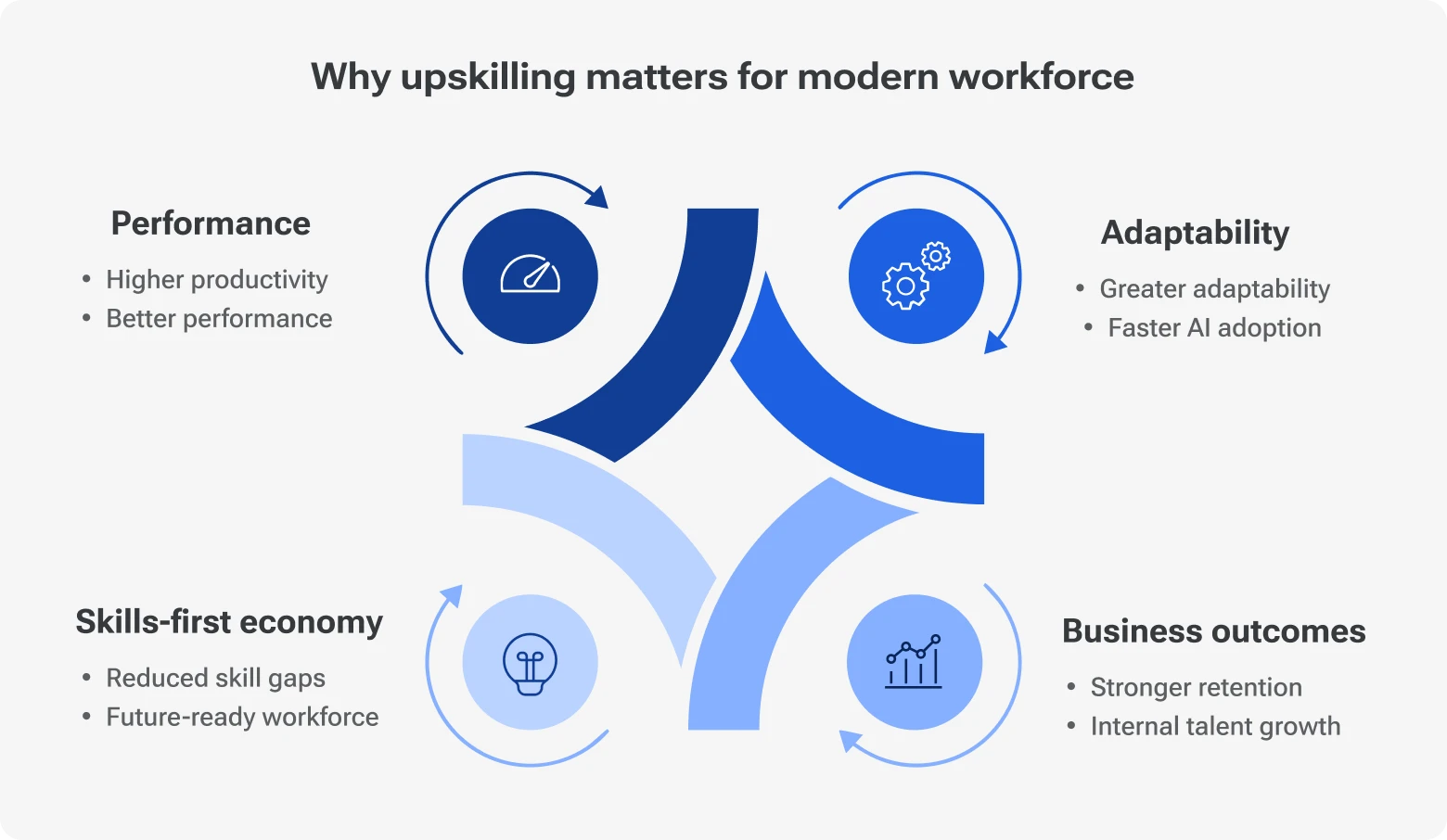
Upskilling has become more strategic than before. The thing is that AI is changing software engineering faster than companies can replace their workforce. This makes continuous learning paramount. According to the World Economic Forum's Future of Jobs Report 2025, 63% of employers see skills gaps as the main barrier to business transformation, while 85% plan to prioritize workforce upskilling.
This approach makes perfect sense, as your engineers already understand the product and business domain, and teaching them to work with any new technology is often more efficient than gaining that expertise through new hires.
Hiring, in turn, is becoming more selective. While AI speeds up the completion of routine work, it also makes engineering judgment more valuable for tackling sophisticated tasks. Therefore, companies now look for engineers who not only deliver clean code quickly but can also evaluate AI-generated code, make far-sighted technical decisions, and tackle complex challenges.
Also, AI has made hiring more difficult. Nearly two-thirds of managers (65%) said hiring has become harder due to the flood of AI-generated applications, and 58% reported greater difficulty identifying really competent candidates compared to one year ago.
As AI tools enable job seekers to create highly polished CVs, applications, and test assignments, employers spend more time validating qualifications, which slows down the hiring process and increases the risk of misalignment.
Staff augmentation is evolving as well. Usually, companies used it to add capacity during busy periods or fill niche skill gaps. Today, it's often used to access expertise that changes too quickly or is needed temporarily. It also helps organizations avoid lengthy hiring processes and the associated hassle.
None of these strategies has become better because of AI. Each one can be used based on a business problem you need to solve. The key is knowing when each approach delivers the greatest value.
Approach
What it's best for
What AI changed
Limitations
Building long-term internal capabilities and preserving product knowledge.
Skills become outdated faster, making continuous learning more important.
Requires time and senior talent to teach others and doesn't solve immediate skill or capacity gaps.
Building product ownership, preserving product knowledge, developing future leaders, and growing a junior talent pipeline.
The demand for senior specialists is increasing, and the demand for junior engineers is decreasing. Senior screens are more gameable, and verification is harder and more expensive.
High upfront hiring cost, longer time-to-fill, ramp-up time, and the risk of a bad hire.
Scaling quickly, bringing in senior expertise on demand, handling temporary workloads, and bridging hiring or upskilling gaps.
As it becomes harder to hire senior talent and technical verification gets more difficult and costlier, the value of pre-vetted engineers increases.
Not ideal for core roles, and success mainly depends on selecting the right partner.
Upskilling — Developing the engineers you already have
Upskilling is often a wise investment, as it helps you build a capability your company can rely on for years.
While it very rarely delivers quick results, it strengthens your engineering team in ways hiring and staff augmentation cannot.
In the past, upskilling usually suggested learning new programming languages, frameworks, or cloud platforms. Today, it often means learning to work effectively with AI while strengthening the skills it cannot replace, for example, engineering judgment, system design, architectural thinking, debugging, security, etc. As AI becomes a part of the engineering workflow, these capabilities are becoming essential for high-performing teams.
The key advantage of upskilling is that existing engineers have institutional knowledge as well as most decisions that shaped your codebase. Teaching them new technologies is often more efficient than helping new employees build that understanding from scratch.
However, upskilling isn't always the right answer. Developing new capabilities takes time and the bandwidth of senior engineers to mentor teammates, review their work, and help them apply new knowledge in real projects. If your company lacks that mentoring capacity or if you need a new capability within weeks rather than months, upskilling is unlikely to be the best way to close the gap.
Besides, not every skill can be developed quickly. Teaching an experienced backend engineer to use AI coding tools is one thing. Developing expertise in ML infrastructure, distributed systems, or security architecture is another. Some competencies require years of practical experience, regardless of how good the training materials or AI assistants are.
Opt for upskilling when:
There is a need to build a strategically important capability.
You already have engineers with the potential to grow into the role.
Your team has enough senior capacity to mentor and review others.
Preserving institutional knowledge is more valuable than bringing in external experience.
Upskilling alone isn't suitable when:
The capability is needed immediately.
Your business cannot afford a gradual learning curve.
You lack experienced engineers who can coach the rest of the team.
The required expertise is too specialized to develop within your delivery timeline.
Hiring — Adding permanent in-house talent
Hiring is the right option when culture, context, and long-term ownership are important for you. If a role is central to your product, architecture, and competitive advantage, investing in in-house talent is worth the time and cost.
As mentioned above, AI has made the hiring process more effort-intensive. As AI takes over routine work, companies look for engineers who can verify AI-generated code and make the right, farsighted technical decisions. These capabilities are more difficult to evaluate through traditional coding tasks alone.
Candidates can use AI not only to refine CVs or prepare for interviews but also to create polished coding solutions, making it harder to distinguish real expertise from well-assisted performance. As a result, many companies introduce additional types of technical assessment, like architecture discussions, debugging exercises, pair programming, etc.
Location
Calls or interviews per hire
This translates into high hiring time and cost. Tech roles already take around 62 days to fill, which is three weeks longer than the cross-industry norm.
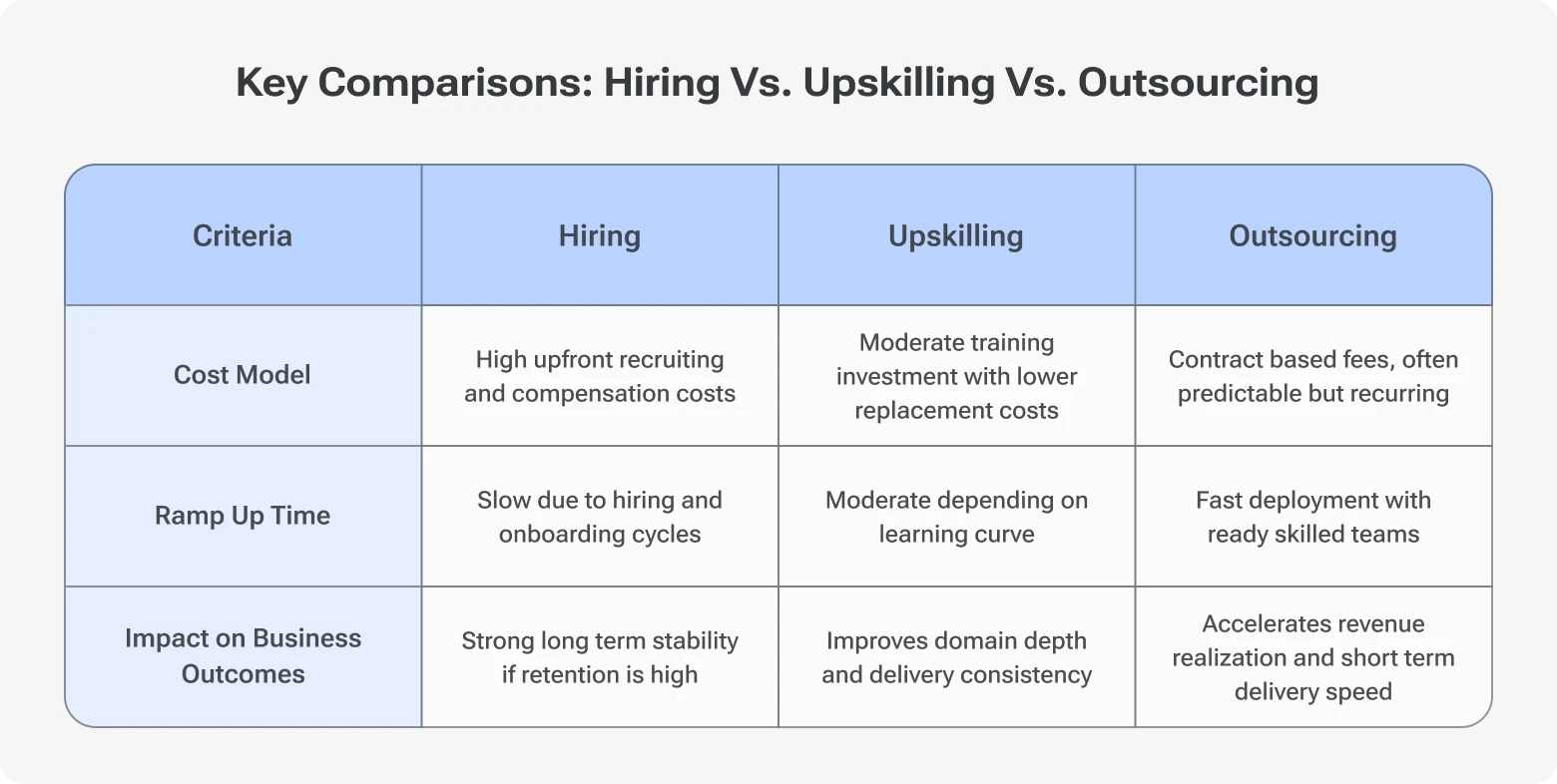
In general, hiring has always been the most costly option. Beyond salaries, companies invest in recruiting, onboarding, management, tooling, training, etc. If the hire turns out to be the wrong fit, replacing them can be costly in both time and money.
One more important change is that engineering team composition in the AI era is becoming more senior-heavy. Therefore, with the introduction of AI-assisted development, companies hire fewer junior engineers, from whom, in fact, future technical leaders stem.
Opt for hiring when:
The capability is core to your product or long-term strategy.
You'll need it for years rather than months.
Ownership, continuity, and cultural fit are important for you.
You have the time and budget for recruiting and hiring.
Hiring isn't suitable when:
You need engineers quickly and can't wait months to fill roles.
The specialist is needed for a short-term initiative or a one-off project.
You don't have the internal capability to properly assess candidates.
Augmentation — Bringing in external expertise
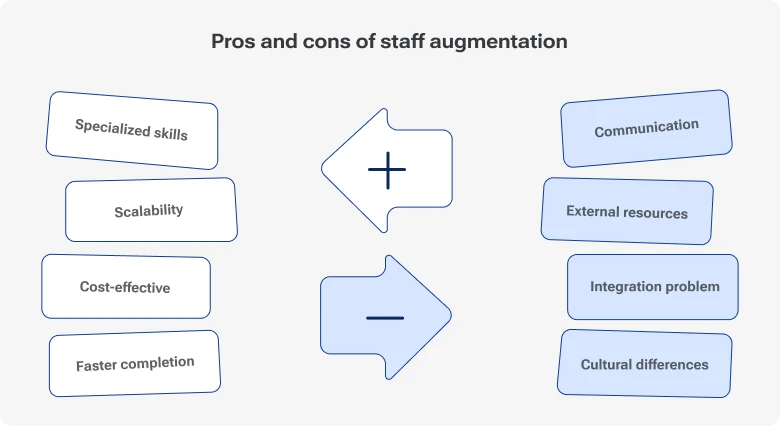
Staff augmentation is the way to go when you need to move quickly, add specialized expertise, or increase capacity without committing to permanent headcount.
AI is making this model more attractive. As experienced engineers become harder to hire and technical evaluation requires more senior involvement, the cost of hiring in-house continues to rise. With staff augmentation, much of that work is handled by a provider that takes care of sourcing, screening, and vetting. This way, you can reduce both time-to-hire and the effort required from your engineers.
However, augmentation isn't universal. If your goal is to build long-term product ownership, grow future engineering leaders, or fill core positions for years to come, in-house hiring is usually the better investment.
Besides, the success of staff augmentation depends a lot on whether you collaborate with a trustworthy partner and integrate external engineers into your team's workflows and culture.
Staff augmentation is the right choice when:
You need experienced engineers quickly.
Demand for the skill is temporary, project-based, or difficult to predict.
You don't currently have senior expertise to evaluate candidates on your own.
There is a need to bridge a gap while you recruit or upskill internally.
You want to validate a long-term need before hiring an in-house full-time engineer.
Of course, staff augmentation cannot replace in-house hiring, but it's absolutely helpful when speed, flexibility, and immediate access to proven engineering expertise are your top priorities.
Defaulting to one approach is a costly mistake
Many sources argue for a single approach: just hire, just upskill, just outsource. Very few mention the cost of defaulting to one option when the situation calls for a blend.
The thing is that, in reality, each approach solves a different problem, has its own limitations, and cannot cover all your needs.
A hire-only strategy gives you maximum ownership but exposes you to long hiring cycles, rising recruitment costs, and a competitive market for senior engineers.
An upskill-only strategy helps you build valuable long-term capabilities, but it takes time. Time that you often don't have when critical roles need to be filled immediately.
An augmentation-only strategy comes with speed and flexibility, but it can't build lasting organizational knowledge. Slowly, it creates dependency as your context ends up living in the heads of external specialists.
No need to pick a winner. 'In-house vs. augmented team?' isn't a question. Every option is effective in particular situations. So the smartest strategy is to use a combination of these approaches based on what your business needs today and what it will need tomorrow.
A framework for choosing the right approach
We've found out that all three approaches are valid and can be used as your project evolves. What you need to know is how to combine them and which one to choose in a particular situation.
So, how to understand when to augment vs. hire vs. upskill? We'd advise you to start from the need. Classify each gap by answering the following questions:
How urgently do I need to fill the role?
How long will you need this capability?
Is the role core to the business or tied to a specific project?
Are there experienced engineers on the team who can mentor others or properly evaluate candidates?
Is the budget better suited to permanent headcount or variable operating costs?
The answers usually point to one approach or, more often, a combination of them. For example, you might augment your engineering team to hit an upcoming release while upskilling your developers to take over in the long run.
The framework below can help you match the engagement model to your situation instead of defaulting to a single approach irrespective of the circumstances.
When to augment vs. upskill vs. hire developers
Your situation
Recommended approach
Why
You need engineering capacity ASAP.
This is the only way to bring in vetted engineers in weeks or even days.
You want to build a permanent core capability.
When ownership, product knowledge, and continuity are crucial, hiring investment pays off.
You want to own the capability, but there's no immediate urgency.
The most cost-effective long-term option when you have experienced engineers who can mentor others.
You have a temporary spike in workload or a time-boxed project.
Lets you scale your team up and down without committing to a permanent headcount.
You need to explore a new technology or product initiative.
You can validate the need with flexible external expertise, then hire permanently once the capability proves valuable.
You need a capability now but also want to build it internally.
Augmentation + upskilling
External specialists help you deliver today while your team develops the capability for tomorrow.
The workload is recurring but too small to justify a full-time hire.
You get the expertise you need without carrying the fixed cost of another permanent employee.
How to implement the blend in practice
As your product evolves, deadlines shift, and priorities change, you need to reconsider your approach to how to grow a dev team. The best results come from using the model that fits your current needs best, not from sticking to a single approach.
Here are a few principles that can help.
1. Start by defining the need
Before deciding whether to build vs. buy an engineering team, define the gap you're trying to close. Is it an urgent capacity issue, a long-term capability you want to own, or a niche skill needed for a specific initiative? Once you've answered that question, the right approach becomes much clearer.
2. Use each approach for what it does best
Treat hiring, upskilling, and augmentation as complementary tools rather than competing options.
Augment when you need experienced engineers quickly or want to reduce delivery risk.
Hire when you want to build long-term product ownership and core capabilities.
Upskill when the knowledge already exists within your team and you have time to develop it.
Each approach is most effective when used for the problem it was designed to solve.
3. Build a senior engineering layer first
Availability of internal senior engineers is the prerequisite for everything else. They set technical direction, make architectural decisions, mentor the juniors you're upskilling, and verify the technical ability of both new hires and augmented engineers. Without a strong senior layer, both hiring quality and internal capability development become much harder.
4. Revisit the mix regularly
The right blend in Q1 may be the wrong blend in Q3. A temporary project can become a permanent product. A new initiative may never move beyond a prototype. A capability you've bought externally may become important enough to bring in-house. So, review your team-building strategy regularly, not once a year.
Conclusion
So, how to build an engineering team in the AI era? The available options haven't changed — you still can address a talent gap through upskilling, hiring, and augmentation.
What has changed are the trade-offs: upskilling is more valuable but slow, hiring is harder and costlier, and augmentation is more attractive because of flexibility and speed.
Each approach is equally valuable, which is why leveraging the mix is better than sticking with a single one. Every time, match the model to the need.
In situations when augmentation is the best option, Devico can be of great help. We provide well-vetted software developers who can quickly strengthen your team while you continue hiring, upskilling, or validating a long-term need.
Great software starts with great people