AI-assisted development is a new reality. 72% of developers use AI every day, and 55% of committed code is AI-assisted or generated. The key drivers are increasing output and faster time to market. Teams ship more code faster, with fewer resources, and healthy throughput metrics.
But volume was never the goal. Working and maintainable systems were, and that's what AI can quietly take away.
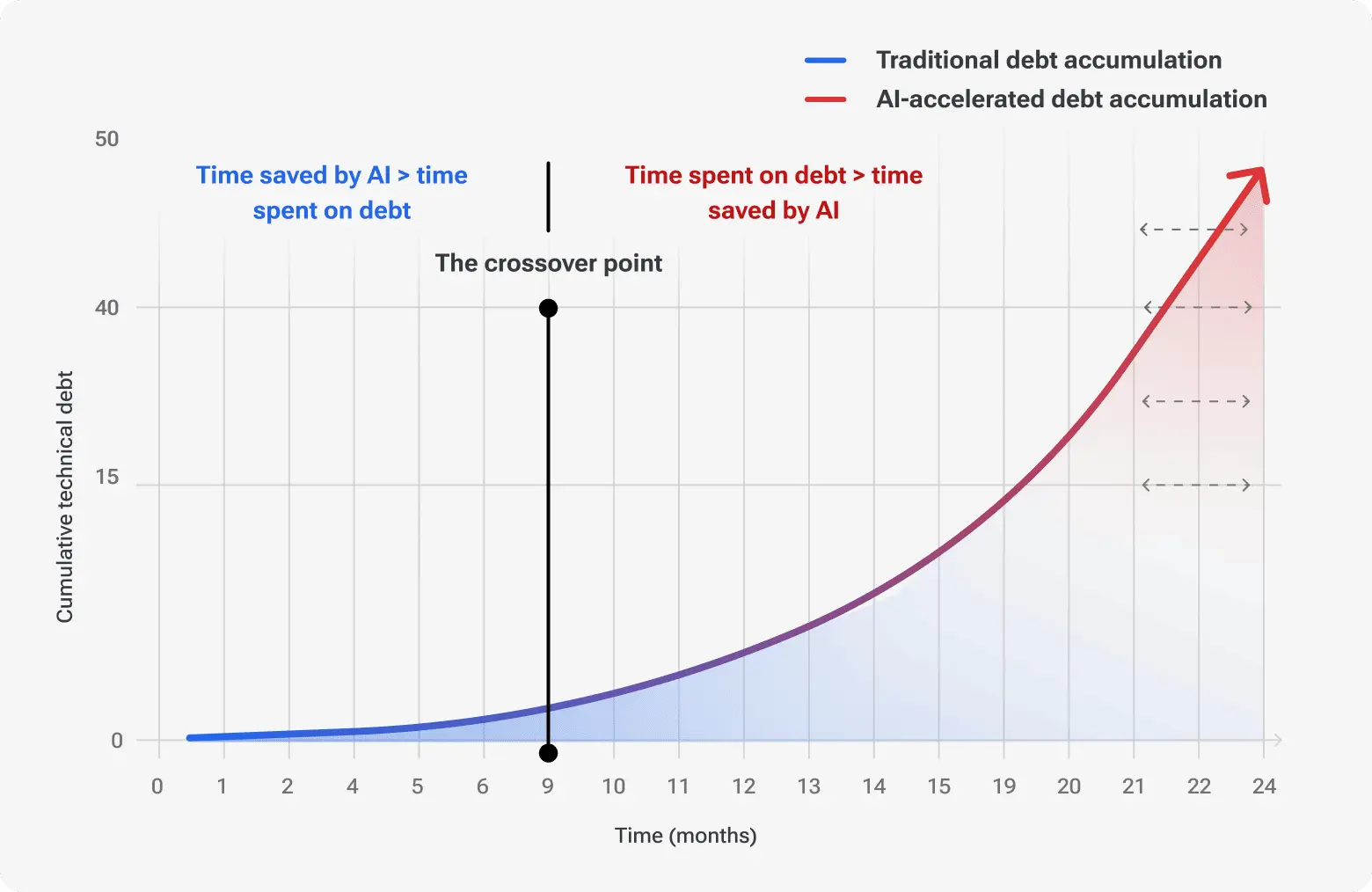
Tech debt in AI-generated code accumulates at scale and mostly invisibly. You receive the bill usually 6 to 18 months later, when changes take more time, debugging becomes harder, and velocity slows without an obvious reason.
This article outlines specifics of AI-generated code technical debt, why it's harder to detect than classic tech debt, what it costs, who pays for it, and how to keep high speed without creating long-term maintenance issues.
Motivated and focused experts for up to 60% less than locals, delivered in days, not months
AI-generated code technical debt vs. classic tech debt
Let's start with the beast you know well — classic technical debt. Its key characteristic is that it's usually a result of someone's decision to hardcode something for now and clean it up later. A TODO is dropped, and a team moves on knowing the shortcut exists, where it lives, and what it will cost to fix it.
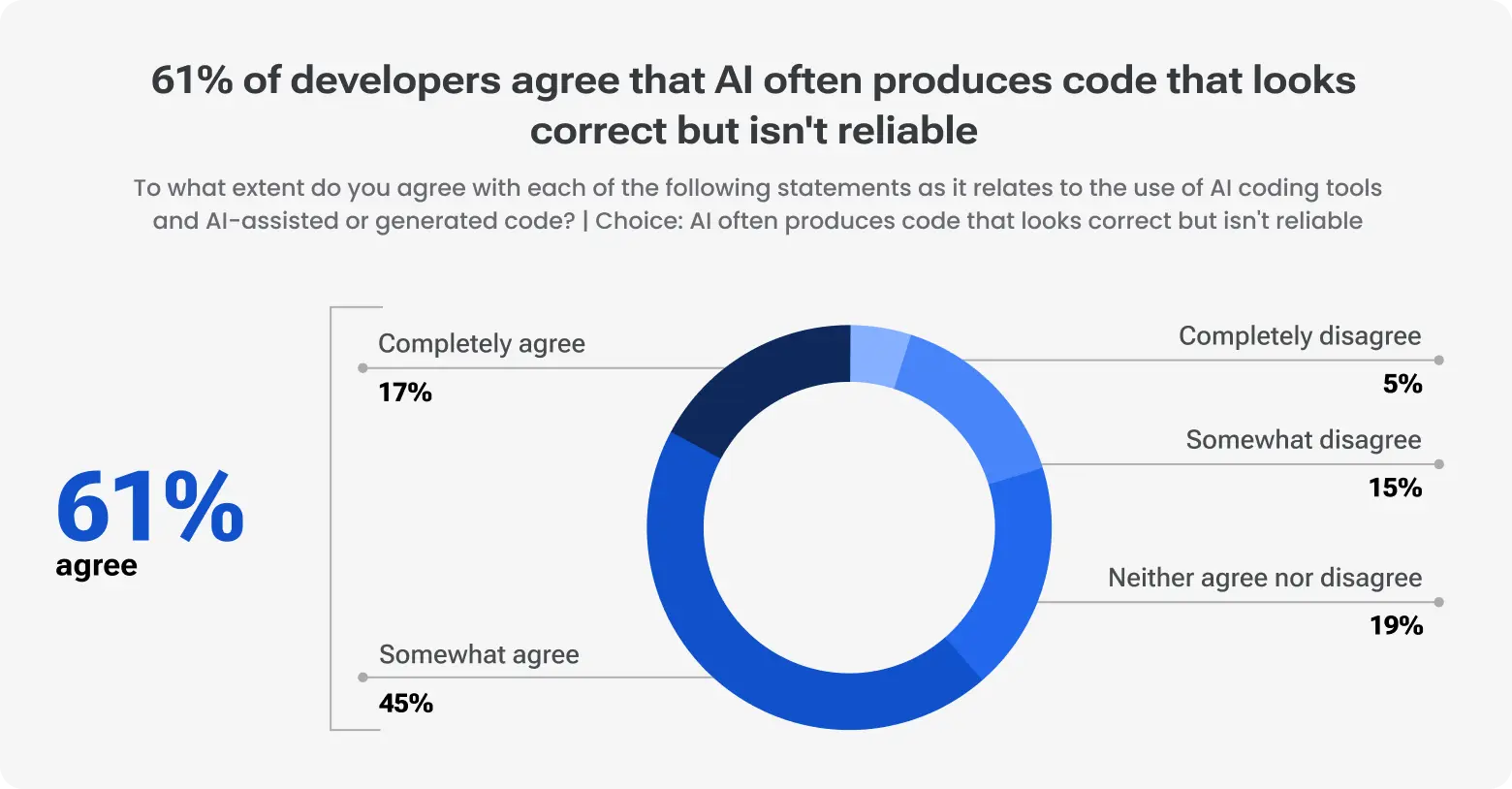
AI debt is a different story. As a rule, it's unconscious. The team doesn't know it is there, and no one chose to take it on. The thing is that AI-generated code often looks good while being incorrect.
In fact, the survey shows that more than 15% of commits from every AI coding assistant introduce at least one issue.
Source: Sonar's State of Code Developer Survey report
Key issues:
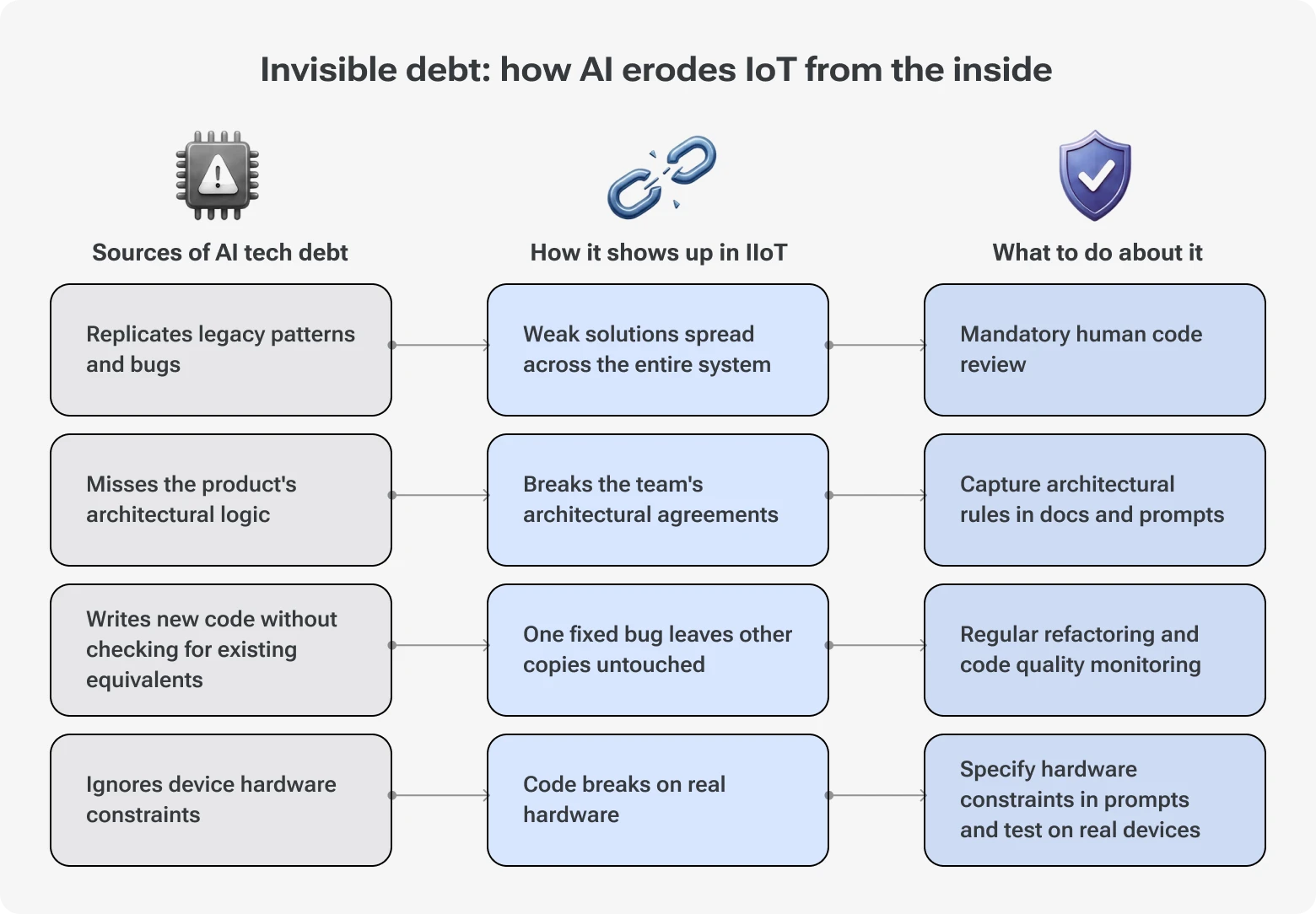
Plausible-but-wrong code: Offered solutions often pass review because they look idiomatic and confident. Flaws get clear under thorough evaluation or under a particular input or load.
Duplications and reinventions: An AI assistant doesn't know your codebase, which is why, instead of reusing the helper you already wrote, it regenerates a slightly different version of it a few directories away.
Local sense, global incoherence: Each generated snippet is reasonable on its own, but stacked across dozens of PRs, they form a system with several different ways to do the same thing.
Over-engineering: Tools often provide solutions with unnecessary abstraction and complexity. This adds to cognitive load as well as makes future changes more difficult.
Security and dependency problems: Insecure settings, outdated libs, and occasional hallucinated packages are common issues.
Comprehension debt: The main difference between writing code yourself and using AI-generated code is that in the latter case, nobody may fully understand the code, which means nobody can confidently change it later.
Recognizing key AI debt types
Debt type
What it looks like
Why it slips through review
Where it shows up later
Clean, structured, confident
It reads correctly, and reviewers skim familiar-looking code
Edge-case bugs in production
Near-identical logic throughout the codebase
In isolation, each PR looks fine
A one-line fix that has to be made in multiple files
Many different patterns for one job
A reviewer doesn't see the whole picture
Onboarding friction, stiff refactors
Abstractions nobody asked for
Solutions look "thorough," so they earn trust
Slower changes, higher cognitive load
Insecure defaults, stale or fake packages
Incidents, audits, supply-chain exposure
Poor codebase comprehension
Code that an engineer cannot explain
The author heavily relies on AI
Code maintenance becomes challenging
So, is AI-generated code maintainable at all? It can be, if a person who shaped a request checks the result and integrates it on purpose. When well examined, AI code is as maintainable as anything else your team ships.
Why AI debt is harder to spot
Traditional tech debt is usually visible in some form. It may show up in tickets, TODOs, documented shortcuts, etc. Even if it isn't immediately fixed, it is at least known.
AI-generated technical debt rarely has that kind of visibility. There are a few reasons for this:
-
AI code often looks clean and structured, which is why it often passes a superficial review without raising concerns. In a fast-moving environment, it's easily treated as working because nothing about it is obviously risky.
-
Velocity metrics are more than good as more pull requests are merged and more features are shipped. Everything seems good until the team faces the first maintenance problems.
-
A reviewer may not fully understand the generated logic and may fail to confidently challenge or thoroughly validate output.
-
AI-related debt accumulates in small, individually reasonable increments. Nothing is alarming in isolation.
The dynamic is that leaders are often lulled into a false sense of security as they keep tracking habitually watched metrics. Throughput, PR count, commit count, ship rate — all of these show progress while long-term system maintenance and codebase comprehension suffer.
Yes, with AI, developers can ship code much faster, but this doesn't always translate into better outcomes. 70% of Sonar's survey respondents say AI has positively impacted their time-to-market, but only 47% say it's had a positive impact on the end-user experience or on reducing technical debt. Indeed, if you ship quickly without decent AI code review, you put user experience as well as the long-term health of your codebase at risk.
The real cost of AI-generated code
According to the McKinsey survey of 2020, about 10-20% of the technology budget is allocated to handling tech debt. Since then, little has changed — technical debt in the AI era is still expensive.
We'd like to highlight the most costly risks.
Time-consuming changes
In barely reviewed and never fully understood AI code, any modification is risky. The work itself may take just an hour, while understanding the code for making changes safely may take the whole day.
Duplication also creates additional work. Instead of updating one implementation, engineers have to track down multiple versions of the same logic in the codebase.
By the way, GitClear found that duplication issues went up eightfold in 2024.
Frequent incidents in production
A lot of defects in AI code aren't apparent enough to be caught during review or unit testing. However, sooner or later, they show up in production as small incidents. Their fixing gradually becomes a major duty of the team.
Instead of building new functionality, engineers analyze problems, address them, and verify fixes.
Review burden
AI allows developers to generate code very quickly. But someone has to review it, and usually this responsibility falls on senior engineers. The more code AI produces, the more review effort is needed to ensure architectural fit, identify risks, and prevent duplication.
In such a way, experienced engineers start spending less time designing systems and more time ensuring code quality.
Slower onboarding
New employees learn systems by identifying patterns and understanding why decisions were made. Yet, this becomes harder when the same problem has been solved in five different ways across the codebase, documentation is incomplete, and no one on the team can give clear answers.
So, engineers piece together a set of local decisions with limited context. This results in a steeper learning curve and slower onboarding.
Velocity reversal
Usually, AI adoption starts with a visible productivity spike as features move faster and backlogs shrink.
Then the momentum begins to fade. More time goes into review, more effort is put into system debugging, and changes require more thorough investigation. Refactoring also takes more time.
The velocity gain that justified AI adoption eventually slows the team down later. There's a certain irony in that.
Who pays for AI debt?
AI can generate code with mistakes — that's a fact. Yet, it never pays for the problems those mistakes cause. The cost is absorbed by everyone else, from engineers to customers.
The on-call engineer responds to production issues, whether it's early in the morning or in the dead of the night. When a customer-facing service is down, they have to quickly fix the problem, diagnosing the code that looked clean and worked well under normal conditions.
The maintainer can be asked to modify a feature built with AI assistance months ago. A straightforward change turns into an investigation because the logic is difficult to follow, and the reasoning behind past decisions isn't documented.
New hires encounter multiple implementations of similar functionality, conflicting patterns, and gaps in documentation when learning a system. As a result, their ramp-up slows, and the first contribution takes longer.
Senior engineers pay with their time. Instead of dealing with architecture, mentoring, or innovation, they mitigate risks of AI-generated code and fix issues.
Customers are also on the list. A poor user experience is the cost they pay. More incidents and slower fixes make systems less reliable and affect user loyalty.
The business pays literally. Slowed delivery, high maintenance costs, increased risk, and project remediation efforts drain the budget.
AI-generated technical debt often stems from the ownership problem. It accumulates quickly when teams treat code as something that came from the AI rather than something they chose to put into production.
'AI wrote it' is an explanation many leaders hear today when discussing a problem. Changing that mindset is a thing to do to reduce debt and associated costs.
Empower your IT team to focus on innovation and growth by outsourcing your technical debt management
How to get the speed without accumulating debt
Delivering fast without accumulating tech debt — is it actually possible? Or is it contradictory, like wanting to eat without gaining weight?
With AI-assisted development, the challenge is real. AI brings speed, but it also increases inconsistency and hidden complexity. In this setup, to make "fast" and "maintainable" compatible by design, you need clear engineering controls around how code is written, reviewed, and accepted.
The table below presents these controls and how to implement them.
Control
What it prevents
Implementation
Comprehension debt and orphaned code
Set up a rule that code cannot be shipped even if it passes tests when its author cannot explain its logic, edge cases, and how it fits the system architecture.
Plausible-but-wrong code reached production
Set up thorough reviews to make sure the offered piece of code is really clean and suitable.
Duplication and reinvention
Provide AI tools with real system context through architecture docs, existing utilities, naming conventions, etc.
Guardrails adapted to AI failures
Security and dependency problems
Reinforce CI with automated tests, linting, SAST, and dependency scanning that uncover common AI failures.
Tracking the right metrics
False confidence based on good delivery metrics
Apart from throughput, monitor also churn, defect rate, review load, and code comprehension.
Overreliance on AI when performing critical work
Define clear boundaries where boilerplate and scaffolding are addressed by AI and high-risk areas (e.g., security, payments, authentication, core domain logic) are handled by engineers or with AI aid accompanied by a thorough human review.
So, the speed-without-debt outcome is impossible without discipline. By introducing controls, you ensure that today's high velocity doesn't turn into maintenance costs tomorrow.
🎧Listen to the episode of the Devico Breakfast Bar where Chris Federspiel, founder of Blackthorn, reasons over navigating AI limitations in business
Signs your codebase is accumulating AI debt vs. smart AI use
You don't need a consultant to tell you whether AI adoption has been successful or whether you're accumulating AI debt. All you need to do is look at the behavior of your system and the team working on it.
Warning signs:
Rising code churn — a great deal of code is rewritten shortly after a merge
Duplicated logic and drifting, as well as inconsistent patterns across the codebase
Growing review times and visible reviewer fatigue
Engineers who cannot explain the code they merged last week
Dependency surprises and regular incidents in production
Signs of smart AI use:
Velocity is up while defect and churn rates stay flat
Engineers can explain everything they ship in their own words
Consistent design patterns across services and teams
AI response is treated as a draft to verify, not a ready-to-ship solution
Review focuses on reasoning and trade-offs, not just correctness
The difference between success and failure lies not in the AI tool choice but in the discipline with which it is used. This, in turn, corresponds directly with the seniority and judgment that you should vet when hiring engineers. So, bring in people who have a habit of challenging AI-generated code and making the final decisions themselves.
Hiring in the AI era: how to vet engineers when anyone can generate code
Is the assumption that AI lets you hire fewer engineers reasonable?
The marketing call behind almost every AI-driven coding tool is that you'll deliver the same output with a lower headcount. Sounds reasonable. Let's find out if this is true and if it can backfire on you.
Imagine that the tool has enabled your team to produce more code, just as it promised. Can you take its accuracy and relevancy at face value? Not at all.
In fact, Google's DORA report shows that despite the productivity gains, 39% of the respondents reported little to no trust in AI-generated code. This necessitates thoughtful AI integration management, an essential part of which is a thorough review of AI-generated code. This means that by cutting engineering capacity for review while increasing code volume, you create favorable conditions for debt generation. The bottleneck now is judgment needed for managing AI code quality.
That's why we can conclude that AI-heavy teams need more senior judgment per line shipped, not less. And while it may make sense to reduce purely execution-oriented roles, engineers with review instinct, system-level judgment, and product ownership are still the hires to prioritize, not the ones to cut.
Bottom line
AI-generated code technical debt is real, specific, and harder to spot than classic tech debt, primarily because throughput and delivery metrics shine. The cost you pay is still high: challenging maintenance, more production incidents, poor codebase comprehension, slower onboarding, and so on.
So, does AI increase technical debt? The problem isn't in AI itself but in how it's used. Ownership mindset and review discipline reduce the risk of AI-related debt. Without them, AI adoption results in long-term maintenance costs.
At Devico, we provide staff augmentation services that let you bring in engineers who work effectively with AI but don't rely on it blindly. They use it where it adds value, check outputs, and take responsibility for the final implementation. The mission is to ensure a speed-without-debt outcome.
Great software starts with great people