Why did you hire your last few engineers? If it was because the backlog was growing, or someone left the team, or you just needed to move faster, you're not alone. Many engineering hiring decisions are driven by immediate pressure rather than a business strategy.
Companies repost last year's job descriptions, replace people one for one, and hope that adding headcount will solve the problem. Yet even a team of competent engineers can struggle if its capabilities don't match the company's strategic goals.
That mismatch is becoming more expensive in 2026. Business priorities evolve, AI is changing how software is developed, and different skills create the most value. In fact, nearly 40% of core job skills are expected to change by 2030. A team built for yesterday's needs is likely to become tomorrow's bottleneck.
This guide explains how to hire the right engineers — not simply to grow your team. You'll work backward from strategic goals to the capabilities they demand, from capabilities to specific roles and seniority, and from roles to the right way to acquire each one.
Motivated and focused experts for up to 60% less than locals, delivered in days, not months.
Difference between hiring engineers and hiring the right engineers
A strong engineer isn't always the right engineer. A brilliant distributed-systems expert is the wrong hire if your plan for the next year is shipping a compliant patient-data integration. When an engineer's expertise doesn't match the company's priorities, they won't get the chance to apply their core skills and may eventually look for work that's a better fit.
Often, the problem lies in reactive hiring, which starts with an unexpected trigger. Let's say a backlog grows and you add extra hands, or your competitor ships an AI feature and you feel an urgent need for an AI engineer, too. In both cases, hiring is a reaction rather than a strategic decision.
Strategic hiring, in turn, starts with a business goal. Thus, entering healthcare, you may figure out that you need engineers who've built HIPAA-compliant systems and integrated with clinical platforms.
Hiring in reactive mode results in a team that's busy but doesn't deliver tangible output. Though tickets get closed and the velocity chart looks good, strategic objectives stay unachieved. McKinsey found that only 16% of executives feel comfortable with the tech talent they have to drive their transformation.
It's worth mentioning that a fit gap is less visible than a headcount gap. An empty seat shows up on every dashboard. A capable engineer working on the wrong problem often goes unnoticed until the quarter ends, and the business is no closer to achieving its strategic goals.
Hiring for pure ability without a strategy is like assembling an all-star team before you've decided which sport to play. Every player may be exceptional at their sport, but they're not necessarily the ones you need to win your game.
Adapt your engineering talent strategy to your business strategy
Most hiring tips suggest improving the hiring process by writing a better job description, sourcing more candidates, or running better interviews. Those things are important, of course, but they assume you hire for the right reasons.
However, aligning hiring with company strategy is something many teams overlook. They keep on recruiting for the same roles, using the same job descriptions and applying seniority blends that made sense a year ago, not today, when a different set of business problems needs to be solved.
So, before opening a role, ask yourself what exactly you're going to achieve over the next year. Your hiring plan should always stem from your business strategy.
Avoid vague goals like "grow" and add details like entering the healthcare vertical, delivering an AI feature, scaling from 5,000 to 50,000 tenants, or hitting SOC 2 with 99.95% uptime.
The next step is identifying which engineering capabilities each goal requires. For example, if your goal is to enter healthcare, the capabilities needed to achieve it are regulatory fluency, healthcare data integration, security-review discipline, audit-ready architecture design, etc.
Now, let's say your goal is to add an AI feature to your product. In this case, instead of looking for a generalist backend engineer, you'll need people who have worked with LLM integrations, know how to deploy and monitor AI systems, and can evaluate model outputs. You definitely cannot expect those capabilities from every software engineer, especially junior hires.
As you see, your strategic engineering hiring decisions become more effective when they're tied to the business objective.
Translate capabilities into roles and seniority
Once you know which capabilities your business strategy requires, you can turn them into a team.
First of all, define which role covers each capability. Some matches are straightforward. For example, security compliance may require a security engineer, while platform scalability may call for an SRE or platform engineer. Some capabilities can also be covered by experienced generalists, especially in smaller teams where engineers are expected to move comfortably across the stack.
The next question is seniority. In 2026, this decision deserves more attention. As 84% of developers now use or plan to use AI coding tools, and 51% of professionals reach for them daily, more routine work is automated. As a result, the greatest value increasingly comes from technical judgment: making architectural decisions, reviewing AI-generated code, evaluating trade-offs, and solving non-trivial problems. So, the demand for senior engineers is increasing.
Yet, not every challenge requires your most experienced engineers. If the work is well defined and supported by refined processes, a mid-level engineer may be the better investment. Hiring senior talent where it isn't needed fuels costs without necessarily improving outcomes, while hiring too junior for strategically important work can slow delivery and create expensive rework.
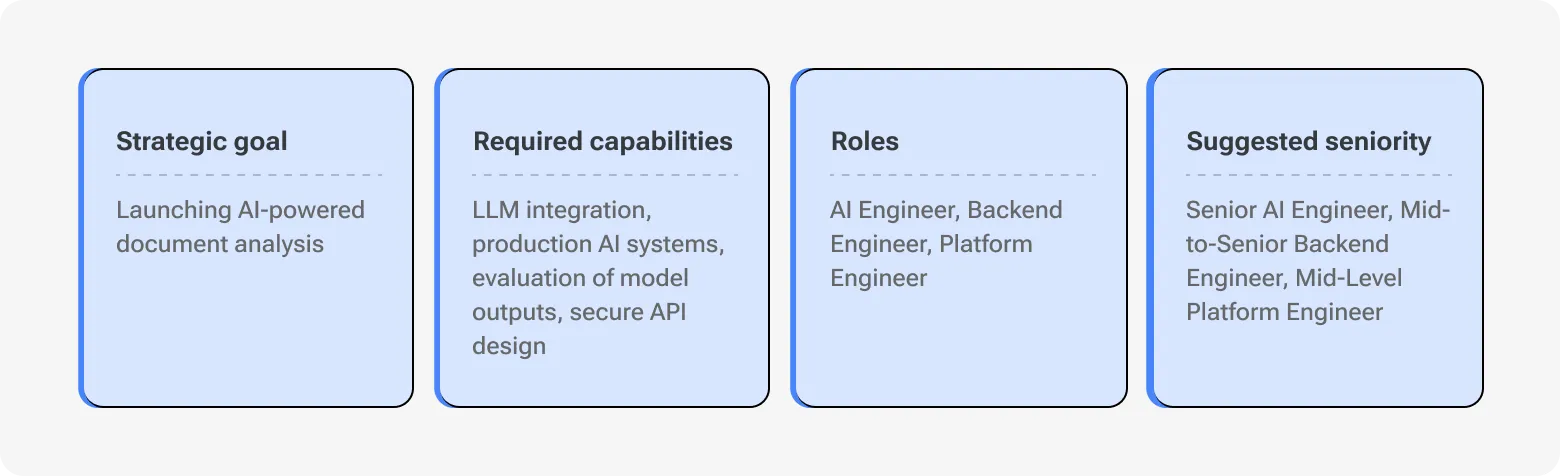
For example, your company plans to launch AI-powered document analysis for enterprise customers.
As you see, not every role is senior. The AI engineer addresses much of the technical uncertainty and architectural decision-making, while the platform work may rely on established practices that a mid-level engineer can handle very well. The right seniority mix depends on where your business strategy demands experience and judgment. No need to apply the same hiring standard to every role.
Choose how to acquire each capability: Upskill, hire, or augment
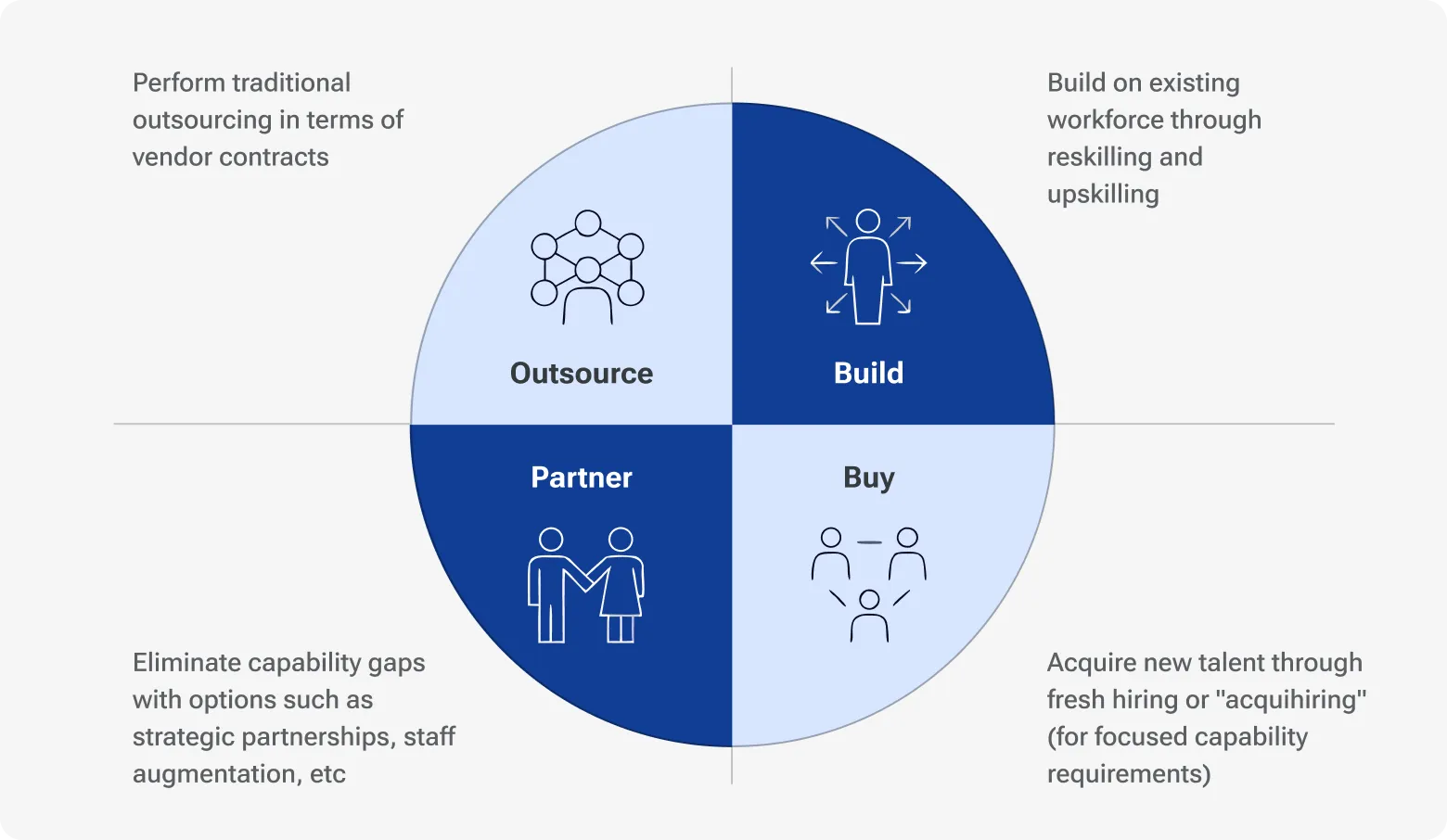
Once you've identified what engineers to hire, you need to understand how to bring them into your company. The thing is that not every capability your strategy depends on should become a permanent hire.
To decide, evaluate each capability against three factors:
how urgently you need it;
whether you'll need it long-term.
Capability profile
Best engagement model
Why
Permanent and core to your business
Since you'll rely on it for years, it's better to have it in-house.
Permanent and core, with adjacent talent already on staff
It's cheaper, keeps context, and builds loyalty.
Urgent, specialized, and finite
You can move without a long-term commitment.
Scarce senior capability you need this quarter
Often, that's the only way to bring the needed specialists quickly.
If a capability is core to your product and will be important for years to come, investing in permanent talent usually makes the most sense. Upskilling engineers who already understand your product and domain works too if you have time for them to develop the required expertise.
Some capabilities might be highly specialized or needed only for a particular initiative. For instance, you may need a cloud architect to lead a migration or a security expert to prepare for SOC 2 certification. That's where augmentation earns its keep. With its help, you can engage experts for as long as needed without making a long-term commitment.
When you need to fill the role urgently, staff augmentation is also the way to go. This is particularly relevant in 2026. Senior engineering talent is increasingly difficult and time-consuming to hire. According to SHRM, nearly 7 in 10 organizations (69%) report difficulty recruiting full-time employees due to the shortage of qualified applicants and high competition for talent.
If your initiative depends on rare capabilities, waiting several months to fill a permanent position may slow you down. Augmenting your team with seasoned specialists allows you to move forward now while deciding whether those capabilities should eventually become in-house.
All in all, to succeed with talent acquisition, don't stick to one particular model. Instead, choose the approach that best fits each capability. This will give your business the best balance of speed, flexibility, and long-term value.
Vet for strategic fit, not just technical skill
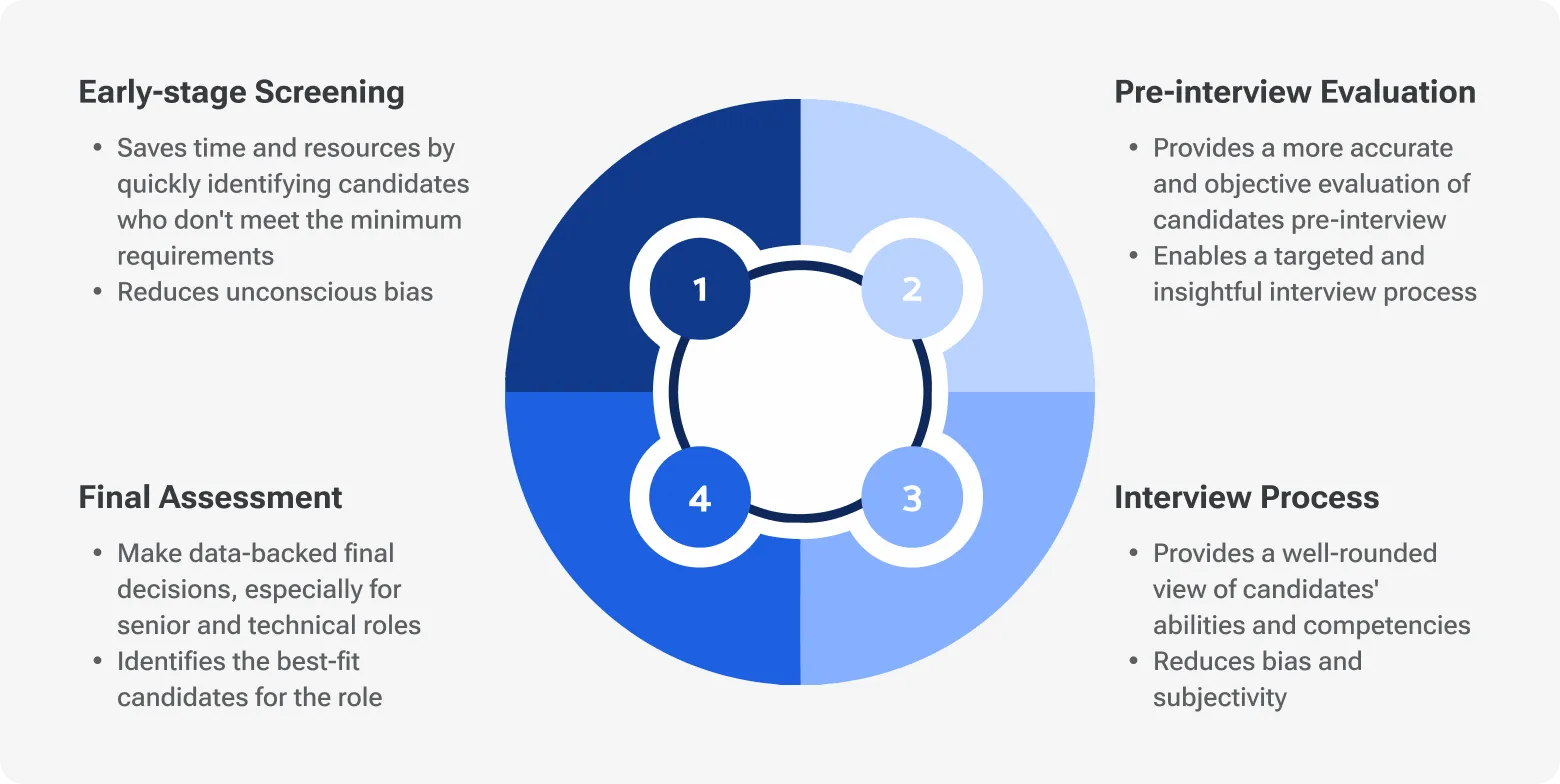
One more important aspect is to ensure your evaluation process considers not only technical skills but also strategic fit. You see, the technically strongest candidate on a standard interview rubric isn't necessarily the right hire for your business context.
The objective is to identify engineers who can help implement your strategy. So, beyond technical skills, assess your candidates against the following four criteria:
Relevant experience in your industry or problem space, be it fintech, healthcare, AI, cybersecurity, or large-scale SaaS, is a great advantage. Engineers with domain knowledge understand the technical and business constraints they'll face and therefore require less ramp-up time and make fewer context-related mistakes.
Make sure an engineer not only writes working code but also knows how to balance technical quality, delivery speed, business priorities, and system maintainability. Opt for the candidate who has not only completed assigned tasks but also made architectural decisions, addressed ambiguity, prioritized competing requirements, and justified trade-offs.
The environment an engineer has worked in is also an important factor. While early-stage startups prioritize adaptability, broad ownership, and the ability to work with changing priorities, established companies usually require specialization, structured collaboration, and experience working with mature engineering processes. Although many engineers can adapt over time, those who have already succeeded in an environment similar to yours are more likely to make contributions faster and more effectively. A mismatch between your company's stage and an engineer's working style can slow both the individual and the team.
AI proficiency is one of the top skills in the engineering hiring strategy 2026. Assess whether the candidate can integrate AI into their workflow while taking full responsibility for the outcome. Strong engineers verify AI-generated code, recognize incorrect or insecure suggestions, understand the limitations of AI tools, and use them to improve productivity, not to replace thinking.
Hiring a technically strong candidate who doesn't match the context is a big mistake. A coding test shows you that someone can build, but it doesn't ensure they can build the thing your strategy needs, at your stage, and in your domain. Take this into account when vetting.
If the goal requires HIPAA fluency, a candidate who excels at algorithms but has never worked with regulated data is a strong engineer and a weak hire. And this is where a check for strategic fit is important: an engineer who has shipped several healthcare integrations understands audit traps, failure modes, and integration quirks that show up only in production. This way, they bring pattern recognition you can't extract from a take-home test.
How to build an engineering hiring plan
A structured approach is needed to set up strategy-aligned hiring. We'd recommend following a pretty simple five-step process:
Step 1: Define your main goals within the next 12–18 months and list the capabilities required to achieve each of them.
Step 2: Categorize each capability as permanent and core, temporary, or specialized and match each with the most suitable acquisition model.
Step 3: Deliberately set seniority. Take into account the fact that AI automates more routine work, taking over some juniors' tasks and making technical judgment more valuable. Instead of following a standard hiring template, choose seniority based on the work complexity.
Step 4: Arrange your interview process so that it checks not only candidates' technical skills but also strategic fit. Assess domain knowledge, decision-making, stage fit, and AI fluency.
Step 5: A strategic engineering hiring plan shouldn't be drafted once and forgotten. Review it whenever your business priorities change or new technologies impact the skills your team needs.
As a result, you may have something like this:
Strategic goal
Required capability
Role & seniority
Acquisition model
Launching AI-powered document analysis
LLM integration, AI evaluation, secure API design
Senior AI Engineer, Mid-Level Backend Engineer
Entering the healthcare domain
Healthcare compliance, secure data handling, system integrations
Senior Backend Engineer, Security Engineer
Modernizing a legacy platform
Cloud architecture, migration planning, DevOps
Senior Cloud Architect, Mid-Level Platform Engineer
Augmentation + upskilling
Scaling from 5,000 to 50,000 tenants
Distributed systems, observability, platform reliability
Senior Platform Engineer, SRE
Short checklist for strategy-aligned hiring
Before opening a new engineering role, make sure you can answer yes to each of the following statements:
The role supports one of the clearly defined strategic business goals.
The required engineering capabilities have been identified.
The role and seniority match those capabilities rather than past hiring patterns.
The acquisition model has been chosen deliberately.
Your vetting tests for the strategic context, not just a coding bar.
The hiring plan has been reviewed recently and is in line with current business priorities.
Bottom line
How to hire the right engineers is what every tech lead cares about. Here, it's important to understand that the strongest people on the market aren't the right hires if their skills, even outstanding ones, don't support your business strategy.
What you need to look for is people whose capabilities move your strategy. So, work backward from goals to capabilities to roles to acquisition models and vetting for strategic fit. Companies that hire engineers for business goals build high-performing teams, while companies that hire reactively build teams that cannot achieve those goals.
When your strategy depends on scarce senior expertise that you can't hire or develop in-house quickly enough, that's the gap Devico's staff augmentation services can fill. We provide vetted, AI-fluent engineers matched to your goals, not just to the seat. Let us know your needs, and we'll pick up the most suitable candidates for you.
Great software starts with great people