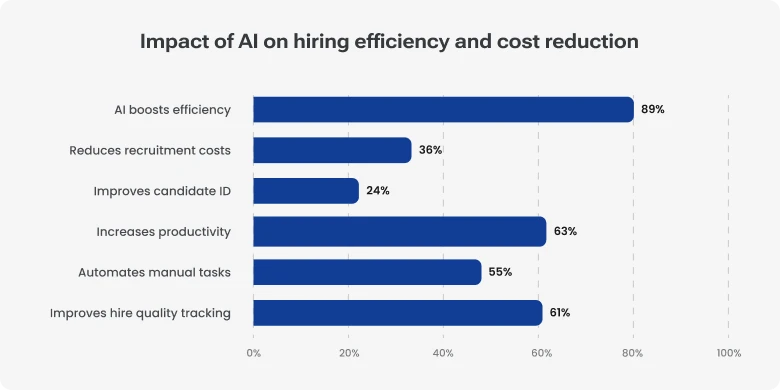
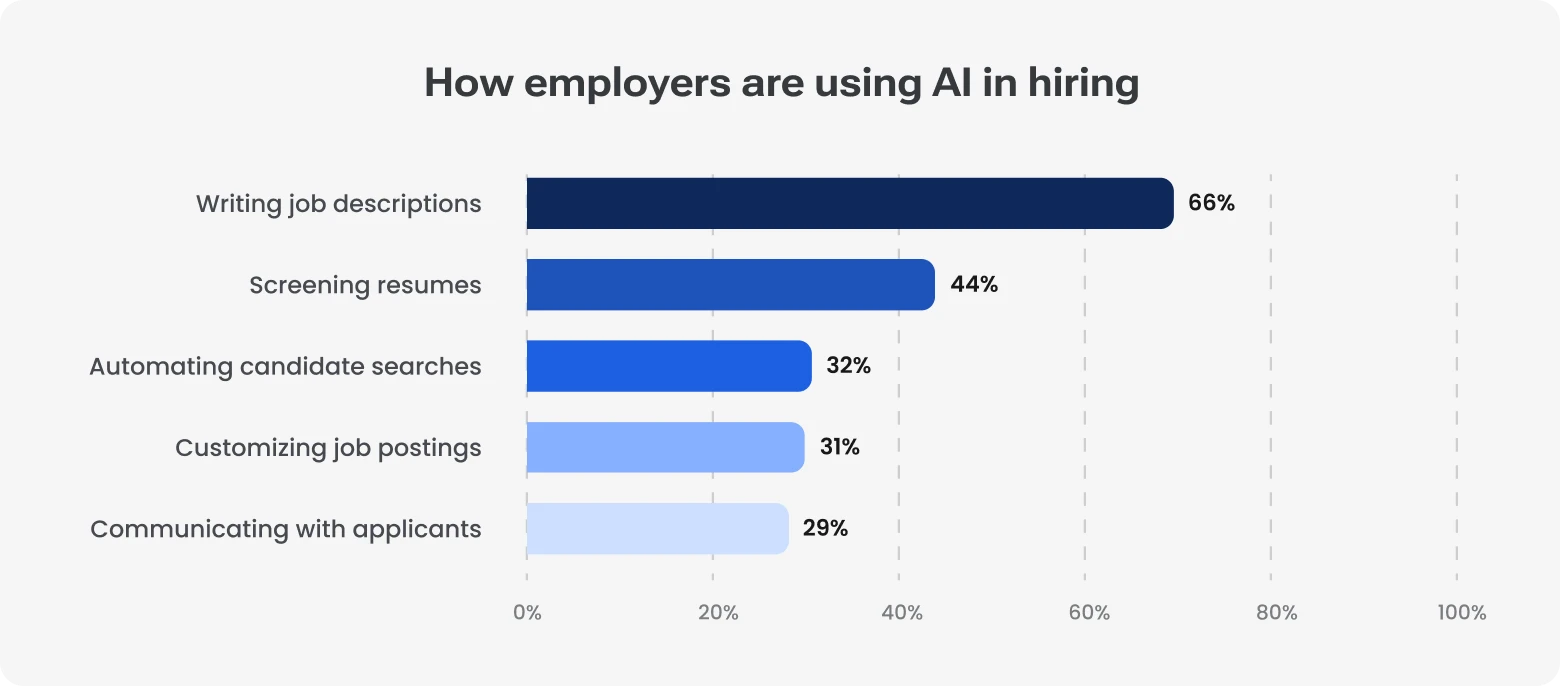
Nowadays, AI plays a significant role in hiring. A survey showed that in 2025, 72% of HR specialists used AI. Organizations implement AI to automate sourcing, resume screening, scheduling, and even some types of assessment. The promised benefits are very attractive: faster hiring, less manual work, and lower recruiting costs.
The problem is that applicants also actively use AI. With its help, they create resumes, prepare for standard job interviews, and complete coding assignments. As a result, flooded with AI-generated resumes, tech companies add steps and humans to identify fake profiles.
So does AI lower the cost of hiring engineers? It depends on which part of the hiring process you assess.
In this article, we'll explain where AI reduces hiring costs, where it adds new ones, and how this changes the strategic decision of whether to hire in-house or use staff augmentation.
Motivated and focused experts for up to 60% less than locals, delivered in days, not months
Cheaper hiring vs cheaper employment
Before talking about AI's impact, let’s distinguish two types of costs that people often mix up. There's the cost of acquiring an engineer, which includes costs on sourcing, screening, time-to-fill, ramp-up, and the risk of getting it wrong. Also, there's the cost of employing an engineer that includes salaries, perks, tooling, training, and other long-term expenses.
AI influences both, though in different ways. It may cut one while increasing the other. When these two costs are treated as one, managers make wrong conclusions about the financial impact of AI.
This article is dedicated to the cost of acquiring engineering talent. We'll find out how AI changes recruiting efficiency, candidate evaluation, time-to-hire, and the economics of filling open roles.
Where AI reduces hiring costs
What makes AI recruiting platforms so attractive is the promise to reduce hiring costs and time. While many of the performance figures come from vendor studies, some efficiency improvements are real. Mainly, they are concentrated at the top of the hiring funnel and in administrative work.
With AI resume screening, recruiters can quickly find suitable candidates and score them against job requirements. Also, using AI, recruiters can easily create personalized outreach. Whom to contact is still up to them, but the time spent on routine sourcing tasks is far less.
Common administrative work is the simplest area to automate. Modern AI-powered hiring tools manage calendars, send reminders, handle rescheduling, and inform candidates about updates throughout the process.
Thanks to AI, recruiters can get prepared for hiring much faster. Work on job descriptions, outreach emails, and interview questions isn’t a half-day task anymore. It takes just about half an hour.
Instead of manually checking every application, recruiters can delegate this task to AI. It quickly reviews a bulk of resumes and detects developers who meet all the basic requirements.
AI really excels at the tasks above since they follow quite clear rules and established workflows.
However, these activities have never been the most expensive part of hiring. The real cost lies in assessing whether a candidate can address non-trivial technical problems and make sound engineering decisions. All of these require human judgement. So, AI speeds up the easy parts of hiring, while the hardest and most expensive parts are still on senior developers.
Where AI drives up hiring costs
The problem with AI in tech recruiting is that while making some hiring steps cheaper, it increases the cost of others.
Most often, the additional costs show up in the following areas:
Using AI, job seekers can create polished resumes and cover letters. This simplifies applying for a job. As a result, companies get swamped with countless, almost identical AI-generated CVs. Thus, LinkedIn reported that the number of applications increased by more than 45% in 2025, with about 11,000 applications per minute. A larger number of applications require recruiters to spend more time on filtering.
As candidates increasingly use AI during coding assessments and take-home assignments, more of them pass the early stages of the hiring process. As a result, an initial screen has become a less valuable signal of engineering competence than it used to be. To see the full range of candidates’ abilities, companies add architecture discussions, live debugging sessions, pair programming tasks, and other types of technical assessment.
Hiring in the AI era: how to vet engineers when anyone can generate code
Confirming that developers have the judgment, problem-solving ability, and profound technical knowledge is still the main challenge that AI can't handle. On the contrary, it has made it even more demanding. Senior engineers now spend more time assessing candidates’ architectural knowledge, trade-off understanding, and hands-on expertise to be sure of their ability to work efficiently without AI support.
AI can help candidates present themselves more effectively. As a result, the risk of making the wrong hiring decision increases. Getting a hire wrong is quite expensive. You invest time in interviews, onboarding, mentoring, and management before deciding on a replacement. In fact, a bad hire costs companies at least 30% of the employee’s first-year earnings. To mitigate that risk, many companies introduce additional technical assessments and more hands-on validation that burn the time and cost savings obtained through automation earlier in the hiring process.
As AI takes over more and more routine work, companies find themselves in instant need of senior engineers who can review AI-generated code and manage complex technical work. At the same time, fewer companies invest in junior engineers, reducing the future pipeline of senior talent. The change is already underway. In 2024, entry-level tech hiring fell by 25% while junior tech postings dropped by 35% across the EU. If it continues, finding competent engineers is likely to become more challenging and expensive over the next few years.
All in all, AI makes it cheaper to process candidates, but deciding whom you can trust is getting even more expensive now.
AI's net effect on time-to-hire
Can artificial intelligence reduce the time to hire developers? The answer depends on where your hiring process slows down. As mentioned above, AI speeds the top of the funnel and slows the middle. If your blocker is sourcing or admin, your time-to-hire will improve with AI. When your blocker is verification and decision confidence, AI is helpless and can even make things worse.
AI’s impact on time to hire software engineers by stages
Hiring stage
AI effect on cost
AI effect on time
Net for most teams
JD and interview-kit drafting
Scheduling and coordination
Lower per unit, higher volume
Before you assume AI tools cut your time-to-hire, analyze your funnel. A team whose pain is sourcing will see immediate benefit from introducing these tools. A team whose main challenge is verifying will get clogged with candidates nobody can assess properly.
So, AI doesn't always remove work – sometimes it just redistributes it. Let’s imagine that AI trims a week off sourcing and scheduling. Then the application volume triples, your screen passes two candidates who aren’t quite capable, and your staff engineers burn three extra interview loops figuring out who can actually do the job. The week you saved at the top is gone twice over in the middle. Eventually, you are at a loss: the net time-to-hire went up, not down. Add to this the AI recruiting tools cost.
We’re not arguing against AI tooling. Our point is that you should clearly understand what exactly you can optimize with their help. Equally important, you need to recognize when a hiring process has become easy to game with artificial intelligence. Every additional verification interview, every false positive, and every bad hire moves the burden from recruiters to your most experienced—and most expensive – engineers. If you don't take this into account, AI hiring tools can appear to save money while increasing the total hiring cost.
The bigger lever: Build or augment?
If to look at the big picture, the cost per hire in engineering is less dependent on AI assistants and more on an acquisition model, i.e., whether you employ in-house or bring engineers through staff augmentation services.
When you hire in-house, the total cost goes far beyond a recruiter's effort. It includes sourcing, screening, interview time, weeks or months of time-to-fill, onboarding, ramp-up, and the risk of making the wrong hire. As we've discussed, AI optimizes only certain parts of the hiring process while increasing the effort required to verify engineers and make confident hiring decisions.
Staff augmentation delegates much of that work to a provider. The partner is responsible for sourcing, CV screening, and technical vetting before candidates reach you.
Having a refined recruitment process, skilled recruiters, and senior experts to evaluate applicants, a staff augmentation company cherry-picks engineers. You, in turn, still make the final hiring decision, while your team spends less time sorting out and assessing candidates.
Along with this, augmentation isn’t always the best option. If you hire for long-term strategic roles, have a stellar employer brand, and don’t need to have the position filled yesterday, building an in-house team can be the right investment. But when speed, flexibility, or access to unique expertise is the case, the augmentation model is more attractive.
Build vs. augment cost comparison by scenario
Scenario
More cost-effective approach
Why
Building a core engineering team
Long-term continuity and organizational knowledge justify hiring investment
Need to scale very quickly for a product launch or client project
Faster access to well-vetted engineers without a lengthy hiring process
Hiring for highly specialized or niche skills
Vendors have talent networks that are difficult to build internally
Hiring at a steady pace with a mature recruiting function
Existing hiring processes can absorb recruiting costs more efficiently
Having a spiky or uncertain demand
Variable cost beats carrying a fixed headcount you may not need in two quarters
Having no internal engineers who can run a real technical interview
You can't verify what you can't assess, and a vendor can provide you with already vetted engineers
Building a training culture and junior bench
A wise long-term investment, especially as fewer companies invest in junior engineers, putting future senior talent supply at risk
How to actually lower the cost of recruiting engineers in the AI era
If there's one takeaway from this article, it's that AI doesn't automatically decrease hiring costs. The teams that benefit are the ones that adjust their hiring process accordingly.
Here are a few tips for you:
1. Measure cost-per-hire and time-to-fill by stage
You can't fix a bottleneck you haven't identified. Break your funnel into sourcing, screening, verification, and decision, and identify the stage that's too slow and expensive for you.
2. Use AI where it really helps to save
Sourcing, scheduling, drafting job descriptions, and first-pass screening are structured, repeatable tasks that AI handles well. Utilize it to automate that administrative work, not to make decisions instead of you.
3. Redesign your technical screening
Candidates may use AI at different interview rounds. So organize assessments that check reasoning, decision-making, and judgment rather than the ability to produce code with the help of AI assistance.
4. Treat augmentation as a strategic cost lever
When speed, specialized expertise, or hiring confidence are more important than building permanent headcount, staff augmentation is often a more cost-effective option.
Ultimately, don't accept claims that AI fixes all hiring problems and cuts hiring costs at face value. Model your own hiring funnel. Identify where AI automates work efficiently, where it creates additional effort, and where changing your hiring model will have a greater impact than adding another AI tool.
Bottom line
“Does AI lower the cost of hiring engineers?” is the question most hiring managers ask themselves today. It lowers the cost of processing candidates and raises the cost of verifying them. Therefore, whether your net cost and time-to-hire fall depends on where your bottleneck sits.
Yet, you may benefit from a completely different acquisition model - staff augmentation – where a vendor takes on much of the sourcing, CV screening, and technical vetting.
If you'd like to cut time-to-hire without lowering the bar, staff augmentation services from Devico can be of great help. We rigorously vet engineers, providing you with seasoned, AI-fluent engineers so that you can minimize the hiring burden on your side and move quickly.
Great software starts with great people