Will AI replace junior developers? No, but it's changing the way junior developers grow into senior engineers.
For decades, simple, low-stakes tasks have been the responsibility of juniors. This way, they delivered business value while developing engineering judgment. Today, AI does most of them faster and cheaper. As a result, lots of organizations find the idea of not hiring juniors reasonable.
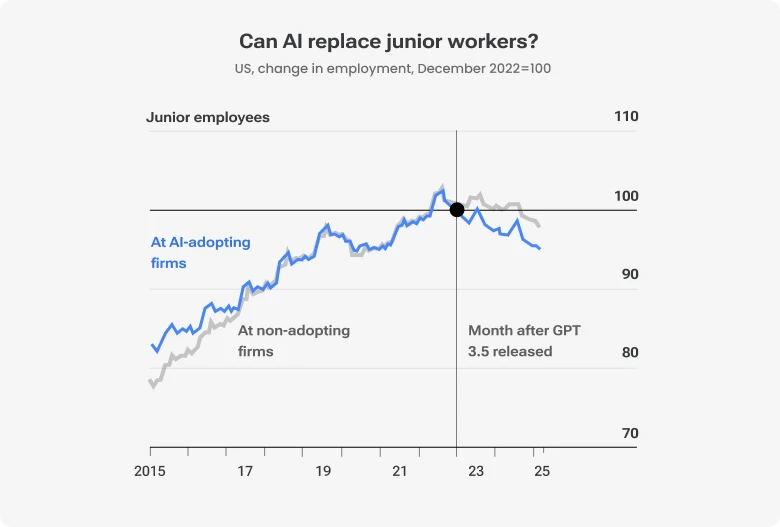
The decline is already visible. Since the broad AI adoption, early-career workers aged 22–25 in AI-exposed occupations have experienced a 16% drop in employment.
That's the paradox: AI increases the need for judgment while removing the opportunity for juniors to gain the experience needed for career growth.
By freezing junior hiring today, companies may have problems in 3–5 years, when the senior pipeline runs dry.
In this article, we'll discuss what impact AI makes on junior-level work, how the role of junior developers is changing, whether you should continue hiring them, and where new seniors will come from if the whole industry stops training them.
Motivated and focused experts for up to 60% less than locals, delivered in days, not months.
AI-driven change in junior-level work
Open almost any IDE today, and you'll probably find Copilot, Cursor, Claude, or another coding assistant running in the background. A survey shows that 51% of professional developers use AI solutions every day. No doubt that this number will increase soon.
AI helps teams complete different tasks in seconds. Instead of writing an API endpoint from the ground up, engineers ask an AI assistant to generate the first version. Unit tests are created seemingly. Even routine debugging often starts with a conversation with a coding assistant.
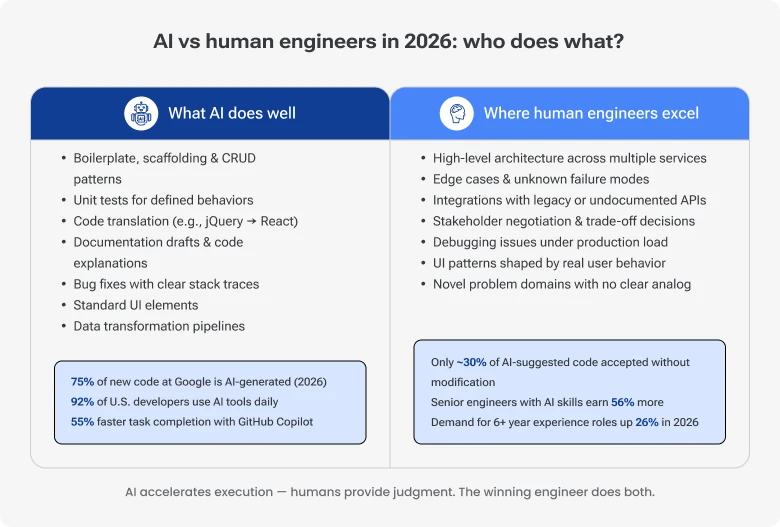
However, AI doesn't cover all parts of software development. As of now, it easily handles simple, well-defined work previously handed over to junior developers.
Implementing CRUD endpoints, creating unit tests, fixing common bugs, updating documentation, converting designs into UI components — AI does all these tasks that used to be on junior engineers' backlogs.
For example, let's take simple feature development. A few years ago, a junior developer spent half a day creating a new REST endpoint, writing tests, and fixing review comments. These days, AI assistants generate most of that code in the blink of an eye.
While for seasoned engineers, AI-assisted development often results in better productivity, for junior developers, it implies fewer opportunities to learn through practice. This creates some tension between junior developer jobs and AI.
A dangerous assumption that juniors aren't needed anymore
Salaries, onboarding period, and senior engineers' hours spent on reviewing work that often needs to be redone are the costs you pay when hiring juniors. On the flip side, you can just buy a subscription for Claude that creates code in seconds. In terms of cost efficiency, the idea of replacing juniors with AI looks very attractive.
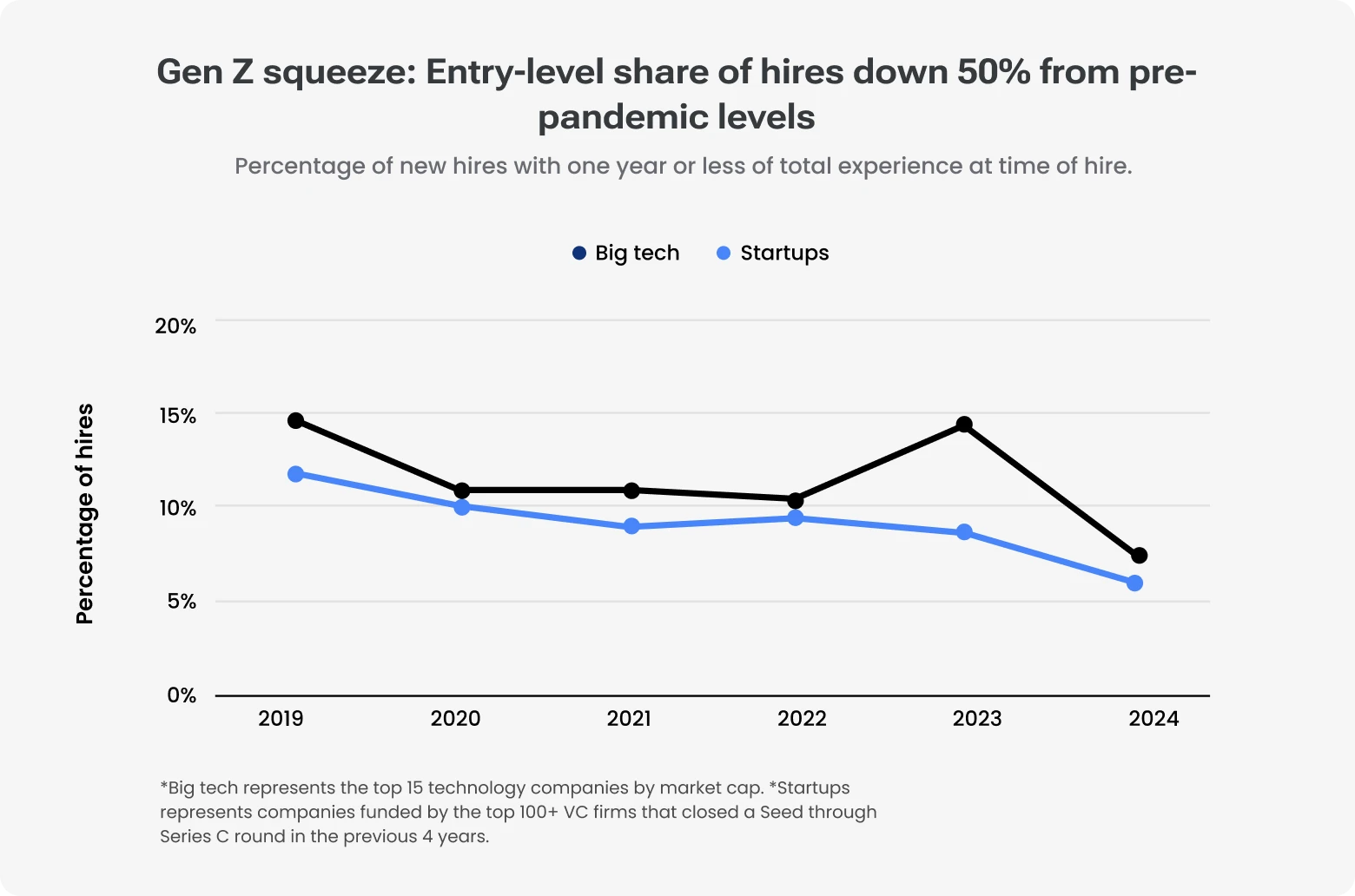
Some companies have already made this move. Research shows that 37% of managers would rather use AI than hire a Gen Z employee. Moreover, the World Economic Forum's Future of Jobs 2025 report says that around 40% of employers plan to cut back on roles whose tasks can be executed by AI.
Yet, when analyzing AI and entry-level tech jobs more carefully, you spot an important detail.
Junior work is more than just getting features done — that's also how engineers learn to do their job well.
Debugging, decision-making, root cause analysis, system thinking, risk assessment, performance awareness, and other skills develop through the hands-on work that AI is increasingly taking off juniors' plates.
When companies don't hire juniors, they lose an important training layer and weaken their internal pipeline for future senior engineers. Many hope that someone else will keep doing the training, but in reality, everyone is assuming that.
Eventually, the entire industry may encounter a serious talent shortage. Fewer juniors, more AI, and more work pushed to outsourcing vendors are beneficial locally and in the short term. Globally, this removes the entry point that delivers future mid-level and senior engineers.
The problem is that nothing breaks right away, and things even look much better at first. Teams ship faster, budgets shrink, and output holds.
Trouble will show up a few years later with a critical shortage of engineers who have actually built systems from the ground up, debugged real production failures, and carried a feature end-to-end without AI doing half the thinking for them.
What makes things even worse is that the problem won't be fixed quickly since experience is built over years.
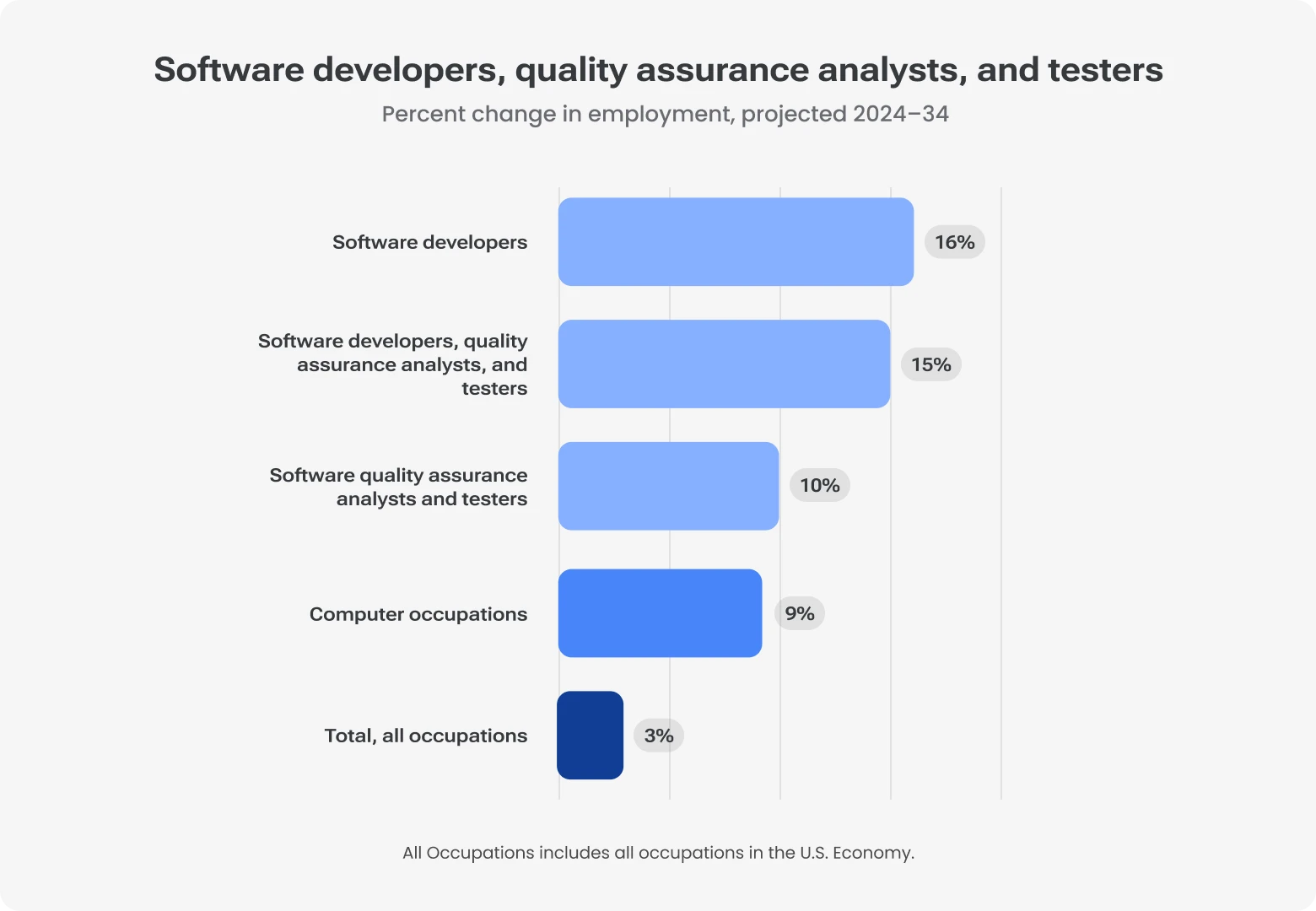
There's also one more aspect that makes the situation more serious. Software demand isn't slowing down. The U.S. Bureau of Labor Statistics still projects about 15% growth in software developer jobs through 2034.
So what does the decision to cut junior hiring lead to? Fewer juniors entering, more demand for experienced engineers, and AI increasing the value of judgment-heavy work. This way, you may save some money today, but it's likely to cost much more in the future.
The new role of junior developers in AI-powered teams
AI can handle much of the work traditionally assigned to junior developers — that's the fact. Does this mean that the future of junior developers is in danger? Not at all. The role isn't disappearing — it's evolving to meet the new reality.
The old job description suggesting writing tickets off the backlog is obsolete. Judging when AI helps and when it unintentionally hurts is a new mission, a new skill, and a new expectation from the role.
That changes what juniors spend their time on. Instead of writing everything from scratch, they're supposed to review AI code, verify that it solves the right problem, detect mistakes, and adapt it to the project's architecture and coding standards.
In other words, now juniors focus on:
The problem with the AI code is that it may look good while being wrong. 66% of developers say their top frustration is AI output that's almost right, but not quite. Juniors should step in to ensure the correctness of the AI output.
An AI model can give a solution or even several solutions, and the junior's value now is in understanding why one approach is better than others, why this breaks under load, and why the provided working code cannot be used anyway.
These tasks require a real understanding of the system, which is why AI handles them badly. Debugging and integration cases, even quite painful ones, are the responsibility of juniors.
An engineer who knows all the ins and outs of your codebase is one who can make safe decisions confidently. Juniors should gradually grasp all the nuances to prompt AI properly and adjust its outputs to a real system.
So, a junior developer is moving from a code producer to an apprentice evaluator. It's less important how quickly they can write code. What matters is how well they can challenge, validate, and improve what AI produces. In fact, a key distinction between junior vs. senior engineers in the AI era is the level of engineering judgment.
That change should be taken into account when hiring. Companies need to rethink what they look for during recruitment and how they evaluate performance after hiring. Curiosity, critical thinking, debugging ability, and the willingness to challenge AI replies are what you should prioritize apart from programming knowledge.
Hiring in the AI Era: How to Vet Engineers When Anyone Can Generate Code
How juniors learn to code when AI takes over the practice work
The question of how juniors learn to code with AI automating more and more of the execution work is strategic.
Practice used to be the teacher. Rookies wrote the code, broke it, fixed it, and slowly gained knowledge of how systems behave. If this learning loop is breaking down, can experience still be built? Of course, but now learning switches to the parts of engineering that AI still struggles with and which used to be treated as "advanced."
Here are the best ways to boost the professional growth of your juniors:
Stop treating code review as something only seniors can do. Juniors need to participate in that process early. Reading AI-generated code, questioning it, and spotting issues is a primary learning technique, not a side activity.
AI is a great learning tool when used mindfully. It can explain unfamiliar codebases, suggest alternative implementations, or walk through debugging steps. Used this way, it becomes a personal mentor a junior can turn to whenever they're stuck, helping them work toward the right decision.
Earlier involvement in judgment-heavy work is a must. Let juniors join architecture or system design discussions, even though they don't make final decisions. Witnessing how trade-offs are evaluated in real life is one of the fastest ways to build engineering judgment.
Things still break in different ways: services stop communicating properly, edge cases show up in production, a minor change breaks the whole system, or data behaves differently than the documentation suggests. These are the situations where junior engineers learn the most. Working on real failures, they're forced to understand how the system actually behaves.
Some skills that used to be learned implicitly now need to be taught explicitly. Reading unfamiliar code, understanding design trade-offs, recognizing what "good" looks like in a given codebase, and other skills were once grasped over time through repetition. With AI reducing that repetition, teams need to make this learning intentional.
Importantly, besides developing coding and judgment, juniors should learn how to utilize AI consciously. If a junior uses AI just to produce output quickly with zero understanding underneath, they can hardly learn anything. Spot that habit early. Otherwise, you risk getting technical debt and a developer who can't debug their own work.
Keeping juniors productive while making sure they still learn is a key challenge. Mentoring engineers in the AI era is impossible without a clear understanding that judgment is something that has to be trained deliberately through discipline and hands-on experience.
Should you hire junior engineers? A decision framework
AI hasn't eliminated the need for junior developers, but that doesn't mean every company should hire them right away.
Without the bandwidth, structure, or senior support, junior hires won't solve the talent pipeline problem. Moreover, it will create additional troubles.
So before making a final decision, you need to ask yourself whether you have the capacity to turn today's juniors into tomorrow's senior engineers.
Scenario
Should you hire juniors?
What it requires
Risks you are exposed to by doing the opposite
You have experienced senior engineers who can mentor teammates, and you're planning beyond the next year or two
Structured mentoring, regular reviews, exposure to debugging, architecture discussions, and AI-assisted learning
Losing the opportunity to build your own pipeline of experienced engineers and becoming increasingly dependent on an expensive hiring market
You have a scaling team with some senior bandwidth and an AI-heavy workflow
Clear learning plans, dedicated mentorship, and carefully chosen projects where juniors can build engineering judgment
Slower internal talent growth and over-dependence on external hiring later
You run an early-stage startup where every engineer is stretched thin, and there is almost no mentoring capacity
Wait until you can realistically support junior developers, instead of expecting them to become productive on their own
Postponing junior hiring for too long means the talent pipeline problem will eventually become yours as well
You lack senior judgment to provide mentoring
Acquire senior capacity first, then add juniors
Without appropriate supervision, juniors will generate tech debt instead of advancing into seniors
The ability to develop juniors into seniors in an AI-first environment is the new challenge. The mission is to pass engineering judgment from one generation of engineers to the next.
If your senior engineers know how to teach code review, architectural thinking, debugging, and wise AI use, junior hiring is still a good long-term investment.
If they don't, hiring juniors won't produce future senior engineers. It will produce more code, more review work, and more technical debt.
Where to get senior engineers in the meantime
A tech talent pipeline and AI is a hot topic. Even if you invest in developing juniors today, home-grown seniors are years away. To bring in senior judgment right now, whether to help you ship faster or to mentor the juniors, you may choose between two options.
The traditional approach is hiring in-house, which is quite expensive and time-consuming. Moreover, it's getting harder every quarter due to talent shortages and high demand.
Another option is staff augmentation. A trustworthy partner can quickly provide you with vetted senior engineers to help you address your current needs. You can scale them up and down as the project requires. Thanks to that flexibility and speed, augmentation is a great fit.
Yet, for many companies, this isn't an either-or decision. They hire internally to build their own talent pipeline, but while that pipeline is still filling, they engage external senior engineers to bridge the gap.
Bottom line
AI models excel at carrying out tasks that juniors used to perform. Naturally, the "Will AI replace junior developers?" question arises across teams.
In reality, the junior question is a senior question. Future seniors stem from today's juniors, and in the pursuit of saving some money today, engineering companies risk facing a tremendous senior talent shortage in a few years.
That's why developing juniors well is a strategic goal. The role is changing from writing code to reviewing, validating, and improving AI-generated output, which helps build engineering judgment faster. However, this requires a different kind of apprenticeship — one that's built intentionally rather than left to chance.
Companies that adapt to this new reality develop stronger engineers, building a sustainable pipeline of future senior talent, while others compete for an increasingly limited supply.
If you're rethinking your junior strategy, Devico can cover the senior capacity while you assemble the pipeline. We supply vetted senior, AI-fluent engineers who can help you ship software as well as mentor the next generation of your team.
Great software starts with great people