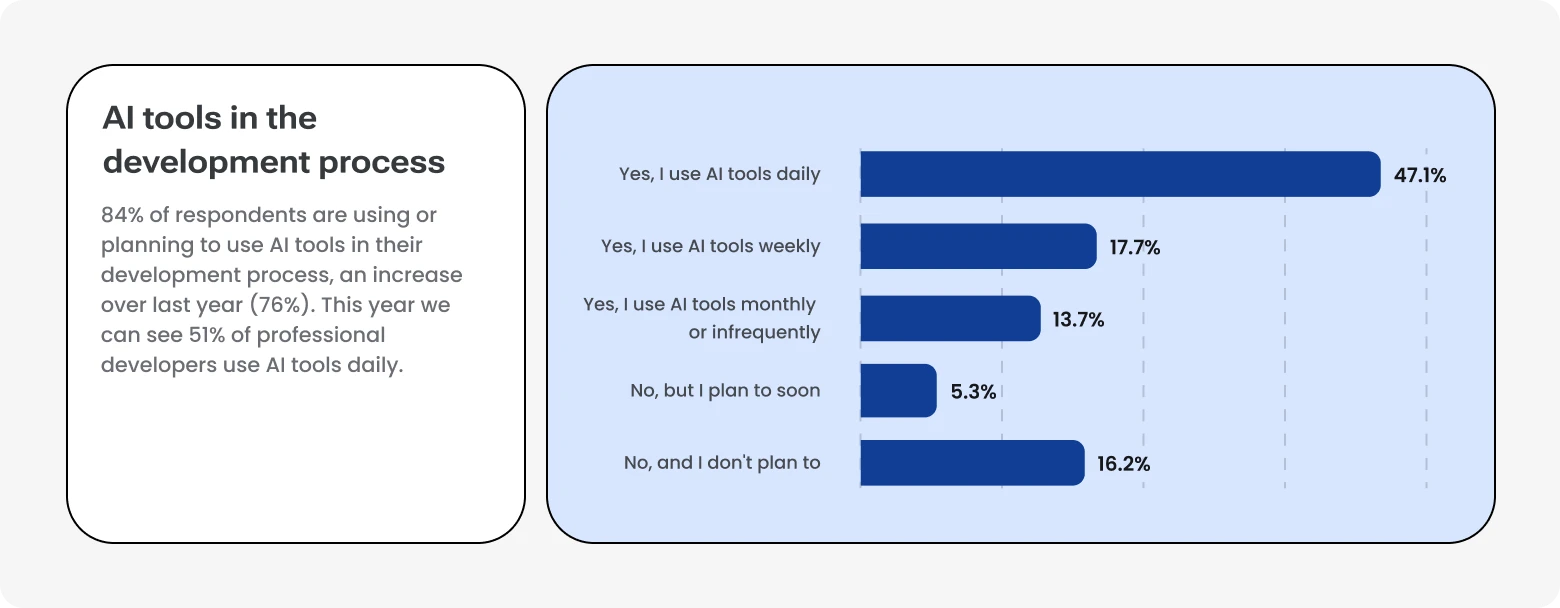
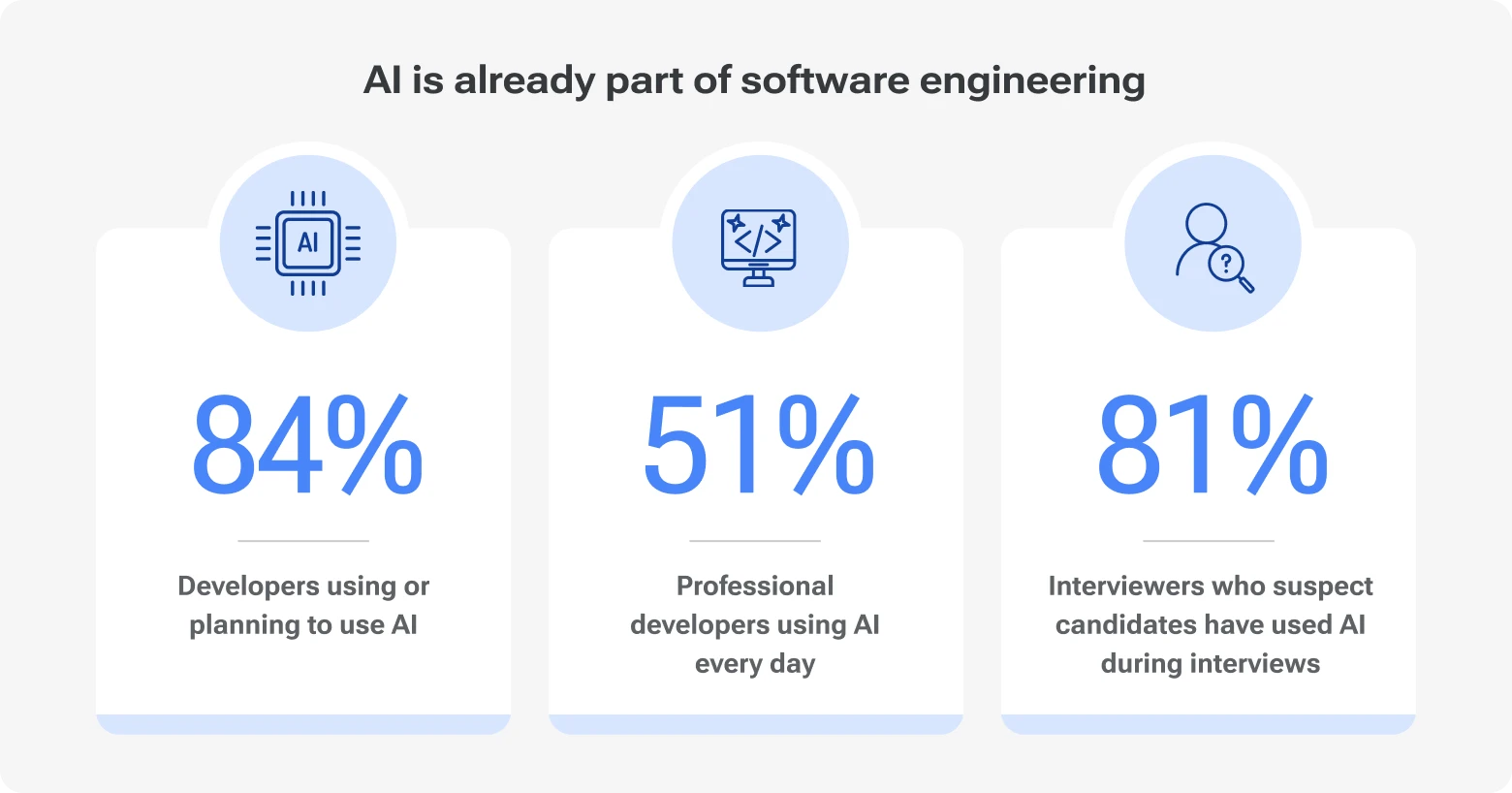
Is there at least one developer around you who still works without an AI assistant? Probably very few. In fact, 84% of developers report using or planning to use them. So, it's no wonder that your candidates use AI tools while working on a take-home or ask whether AI is allowed during live coding.
Yet, there are interviewers who call it cheating and those who call it Tuesday. The debate between these two camps is heated.
So should candidates use AI in technical interviews? In reality, either approach makes sense, and the choice depends on the signals you'd like to measure.
This article helps you decide whether to allow AI in your interviews, explains formats that work best for each approach, outlines common interviewers' mistakes, and points out what to evaluate so the interview predicts on-the-job performance.
Why AI in coding interviews is suddenly a real question
A few years ago, when engineers were just experimenting with generative AI, hardly anyone asked whether candidates should be allowed to use it during technical interviews.
AI is part of the development workflow. Developers use it daily to generate code, explain unfamiliar APIs, draft tests, investigate bugs, and even brainstorm architectural ideas. In other words, AI is no longer an experiment but how engineering work gets done. The engineer who never uses an AI assistant is now the outlier.
The hiring process, however, hasn't evolved at the same pace. Most interviews still model a situation where a candidate works with nothing but their own knowledge and access to documentation at most. That format was effective when it reflected the real work environment. Today, it often doesn't.
So, does it make sense to evaluate developers under conditions that no longer resemble their actual job? If people on your engineering team are supposed to use AI every day to tackle different tasks, asking candidates to ignore those tools during the interview creates an artificial environment. This way, you measure engineers' performance without a resource they'll certainly have once they're hired.
There's also a practical problem. Even if you opt to prohibit AI during interviews, you cannot be sure that your candidates complete take-home assignments without using AI. Though 88% of hiring managers say they can spot AI-assisted work. Along with this, 54% of them say that they actually don't care. For them, using AI even in live coding is totally ok. The 2026 Job Seeker Insights Report found that 22% of candidates in the USA are already using AI during real‑time interviews.
However, that doesn't mean that AI-free interviews are obsolete or useless. There are still situations where evaluating unaided knowledge is valuable, especially when you assess programming fundamentals or verify that a candidate doesn't hide major knowledge gaps behind AI assistance.
So, the question isn't whether candidates will use AI — it's whether your process acknowledges that they do.
Motivated and focused experts for up to 60% less than locals, delivered in days, not months.
Arguments for allowing AI
Allowing AI in technical interviews has a lot of supporters, and for a good reason. Let's see the key advantages of this approach.
- It reflects real work
Candidates use AI in their daily work — that's how they keep up with industry trends and meet growing performance expectations. They'll write code, investigate bugs, understand unfamiliar frameworks, and explore implementation options with the help of AI. An interview that allows AI simply mirrors the environment they'll work in every day.
- It evaluates the skills that matter now
Since engineers will use AI assistants anyway, you need to be sure they do it mindfully and effectively. When allowing AI, interviewers can check whether candidates:
clearly frame the problem;
challenge AI's suggestions;
catch mistakes and hallucinations;
seamlessly integrate AI output into a solution.
These days, those skills separate strong engineers from average ones.
- It removes an unenforceable rule
Even if your interview policy prohibits AI, you can't be sure whether candidates used it on a take-home assignment. Live coding isn't immune either, with AI assistants now available through IDEs, browsers, phones, and secondary screens. AI allowance removes the need to police something that's becoming more difficult to police.
- It lets you raise the bar
AI handles boilerplate really well. Therefore, with the grunt work compressed, you can give candidates more intricate and realistic engineering problems that require architectural thinking, debugging, prioritization, and trade-off analysis.
AI-assisted technical interviews can be really efficient. The key thing is to change the object of evaluation. Judgment must be the key criterion, while code production is less important here.
Arguments for restricting AI
In certain interview rounds, it makes sense to limit AI use. This works when an AI-free exercise is short and combined with an AI-allowed one. Use this approach when you need to assess skills that an AI assistant can obscure:
AI cannot solve each and every engineering task. Engineers regularly solve difficult problems on their own. An AI-free interview can prove that the candidate has the necessary experience and knowledge.
Without AI, interviewers can see how candidates decompose difficult, confusing problems before any code exists. That thinking process often tells you a lot about the candidate's competency.
When junior developers are evaluated, hiring managers usually care less about output volume and focus on problem-solving ability and learning capacity. An AI-free interview makes those qualities easier to assess.
All in all, AI restriction isn't useful on its own but brings value when used intentionally to reveal a certain signal.
Mismatch between a technical interview AI policy and a rubric as a common mistake
Often, problems arise not because of the wrong AI policy choice but because the rubric contradicts the idea behind the applied policy.
Companies may pick "allow" or "ban" and keep evaluating exactly what they evaluated before. That's a big mistake.
Consider a team that allows AI but still assesses whether the solution works, whether the code is clean, and whether the task is completed in time. When an AI assistant is used, these metrics are less valuable, as an advanced AI model can produce clean code very quickly. With those metrics, you evaluate the tool rather than the engineer.
The opposite mistake is also quite common. Some companies prohibit AI throughout the interview process, even though the role suggests using AI from day one. In that case, the interview is built around a workflow that doesn't exist inside the company. Engineers are chosen based on how well they perform under constraints they'll rarely face after they're hired.
Whatever approach you use, make sure your evaluation criteria match your interview format.
If AI is allowed, evaluate:
Clear problem definition before prompting
Habit to assess every AI's suggestions
Ability to spot hidden bugs and security issues
Ability to explain and defend every decision
Your mission here is to understand whether an engineer thoughtfully uses AI and exercises sound engineering judgment rather than simply copying its replies. In fact, Gartner expects 75% of hiring processes to include certifications or tests for workplace AI proficiency by 2027.
If AI is restricted, focus on:
Knowledge of core programming principles
Ability to reason through unfamiliar problems
Ability to address uncertainty
Importantly, ban AI only when doing so helps you measure a specific capability.
A decision framework: Allow, restrict, or mix AI by interview round
When choosing between different interview policies, you should first define what you'd like to measure.
In fact, no need to choose between allowing AI and prohibiting it. A mixed approach usually provides a better picture of a candidate's abilities. Different interview rounds reveal different signals, so they don't all need the same AI policy.
For most engineering roles, AI can be allowed during the primary problem-solving exercise. This way, you'll see how candidates tackle realistic engineering tasks, collaborate with AI, validate its output, and make technical decisions. Copying real working conditions, this round has the highest predictive value.
If you need to verify something AI could easily mask, add a short AI-free exercise. Keep it focused and explain its purpose to the candidate. People usually feel more comfortable with AI restrictions when they understand what the interviewer is trying to evaluate.
When choosing the interview format, take into account also the seniority level you're hiring for.
For junior engineers, AI can still play a role, but you first want to know whether the candidate has a solid foundation to build on, which makes the AI-free approach more relevant.
For senior engineers, the balance shifts. They are rarely hired because they can write code without assistance. What matters more is the ability to make good technical decisions, handle ambiguity, review solutions, and design scalable and maintainable systems. Since AI is already part of that workflow, interviews should reflect it.
So, should you allow AI in interviews? The table below can serve as a starting point when designing your interview process.
Round
Goal
AI policy
What to evaluate
Strong signal
To see how candidates actually work
Problem framing, AI output verification, integration, engineering judgment
Catching AI mistakes, questioning its suggestions, and being able to explain why any output is accepted or rejected
Check of fundamentals (when needed)
To isolate core reasoning and technical fundamentals
Problem decomposition, core computer science concepts, independent reasoning
Breaking down an unfamiliar problem before writing code
To evaluate engineering judgment at scale
Architectural thinking, trade-off analysis, constraint management, mindful AI usage
Using AI to explore options but owning every architectural decision
To assess learning ability
Reasoning, learning ability, adaptability
Thinking aloud, grasping context quickly, and adjusting when new information is introduced
Each interview round measures a specific capability, and the AI policy should support that goal instead of working against it.
When the technical interview AI policy, the rubric, and the role are aligned, interviews accurately predict how engineers will actually perform once they join your team.
How to run AI-allowed interviews
Allowing AI while running interviews wrongly can be even more inefficient than banning it completely. Based on our experience, we'd like to give you a few tips on how to interview developers in the AI era.
- State the policy and the rubric upfront
Candidates should know what's expected of them. Tell them which AI tools they may use and what you're going to evaluate. Make it clear that for you the interview isn't a race to generate the most code. What matters is how they approach the problem, verify AI's output, and justify their decisions. This way, interviewers are aware of what to pay attention to, and candidates know what skills to demonstrate.
- Pick a problem AI can't finish on its own
If a coding task can be completed by pasting the prompt into an LLM and copying the answer, you'll learn nothing about the candidate's skills.
So, design problems that require engineering judgment rather than code generation. For example, you can introduce:
incomplete or ambiguous requirements
a realistic production bug
performance or security considerations
several acceptable solutions with different trade-offs
AI can certainly help with these tasks to some extent, but it won't eliminate the need for human reasoning.
- Watch the process, not the result
As mentioned above, your goal is less about evaluating the code and more about observing how the candidate interacts with AI. Strong engineers treat AI as an assistant, not an authority. They don't use AI's suggestions blindly but check them, refine them when necessary, and ignore them when AI leads them in the wrong direction.
- Ask candidates to explain their decisions
Ask candidates to walk you through the implementation to make sure they understand every aspect of their solution and can defend any of their decisions. For example, you can ask the following questions:
Why did you accept this AI's suggestion?
What would you change before merging it?
Why did you modify that suggestion?
What risks do you see in this implementation?
- Include review and debugging of AI-generated code
One of the most efficient interview formats today is asking candidates to review, debug, and improve code produced by AI. This task quickly shows whether candidates can identify bugs, question AI's assumptions, recognize maintainability issues, and make intelligent engineering decisions instead of relying on AI.
All in all, arrange AI-enabled interviews in a way that evaluates whether candidates can direct AI effectively, recognize its limitations, and take responsibility for the outcome.
Red and green flags during AI-assisted technical interviews
Interviewers who can "read" people and spot positive and negative signals during an interview are much less likely to make a bad hire.
The patterns below can help you distinguish engineers who use AI as a productivity multiplier from those who use it as a substitute for thinking.
Green flags:
Checking every output instead of accepting it immediately
Catching the bug you planted
Explaining why certain suggestions were accepted or rejected
Using AI to tackle boring parts quickly
Jumping into the driver's seat when AI starts going off track
Red flags:
Pasting AI's suggestions without understanding them
Inability to explain their own solution
Accepting obviously wrong output at face value
Reaching for AI to avoid thinking, not to think faster
Treating every working solution as done
AI literacy isn't assessed by how often someone uses AI. It's measured by whether they understand its strengths and limitations and know when to rely on their own judgment. The signals above tell you whether you can trust an engineer because they don't blindly trust AI.
Stop detecting AI use in interviews
Many teams are concerned about AI use in interviews. This is completely understandable when it comes to real fraud in the form of candidate impersonation and deepfakes. This is why organizations are falling back on video interviews (81%) and in-person rounds (74%).
Yet treating AI assistant use as cheating is nonsense that actually has given rise to the entire industry — proctoring, keystroke analysis, eye-tracking, the works.
Cheating with AI in interviews is the wrong problem. Candidates who use Copilot to write cleaner code don't cheat because that's exactly how they do the job in real life.
The real problem is whether they use AI assistants wisely and can explain their own solution.
So set the right goal. And it isn't to catch candidates using AI but to understand whether they remain in control from start to finish.
Takeaway
So should candidates use AI in technical interviews? There's no universal answer, but there is a wrong way to frame it. Ban AI, and you risk testing a workflow no one uses in real life. Allow it without adjusting your rubric, and you let candidates hide behind AI.
To succeed, match the policy to the signal you need to catch. If you need to verify programming fundamentals or independent reasoning, an AI-free interview is the right choice. If you want to understand how candidates will actually perform on the job, allow AI but evaluate candidates' judgment rather than code generation alone.
At Devico, we evaluate how engineers use AI, prioritizing judgment, verification, and ownership. If you're looking for a vendor whose hiring process reflects the realities of modern software engineering, we'd be happy to talk.
Great software starts with great people