More than two thousand years ago, Aristotle said, "Well begun is half done." This idea is still relevant, particularly when it comes to software engineer onboarding.
The first 90 days decide whether a new hire turns into a valuable team member. Yet, success depends not only on the engineer's ability but also on the company's approach to onboarding.
Drop a capable engineer into an ad-hoc onboarding process, and they hardly become a high-performing contributor you'd like to have on a team within three months.
In fact, things get way easier for today's engineers, as AI can summarize documentation, explain unfamiliar code, and help them learn complex systems much faster. But onboarding is more than understanding the code. New engineers also need to learn how the product works, why architectural decisions were made, how the team collaborates, and how engineering decisions are made. AI cannot tackle this, which is why mentors and teammates are still essential, though their role is shifting from answering every technical question to providing context, validating understanding, and explaining trade-offs.
So, proper onboarding is a structured process, not a one-day introduction and a pile of documentation.
This article provides a 30-60-90-day onboarding plan, covering what to prepare before day one, what goals to set at each stage, and how to help new hires get up to speed as quickly as possible.
Motivated and focused experts for up to 60% less than locals, delivered in days, not months
Why new engineers fail in the first 90 days
When a new hire productivity is low, the first question is whether the hiring decision was right. While interviews sometimes miss important signals or candidates oversell their experience, more often, early underperformance is an onboarding problem rather than a hiring problem.
Even skilled engineers cannot contribute on day one. They need time to understand the codebase, learn the product, build relationships with teammates, and figure out how work gets done. Until all those pieces come together, their technical ability alone isn't enough to perform at their best.
Yet, Gallup finds that only 12% of employees strongly agree that their company does a great job onboarding new people. A common situation is when an organization just ships a laptop, creates GitHub and Slack accounts, shares a list of documents, and considers the process complete. In reality, new engineers are left to figure things out on their own. Some eventually succeed while others spend weeks feeling blocked and uncertain.
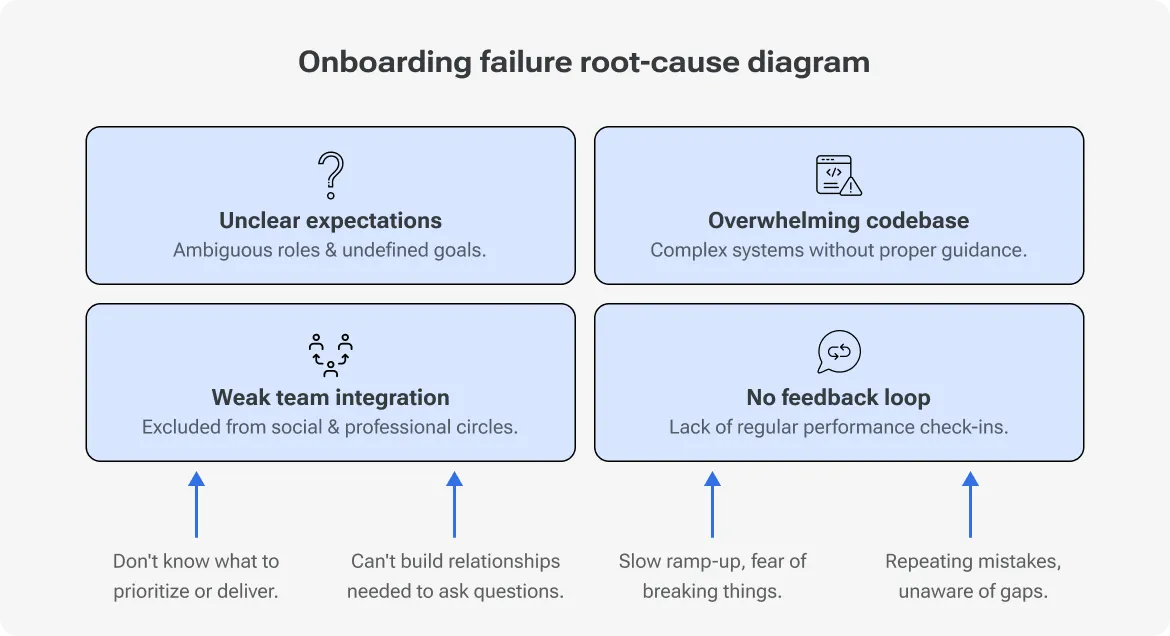
Most onboarding failures come down to the following issues:
Unclear expectations: New engineers don't know what success looks like during the first weeks or what they're expected to achieve by the end of the first month.
An overwhelming codebase: The system is large, poorly documented, and much of its institutional knowledge lives in one senior engineer's head.
Weak team integration: Without daily interaction with teammates, new hires cannot build the relationships they need to ask questions, review code, and solve problems efficiently.
No feedback loop: Problems a five-minute talk would solve are allowed to grow for weeks.
All these issues have nothing to do with an engineer's potential. They reflect gaps in the environment around them.
The cost of poor onboarding is high. A slow or unsuccessful onboarding doesn't just delay delivery but also extends the time needed for a new hire to become productive, increases the risk of early turnover, and, in the worst case, calls for the company to repeat a hiring process, which is quite expensive. According to SHRM, the average cost per hire is about $4,700.
Does AI lower the cost of hiring engineers?
That's why a structured onboarding plan is a must. In fact, it's one of the highest-return investments a company can make after signing an offer.
Before day one — set up the ramp
The most demoralizing first week is one spent requesting access, chasing permissions, and troubleshooting development tools. Therefore, onboarding should start days or even weeks before a new engineer joins your team.
Preparation doesn't have to be complicated, but it does need to be intentional. Before day one, make sure the essentials are already in place:
Access and environment: Hardware has been delivered, accounts are created, repositories are accessible, and all required tools and permissions are in place.
A first task, already identified: The engineer shouldn't spend days wondering where to start. A real piece of work — a small bug or a minor feature — should be waiting in the backlog.
A named mentor or buddy: Assign a dedicated mentor who will help a new hire remove blockers quickly and provide context that documentation can't. Microsoft's research on onboarding buddies found that new hires paired with a buddy were 23% more satisfied with onboarding after week one, rising to 36% by the 90-day mark.
A written 30/60/90 plan: Prepare a 30/60/90-day plan and share it with the engineer before they start so they know what success looks like, what they'll be working toward, and how progress will be measured.
A team is prepared: Let teammates know when the new engineer is joining, who will help with onboarding, and how they'll support the first few weeks.
As you see, there's nothing revolutionary here. But having all of these ready in advance, you can significantly reduce new hire ramp time. That's why pre-boarding isn't just administrative work but the foundation for everything that follows.
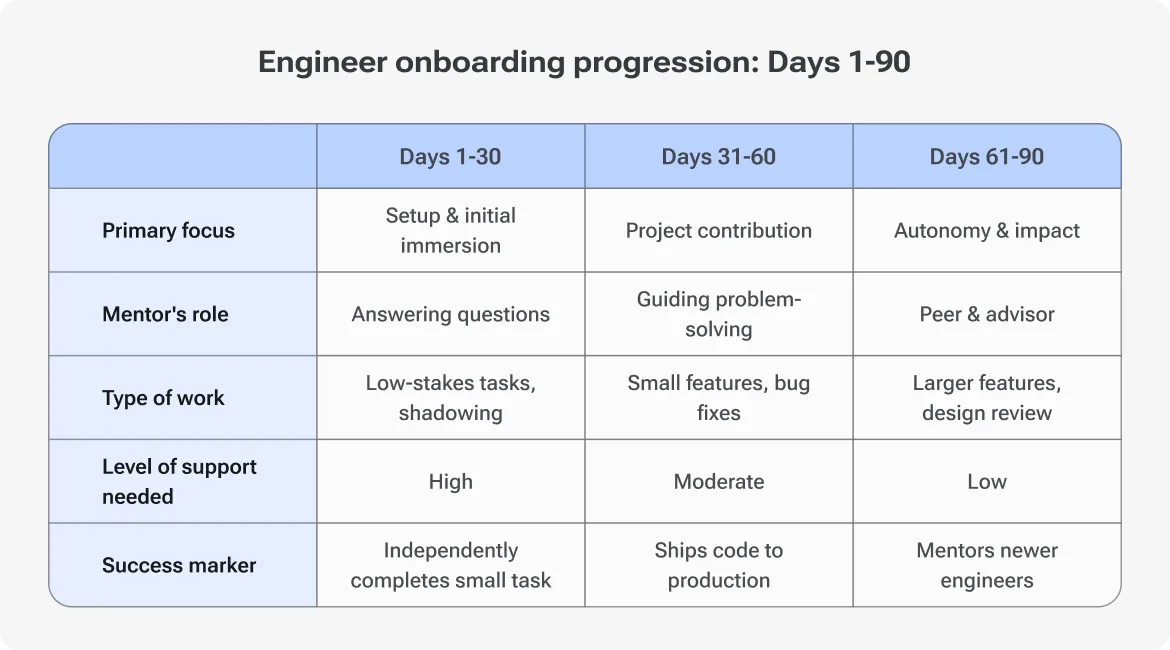
Days 1–30 — Learning the landscape and shipping something small
The first 30 days are mostly aimed at minimizing uncertainty, not maximizing output. During the first month, engineers should gradually gain knowledge about the company, the product, and the technology they work with.
So, learning is the key activity at this stage, and AI plays here a significant role now. While the McKinsey study shows that with generative AI, software developers can complete coding tasks up to twice as fast, it can also help at the onboarding stage. Encourage new engineers to use AI to explain unfamiliar code, summarize documentation, trace execution paths, or understand APIs without interrupting teammates. Used well, it really speeds up exploration of a new codebase.
However, AI should complement, not replace, human guidance. While assistants can explain what the code does, they often miss historical decisions, architectural constraints, business context, or the trade-offs behind a particular implementation. Without that context, engineers risk making poor technical decisions later. Treat AI as an effective tutor but assign mentors anyway to validate understanding and fill in the gaps.
While learning, a new engineer should also complete one small but real task. This might be fixing a bug, improving a test, addressing a UI issue, or implementing a minor feature. The work should move through the same workflow as any other production change, from development and code review to testing and deployment.
Shipping even something small helps new engineers understand the entire development lifecycle while giving them confidence that they can effectively contribute to the team. An early win should be on your engineer onboarding checklist.
By the end of the first 30 days, the engineer may not know everything, but they should:
navigate the codebase with growing confidence
understand how the work is done within the team
know where to find information and who to ask for help when they're stuck
have already shipped their first production change.
Days 31–60 — Contributing independently
By the second month, the focus shifts from learning to performing tasks independently.
While continuing to explore an unfamiliar codebase, engineers begin taking responsibility for real work and completing it with decreasing levels of support. Questions are still expected, but they become more specific.
The engineer should now work on the same kinds of tasks as the rest of the team. These might not necessarily be the most complex features, but some day-to-day engineering work: bug fixes, incremental features, refactoring, test writing, investigation of production issues, etc.
Meanwhile, technical knowledge should continue to deepen. By now, engineers should understand the parts of the codebase they work with most often and gradually expand their knowledge of adjacent systems and shared services. Importantly, they start understanding not only how things work, but also why they're built that way.
Another achievement you may expect during this period is active participation in engineering discussions. Code reviews are now an opportunity to contribute. Encouraging new engineers to review their teammates' pull requests helps them learn coding standards and architectural patterns while building confidence to share their own opinions.
Relationships across the team should also be strengthening. Engineers should know who owns different parts of the system, who to approach with domain-specific questions, and how decisions are made.
The role of mentors also changes by this time. Instead of showing engineers exactly what to do, they help them think through problems, challenge assumptions, and remove blockers.
By day 60, success looks like this:
completing standard engineering tasks with minimal supervision
continuing to expand domain knowledge
actively participating in code reviews, giving and receiving feedback
effectively collaborating with teammates
working as a fully integrated team member rather than as a newcomer still finding their footing.
Days 61–90 — Working at the expected level
Ownership is the key goal at this final stage. By now, the engineer should do the job you hired them for, owning a feature or an area end to end, making judgment calls, and participating in design discussions rather than just executing assigned tasks.
A good sign that onboarding has been successful is when engineers begin improving things unprompted. They might suggest a better testing approach, update outdated documentation, automate a repetitive task, improve the developer experience, or help a teammate who's just joined. Ownership shows up as initiative, not just completed tickets.
All in all, by day 90, the engineer should work at the expected level, flipping from a net cost to a net contributor.
This is also the right time for an objective review of the written onboarding plan. The purpose isn't simply to decide whether the engineer passed onboarding but also to evaluate the onboarding process itself.
The questions you face here:
Has the engineer achieved the goals set out in the 30/60/90-day onboarding plan?
Where did they progress faster than expected?
If expectations weren't met, was the issue a lack of support, unclear goals, gaps in the onboarding process, or a genuine mismatch between the role and the engineer's skills?
A successful onboarding program doesn't guarantee that every hire will work out. But it gives every engineer a good opportunity to reach the level they were hired for, and it gives the company evidence to distinguish an onboarding problem from a hiring problem.
Factors that determine onboarding success across all 90 days
A 30/60/90-day plan provides structure, but structure alone doesn't guarantee a successful onboarding. Several cross-cutting practices should support every stage of the onboarding journey:
To ensure everyone knows what success looks like, define the goals for each stage of onboarding, explain how progress will be measured, and regularly revisit those expectations. This reduces uncertainty and helps recognize problems before they become serious.
Good documentation enables engineers to learn independently and revisit information whenever they need it. It doesn't have to document every line of code, but it should explain the architecture, development workflow, coding standards, deployment process, and the product domain well enough for newcomers to work on the system confidently.
Assigning a mentor is easy. Being an effective mentor takes time and commitment. The best mentors don't just answer technical questions but explain decisions, introduce new engineers to the right people, and share unwritten team practices. Microsoft's People Analytics research found that new hires are 3.5 times more likely to report satisfaction if their managers play an active role.
Waiting until the end of the probation period to discuss progress is a bad idea. Feedback should be frequent, specific, and mutual. A new engineer who hears nothing for weeks assumes the worst, while one who gets a quick course-correction adjusts and moves on.
Every engineer joins a new company with knowledge gaps. Yet some of them can hesitate because they don't want to appear inexperienced. This way, small misunderstandings turn into serious mistakes. Teams that encourage curiosity, welcome questions, and treat mistakes as learning opportunities help new hires gain confidence much faster.
Handing someone tickets isn't the same as making them part of the team. Engineers need to feel like they're part of the team, not simply contractors handling assigned work. So, encourage them to participate in planning and retrospectives, involve them in technical discussions, and give them opportunities to build relationships beyond the tasks they're working on. The better they get integrated into the team, the easier collaboration will be long after onboarding ends.
Introduce all these practices to turn your new hires into confident, productive members of the team.
Building your software engineer onboarding playbook
So, how to onboard a software engineer? A successful onboarding program requires preparation. However, it doesn't mean you need to spend months on planning. Most companies already have the right ingredients, and all they need to do is to organize them into a routine process that every new engineer goes through.
We'd recommend you start with these steps:
-
Write a 30/60/90-day plan: Define what the engineer should achieve during each phase. Be as specific as possible.
-
Prepare everything before day one: Make pre-boarding a standard phase of the process. Access, hardware, environment, first task, mentor assignment — run the checklist every time, especially when you're busy.
-
Design an early win: To enable an engineer to experience the full workflow and build confidence from the very beginning, assign them a small task. Pick it on purpose — don't let it be whatever happens to be lying around.
-
Assign a mentor and ensure regular feedback: Pair every newcomer with someone who can answer all questions and explain context. Also, arrange regular one-on-one check-ins to discuss accomplishments, blockers, and challenges.
-
Review outcomes after 90 days: Evaluate new developer onboarding against the goals you set at the start, acknowledging achievements and identifying remaining gaps.
The table below summarizes what an appropriate 90-day onboarding plan looks like.
Stage
Goal
Focus
Expected results
To remove possible obstacles before the engineer joins the team
Environment setup, access, first task selection, mentor assignment, 30/60/90 plan preparation
All prerequisites are in place, allowing the engineer to focus on learning day one
To learn the basics and ship something small
Development environment, codebase, product, workflows, one small task completion
The newcomer understands the basics, knows where to find help, and has shipped their first production change
To contribute independently
Day-to-day work, deeper product and technical knowledge, participation in code reviews, strengthening team relationships
The engineer completes common tasks with minimal or no support and is fully engaged in the team's workflow
To work at expected level
Owning work end to end, making technical decisions, participating in engineering discussions, suggesting improvements
Eventually, the new hire reaches the expected level of productivity, works independently, and takes ownership of their work
Is there any difference between onboarding augmented and permanent engineers?
Most onboarding guides assume the new engineer is a permanent, full-time, in-house hire. Yet today, many companies use staff augmentation to quickly add skills or increase delivery capacity.
Upskill, hire, or augment? Building your engineering team in the AI era
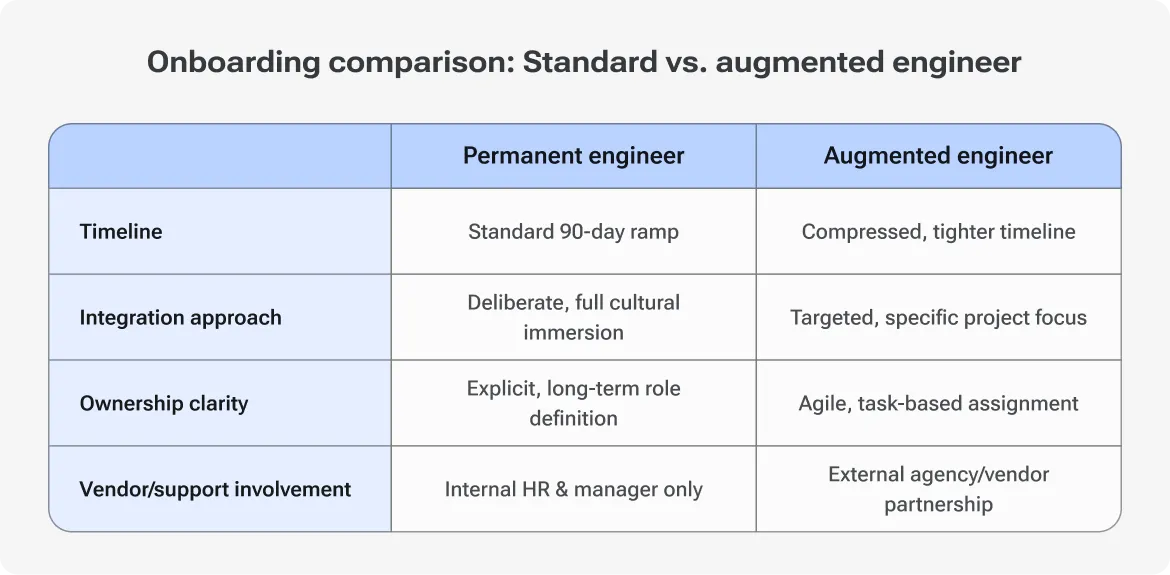
Should augmented engineers be onboarded differently? The same principles apply, but the execution is different. Every engineer needs enough technical, product, and team context to contribute effectively. The difference is that augmented engineers are expected to reach productivity much faster and within a more clearly defined scope.
As a result, the same onboarding playbook can be used but in a compressed form, with a few nuances requiring additional attention:
A tighter timeline: Augmented engineers are expected to progress faster, which is why your scoping and context delivery must be better. A relaxed approach with a vague first week is unacceptable.
Deliberate integration: The "us versus them" split between in-house and external engineers is the fastest way to undermine a staff augmentation engagement. Treat augmented engineers not as "others" but as your regular team members, and ensure shared standups, shared channels, and shared code reviews.
Explicit ownership and handoffs: In the very beginning, spell out what the augmented engineer owns versus what stays in-house. Lack of clarity here causes inefficiency.
A vendor that does its half: A good partner doesn't disappear after introducing a candidate. They stay engaged during onboarding and help solve issues before they evolve into delivery problems.
Although the onboarding timeline is usually shorter, the goal is still the same: helping engineers become trusted, highly productive team members asap.
Bottom line
The first 90 days in a new engineering job are particularly important. They determine whether investment turns into a valuable contributor or another costly hiring cycle.
A well-thought-out software engineer onboarding process creates conditions for a successful start: well-defined expectations, the right tools, early tasks, regular feedback, and people they can rely on when questions arise. Together, these elements shorten the ramp-up period, build confidence, and help engineers take work ownership much sooner.
The same principles apply to onboarding augmented engineers. The only difference is that onboarding usually needs to be completed faster, which makes preparation, clear ownership, and fast integration even more important.
As a staff augmentation partner, Devico supports every client during the onboarding process and beyond, helping engineers quickly get productive and smoothly integrate with the team.
Great software starts with great people