Feel like your tech recruiting process is too slow to keep up with your business needs? You are not alone. The stats show that 75% of technical roles get closed within 60 days. This usually happens not because your recruiters don't put in enough effort, but because the recruitment process has one or several bottlenecks. A day lost here, two days there, another week waiting for feedback — nothing catastrophic in isolation, but together, they can double your time-to-hire.
Slow recruiting is becoming a serious problem as demand for experienced software engineers, especially those with expertise in AI, cloud infrastructure, cybersecurity, and distributed systems, is increasing. The more time your hiring process takes, the more likely you are to lose top candidates to companies that move faster.
In this guide, we'll outline the seven most common bottlenecks in software engineering recruitment and how to spot and fix them so that you can hire faster without lowering the bar.
Motivated and focused experts for up to 60% less than locals, delivered in days, not months
The real reason behind slow recruiting
Many companies track time-to-hire benchmarks to understand how good their hiring process is. Yet, a survey shows that 89% of talent leaders aren't sure they'll meet their speed-to-hire goals.
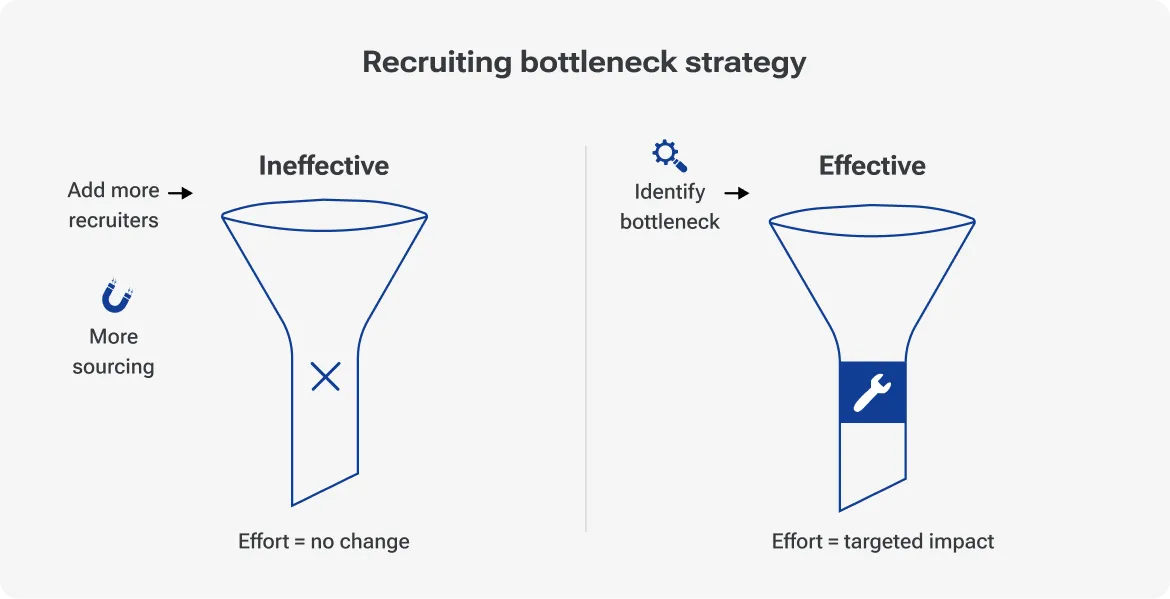
To reduce the time to hire engineers, many teams try to put in more effort by adding recruiters, boosting sourcing activity, or asking interviewers to assign more time to hiring. However, all these measures can barely change the number because the constraint lies somewhere else.
Hiring is a pipeline consisting of several stages, and if one of them isn't efficient enough, the overall speed of the pipeline is affected. If interview feedback always takes a week, sourcing twice more candidates won't reduce your time-to-hire. Likewise, if tech interview scheduling takes ten days, shortening the coding assessment won't help.
No need to optimize everything at once. What you need to do is to identify the stage that takes the most time and make improvements there.
To run diagnostics for your pipeline, take your last ten engineering hires and timestamp each stage: req approved, first candidate sourced, first screen, onsite scheduled, loop completed, decision made, offer accepted. Then calculate the average time of each stage. One that takes the most time is your bottleneck.
Every company has its own pain points, which is why common "hire faster" advice fails. It suggests that you need to do everything better, while what you actually need is to work on a particular stage where the bottleneck hides.
So your strategy should be diagnostic, not motivational: spot the constraint, fix it, and then move to the next one. Once the primary bottleneck is removed, smaller ones become more visible.
Bottleneck 1 — Vague intake and requisitions
A common problem is a broad requisition that doesn't define the role, the must-haves, and the nice-to-haves. It slows down every stage after it.
Let's say a team requests a strong backend engineer while sharing no details. As a result, recruiters have to source broadly, and a hiring manager rejects candidates based on instinct, not predefined requirements. Three weeks later, the funnel is full of people, none of whom have reached a technical round. The key hindrance here is the requirements.
The symptoms of this bottleneck are easy to spot:
recruiters sourcing the wrong profiles;
endless back-and-forth calibration;
candidates rejected with no concrete reason.
The solution is structured intake. Before posting a job advert, a hiring manager and a recruiter agree on capability, seniority, must-haves, nice-to-haves, and the exact bar. Thirty minutes here saves three weeks down the road.
Bottleneck 2 — Slow or untargeted sourcing
A sourcing bottleneck doesn't always look like an empty pipeline. A flooded one can also be a blocker. Both too few candidates and too many irrelevant ones slow hiring down because recruiters spend more time reviewing and filtering profiles before the right engineers reach the interview stage.
The problem has gotten worse with the emergence of AI. Today, many companies receive a bulk of AI-generated resumes. Thus, applications submitted on LinkedIn surged more than 45% in a year — close to 9,500 every minute. Along with this, 70% of hiring managers say fewer than half of applications meet the role's criteria.
The solution for more efficient sourcing isn't posting the role on more job boards or waiting for better applicants to appear. It's targeted outbound, which suggests creating a precise candidate profile and then going out and finding those people instead of waiting for them to find you.
You can start by listing companies that build systems similar to yours and then contact engineers working there. AI can help you identify those companies and detect the best matches. In fact, AI can really speed up the sourcing process by finding relevant profiles, organizing search results, personalizing first-touch outreach, and automating repetitive tasks. However, the recruiter still needs to define the target and decide which backgrounds are relevant.
Of course, targeted outbound takes longer to set up, but it usually ensures much faster hiring than waiting for the right person to stumble upon your posting among a thousand others. The team that sources ten well-matched candidates beats the team that screens four hundred mismatched ones.
Bottleneck 3 — Screening that doesn't discriminate
A good screening process is one that quickly separates candidates who are likely to succeed in the role from those who aren't. When it fails to do that, the entire hiring pipeline is impacted.
If your screen filters out strong engineers, you spend more time sourcing replacements. When it lets too many weak candidates through, your interviewers spend hours on conversations that never result in a hire.
The rise of AI has made this challenge even more difficult. Today, candidates can use AI to create resumes, optimize cover letters, prepare for interviews, and even receive real-time assistance during technical assessments. As a result, traditional screening methods have become less reliable at identifying real engineering competence.
To test the right signals efficiently, you need a short, role-specific exercise that's difficult to fake, quick to evaluate, and similar to the work the engineer will actually do. Pair that with identity verification before candidates reach the interview panel, and you'll reduce the number of unsuitable candidates going through your pipeline.
Done well, screening protects the valuable time of senior engineers who conduct later interview rounds.
Bottleneck 4 — Scheduling and coordination lag
If days go by between pipeline stages because of calendar coordination, that's not good, and a slower hiring process isn't the only consequence.
Robert Half found that 62% of professionals lose interest in a job if they don't hear back within two weeks of the first interview, climbing to 77% at three weeks. The thing is that candidates interpret silence as disinterest, and they don't wait. They continue communicating with other companies and accept another offer before you've even reached the final round.
The good news is that it's really easy to fix this bottleneck. You can streamline scheduling and coordination by reserving recurring interview slots on engineers' calendars, letting candidates self-schedule wherever possible, and using AI or scheduling tools to coordinate interview panels instead of endless email threads.
Also, we'd recommend you set internal SLAs between recruiting funnel stages, for example, no more than two business days between a recruiter screen and a technical interview or 24 hours between the final interview and the hiring decision. This way, you can remove unnecessary waiting and not let great candidates cool off.
Bottleneck 5 — Too many interview rounds
An abundance of interview rounds may provide a false sense of safety. In reality, they often create more problems than they solve.
Every additional interview extends the hiring timeline, takes engineering time, and increases the chances that a strong candidate will drop out.
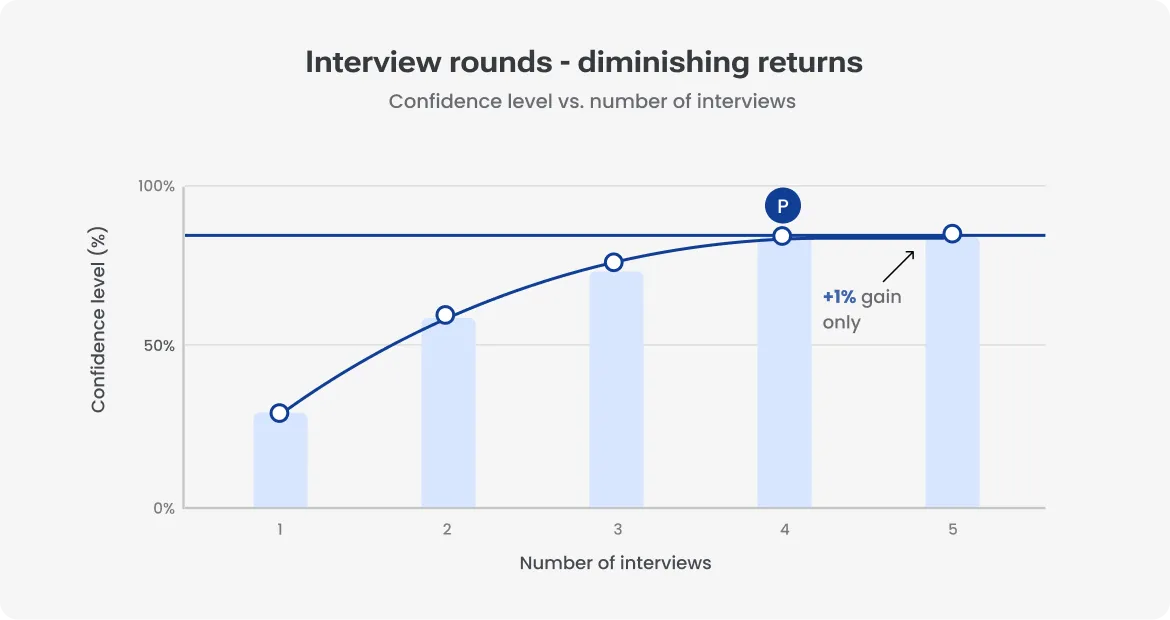
After a certain point, you collect more opinions, not more useful information. Google measured this on its own. Its analysis found that four interviews predict candidate success with 86% confidence, and a fifth interviewer adds roughly one percentage point.
So, if you have a six-round process, multiple interviewers assessing the same skills, and candidates losing interest halfway, you have a bottleneck. To remove it, reframe your interview loop design so that it focuses on the signals you actually need to make a confident hiring decision. Each round should have a distinct purpose. One interview might assess technical fundamentals, another system design, and another collaboration and communication. If two rounds evaluate the same competency, one of them is probably redundant.
Efficient hiring processes aren't the longest. They're the ones where every interview has a clear purpose, every interviewer knows what to evaluate, and every stage brings you closer to a confident decision.
Bottleneck 6 — Slow decisions
A hiring process can run smoothly and rapidly but fail at the final step.
Imagine a situation where the interviews are complete and the feedback is mostly positive, but the process slows down as one interviewer hasn't submitted notes, the hiring manager wants to discuss the feedback again, or the team waits for another opinion before making a call. A decision that should take a day stretches into a week.
This is one of the most expensive engineering recruiting bottlenecks because it happens at the point when candidate interest is often highest and when other companies are still competing for the same person. Every extra day of uncertainty encourages strong candidates to accept another offer or question whether your company is interested in hiring them.
No need to make rushed decisions. A better solution is to create a clear decision process in advance. Set a specific timeline for debriefs, require interview feedback within hours rather than days, and assign one person as the final decision owner.
Most importantly, agree on the hiring bar upfront so that nobody renegotiates the standard midstream.
A fast decision process doesn't suggest lowering standards. It just removes unnecessary waiting after the team already has the information needed to decide.
Bottleneck 7 — Weak closing
Many teams treat the offer as the finish line. But it's too early to relax. This is the moment when you need to convince the candidate to choose you.
A strong close is a fast offer, a clear sell on the role and the mission, an honest read on competing offers, and steady contact so the candidate never goes cold. A weak close is quite the opposite and can undo weeks of work.
33% of hiring managers admit they lost a good candidate in a single year because they were too slow to extend an offer.
But speed is only part of the equation. The other is how well you communicate what makes your company worth joining.
Strong candidates evaluate not only salary. They compare the work they'll do, the team they'll join, the manager they'll report to, the opportunities for growth, and the flexibility your company offers. If another employer communicates that value more clearly, you may lose the candidate.
Closing starts long before the offer is sent. From the very first contact, you learn what is most important for the candidate, what motivates them, and what concerns they may have. In such a way, you can foresee their objections in advance instead of reacting to them at the offer stage.
Once you've decided to make an offer, don't delay. Let the candidate know why you think they are the right fit and tie the role to the motivations they've mentioned earlier. Do your best to show the candidate that this opportunity is the right next step in their career.
Building your bottleneck-free hiring pipeline
So, how to speed up hiring? The whole approach rests on one principle: you can't fix what you don't measure.
-
Break your hiring process into separate stages: intake, sourcing, screening, scheduling, loop, decision, and close. Measure funnel time stage by stage. The longest stage is your bottleneck.
-
Eliminate the identified constraint and then re-measure. Focus on the slowest stage only. Once it's fixed, get to the next bottleneck. Continuous improvement is about identifying and removing bottlenecks one by one.
-
Set SLAs between stages to cap the dead air. A 48-hour ceiling between steps recovers more days than any other hiring pipeline optimization ever will.
-
Introduce AI to handle trivial, routine tasks like sourcing, interview coordination, and outreach. Along with it, don't rely on it when it comes to screening — your direct involvement here is still essential.
Bottlenecks across the recruiting funnel stages
Stage
Common bottleneck
Symptoms
Solution
Having no clear requirements, recruiters source the wrong profiles
Before opening the role, get clear requirements for the role and success criteria
Slow sourcing that relies on inbound only
Too few good candidates or too many irrelevant applications
Create a candidate profile, use targeted outbound, and leverage artificial intelligence for sourcing tasks
Inability to discriminate
Strong candidates are turned down, or weak candidates reach technical interviews
Use short, role-specific tech assessments and check identity in advance
Days or weeks pass between interview stages
Reserve interview blocks, enable self-scheduling, and set SLAs between stages
Multiple evaluations, interviewer fatigue, candidate drop-off
Give every interview round a specific purpose and remove overlapping rounds
Hold same-day or next-day feedback, assign a decision owner, and agree on the hiring bar in advance
Delayed offers and weak candidate engagement
Candidates accept competing offers
Act quickly, stay in touch with the candidate, and adjust the offer to their motivations
Hiring pipeline audit checklist
Before you launch your next engineering search, ask yourself:
Do we know exactly what business problem this hire will solve?
Which stage of our hiring pipeline currently takes the most time?
Does every interview round evaluate a unique competency?
Can we move from one stage to the next within our target SLA?
Do we efficiently use AI to save time on repetitive tasks?
Do we have a clear owner responsible for the final hiring decision?
If our top candidate receives another offer, would they have a compelling reason to choose us?
If you have a negative answer to any of these questions, you've probably spotted your next hiring bottleneck to address.
When even a highly efficient funnel is helpless
A fast hiring pipeline is definitely worth building. However, there are situations where technical recruiting best practices just don't help:
You may need an engineer next week, not next quarter.
You're looking for a rare senior skill your local market can't source on any timeline.
You have a temporary surge that doesn't justify adding another permanent employee.
In those situations, the bottleneck isn't your hiring process. It's time or the talent supply itself.
If the capability is urgent, limited, or temporary, staff augmentation is the best solution. Instead of spending weeks on recruiting and hiring, you bring in experts for as long as needed.
Yet, don't treat staff augmentation as a replacement for good in-house hiring. Your core hiring deserves a fast, well-tuned funnel. Staff augmentation is best suited for roles you need to fill urgently.
The smart strategy is to use any talent acquisition model based on the circumstances — no need to rely on a single one.
Upskill, hire, or augment? Building your engineering team in the AI era
All in all, the smartest talent strategy isn't about choosing between hiring and augmentation. It's about knowing when each one makes the most sense.
Takeaway
The root cause of a slow tech recruiting process is often not a lack of effort but bottlenecks in a funnel — friction points that can affect your entire time-to-hire. Fortunately, you can fix this. The key thing is tackling one constraint at a time, starting from the most serious one that is located in the slowest stage of your pipeline. Continuous improvement, with bottlenecks removed one by one, is the most efficient way to refine your funnel.
In situations when hiring is too slow, even with a fast pipeline in place, collaborate with staff augmentation companies like Devico. We help companies fill critical engineering roles quickly with seasoned software engineers who match their technical and business requirements.
Great software starts with great people