Promotion of AI coding tools is almost always built around the idea of cost reduction based on the promise of the same output with a smaller team. And since many organizations spend around 50% of their IT budget on app development, boards and CFOs just cannot ignore this opportunity.
"Will AI reduce software engineering costs?" is the natural question that arises. The answer, however, is less straightforward than it first seems. The thing is that the cost of producing a line of code and the total cost of software running are different numbers, and AI affects them in different, sometimes opposite, ways.
Before you put AI into headcount plans, we propose to find out what AI really makes cheaper, what it makes more expensive, what costs stay hidden, and how to arrange a team so you get real savings, not borrowed from a future quarter.
What does "cheaper" actually mean in software development?
To understand whether AI makes engineering cheaper, let's first define what "cost" actually refers to. In fact, there are four different layers.
Key cost lenses in software engineering
Cost lens
Description
AI impact
Is it enough to judge the real cost?
Effort to produce raw code
Effort to accomplish an engineering task
Effort to produce a viable piece of functionality
Cost lowers in the build phase, but not necessarily across the software lifecycle
Total effort to create, run, and maintain reliable software in production
Cost is often flat. Without strong engineering discipline, it easily grows
At the code level, the impact is most noticeable. With AI, code generation isn't as effort-consuming as it used to be. Boilerplate, scaffolding, simple features, and standard integrations can be created much faster now. This quickly affects the development speed and team throughput.
However, a cheaper line of code doesn't always ensure a cheaper feature. And a lower cost per feature can still increase the total cost of the outcome if the solution is more complex and less maintainable.
Let's say AI reduces feature development time by 50%, and the build stage drops from 10 engineer days to 5. If review, testing, and eventual debugging of AI-introduced bugs add 4 days where they used to add just 1.5, your cost per outcome barely decreased — you just take three days from juniors and give them to senior reviewers. That's not the efficiency board members expect.
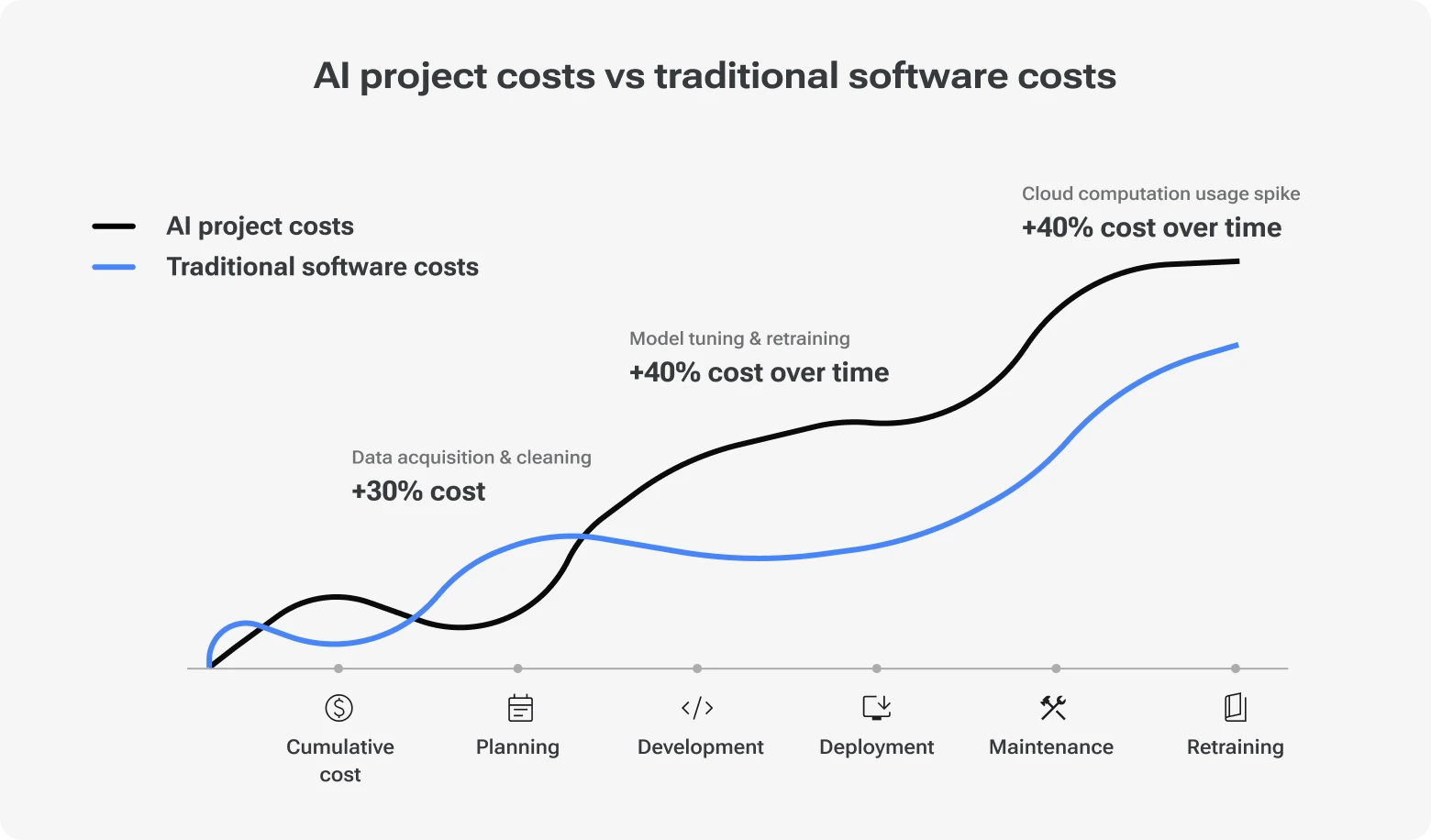
This is actually where the trade-off lies. Some of the time saved on implementation may be recouped later as additional review effort, more debugging, deeper integration work, and more challenging maintenance. AI helps minimize the cost of producing software, but it doesn't automatically cut the cost of running it.
That is why the most useful metric to track isn't cost per line, task, or even feature but the total cost of the outcome, i.e., the cost of delivering and maintaining software in production.
Motivated and focused experts for up to 60% less than locals, delivered in days, not months
Tasks that AI really makes cheaper
While debates about whether or not AI will transform engineering costs are still going on, let's highlight day-to-day tasks that AI-assisted development has already made cheaper.
The categories of work described below are where AI delivers real savings.
Boilerplate, scaffolding, and glue code: Regular plumbing is required to set up services, connect systems, and establish standard patterns. This is crucial work that has been greatly sped up by AI.
Tests and documentation: Document writing and test creation are needed for long-term system stability, but they're often skipped when deadlines get tight. AI lowers the effort needed to produce tests and documentation, due to which quality can be maintained without slowing delivery.
Throwaway prototypes and experiments: With the help of AI, assumptions that used to take a lot of engineers' time can now be tested pretty quickly. This way, ideas that don't work are dismissed early. For teams whose main problem is figuring out what to build rather than implementing it, that's the major saving that shows up as smarter decisions, not a smaller cost.
Onboarding in new systems, platforms, or languages: AI shortens the intro phase by explaining codebases, clarifying concepts, and cutting down the time needed to make first contributions in a new environment.
Surveys support this. In a study reported by McKinsey, developers using GitHub Copilot finished tasks 56% faster than those without. Less execution time results in less expense.
Yet, the problem is that as of now AI cuts down the cost of well-defined, low-judgment work, which was already the cheapest component of engineering. Even large efficiency improvements here don't always result in significant reductions of total engineering cost.
What AI makes more expensive
Physicists discovered that energy never disappears but changes its form. Something like this actually happens with engineering costs. AI makes some work cheaper, but often, the cost doesn't vanish. It simply moves from code writing to reviewing or maintaining.
Here are the areas where AI often adds effort:
Undoubtedly, AI-powered tools help teams write code much faster, but the output nevertheless requires diligent review. And senior engineers usually get responsible for reading, validating, and correcting code. No need to remind you that their time costs a pretty penny.
Taking into account the high volume of AI output, software solutions are often built faster than teams can fully understand them. When that happens, initially saved time is later spent fixing bugs, refactoring code, or tackling technical debt.
You cannot be sure that AI-generated code is completely secure. Therefore, teams must extensively check the output for security and compliance issues. That's vital as Veracode's 2025 testing across more than 100 models found that 45% of AI-generated code samples contained at least one security flaw.
Along with reducing the need for work executed by juniors, AI considerably increases demand for senior roles that handle architecture, review, debugging, etc. In such a way, the average cost per developer with AI rises.
Of course, advanced AI models aren't free. So, be ready to invest in tooling subscriptions, model usage, integration overhead, etc.
When AI generates code faster than a team can review and integrate it, engineers spend more time merging changes, resolving conflicts, and coordinating work, which results in higher coordination overhead.
All in all, every hour AI saves now on code creation goes to the people who review it. So, the cost is moved from cheap, junior work to pricey, senior supervision.
Avoid operational and HR hassle and the constant threat of attrition with your own R+D department from Devico
Costs that are rarely considered
Assessing AI ROI in engineering, many companies use common, easy-to-track metrics, like development hours, engineering productivity, headcount savings, etc.
Costs that spread across squads and budget lines months later are rarely considered and almost never tied to AI implementation.
Let's review some of the most prominent of them:
Technical debt
With the help of AI models, you can ship more software, but its quality is still up to the team. If shortcuts, duplicated logic, or inconsistencies bulk up, you pay 6-18 months later through slower feature delivery, more refactoring, and effort-consuming maintenance.
Code comprehension
When a considerable part of a system is built using AI, with limited discussion or shared reasoning, teams spend additional time figuring out why something is there before they can safely change it. That effort is rarely shown in estimates, yet it increases the maintenance cost. Developers themselves don't always realize this. According to METR's research, experienced developers working with AI models were 19% slower, even while they believed AI had sped them up by 20%.
A shrinking junior pipeline
AI performs more and more of the work that junior engineers have traditionally done, gaining experience. If companies stop investing in early-career talent development, they may save money today but create a severe shortage of experienced engineers tomorrow. In fact, Stanford's Digital Economy Lab found that early-career workers in the most AI-exposed jobs, including developers, have seen a 16% decline in employment since generative AI took hold.
Reliability and incident response
Every production incident has a cost, whether it's engineering time, lost revenue, or weakened customer trust. Poorly reviewed or not clearly understood AI-generated code can easily introduce issues that show up in production only. The cost of fixing them can exceed the cost saved initially thanks to AI-assisted development.
When evaluating the AI effect, consider not only immediate productivity improvements. Pay attention also to maintainability, stability, knowledge retention, and long-term engineering capacity. Those are the metrics that show whether AI lowers the cost of software delivery or simply moves those costs somewhere else.
Engineering headcount and AI: Should you hire fewer engineers?
AI introduction is often associated with team ramp-down and, therefore, cost reduction — marketing experts have done a great job here.
However, the real cost comes down not only to the number of engineers you have. Team composition also matters.
AI takes on pure-execution work, so the roles that are mostly about code writing thin out first. What you need more now are skilled engineers who can recognize whether AI's output is right or wrong. 66% of developers already say they spend more time than expected on AI solutions that look correct at first sight but are actually wrong. Someone has to catch discrepancies and issues, and senior engineers are the ones who can do this job right.
Many teams have already gained effectively with fewer purely execution-oriented roles while increasing the number of senior engineers who can review AI-generated code, make architectural decisions, identify risks, and take product ownership. The quality of the headcount is as important as quantity.
So you can hire fewer engineers, but does AI make developers cheaper? Sometimes, but not necessarily because you employ fewer people. A smaller team made up of experienced engineers can cost nearly as much as a larger team with more junior developers. The real benefit comes from higher throughput, better decisions, and fewer production issues.
Hiring in-house vs. staff augmentation under the new math
The cost of an engineering team in the AI era depends not only on the size and composition of your team but also on how you acquire talent.
An in-house senior hire comes with significant fixed costs: recruiting, onboarding, perks, and salaries. Add to this also the time needed to get the right talent in the already competitive market.
Augmentation, in turn, offers senior capacity almost immediately in the amount you need, for as long as you need it. Thanks to that level of flexibility, staff augmentation perfectly fits the AI era.
Build vs. augment cost comparison
Scenario
A cheaper approach
Why
You need core technical leadership that will stay for years
The investment pays off as engineers accumulate product knowledge and get highly efficient over time.
You need senior engineers to speed up delivery, review AI-generated code, improve architecture, or stabilize a product
Senior talent can be brought in almost immediately. No need to spend months recruiting permanent hires for a temporary need.
Your workload fluctuates from quarter to quarter
You can increase or reduce senior capacity without carrying fixed payroll costs when demand falls.
You need engineers experienced in AI-assisted development
Providers that keep abreast of the times can supply engineers who have already learned how to work effectively and responsibly with AI.
Successful work on the product requires in-depth domain knowledge that compounds year by year
In this case, retaining knowledge inside the company brings more long-term value than high flexibility.
As routine work becomes easier to implement, companies need senior judgment more selectively than before. They don't always need another permanent architect or senior engineer. Sometimes they need experienced reviewers for a product launch, assistance with architecture modernization, or additional oversight when embracing AI.
In those situations, flexibility becomes part of the cost model. The cheapest engineering team is rarely the one with the least number of people. More often, it's the one that can access the right expertise at the right time without carrying permanent overhead that it doesn't continually need.
Building the right AI-era cost model
AI is transforming the economics of software engineering, and this should be accounted for when planning engineering budgets.
Counting only the visible savings, like faster implementation, fewer engineering hours, or a smaller team, is a big mistake. A realistic AI-era cost model should also take into consideration the effort that AI adds or shifts elsewhere in the delivery process.
When reviewing your budgets, make sure they include:
- Total cost of ownership of the software team, not salary lines
Place the cost of tooling, compute, token spend, and supervision, not only headcount.
- Review and supervision as a dedicated cost
Time for AI output review and architectural decision validation should be treated as planned engineering capacity rather than invisible overhead. Budget it explicitly.
- A reserve for technical debt and remediation
Errors in AI-generated code may not show up immediately. Refactoring, bug fixing, and debt cleanup often arrive months after the implementation. Budgeting for them provides a more realistic view of long-term engineering costs.
- Cost per outcome as the primary metric
Improvements in cost per line of code, task, or feature are useful operational indicators, but they don't show the whole picture. The total cost of delivering, operating, and maintaining software in production is the key metric you should track.
- The cost of shrinking a junior pipeline
If you replace most junior-level work with AI, you may save on hiring today but face difficulty in developing the senior engineers you'll need three to five years from now. This cost is real, even if it's postponed.
A model that includes these five cost categories will not always predict AI software development cost savings. Yet, it will show you the true number that you can confidently defend at a board meeting.
Wrap-up
So, will AI reduce software engineering costs? It does lower the cost of producing code, but it doesn't directly reduce the cost of running an engineering team. It moves cost from junior execution to senior oversight and adds new expenses for tooling, debt, and security.
Companies capturing savings manage cost per outcome and invest in senior judgment. Those who just cut headcount trade visible costs for hidden costs that are usually larger.
The question, then, isn't whether AI makes engineering cheaper but what the cheapest way is to ship reliable outcomes now. In many cases, that implies a smaller, more senior team, acquired in the most flexible way.
If you reconsider your team makeup to gain maximum value from AI, Devico can provide you with senior, AI-fluent engineers who reinforce your team exactly when you need additional judgment.
Great software starts with great people