OutsourcingDec 16, 2025
Top 10 countries to outsource software development in 2026
Discover the best countries to outsource software development in 2026. Compare talent, rates, English level, time zones, delivery maturity, and risks worldwide.
Hire
Hire by role
Hire Front-end developers
Hire Back-end developers
Hire Full-stack developers
Hire Android developers
Hire iOS developers
Hire Mobile developers
Hire AI engineers
Hire by skill
Hire JavaScript developers
Hire React Native developers
Hire React.js developers
Hire .NET developers
Hire TypeScript developers
Hire Flutter developers
Hire Golang developers
Hire by country
Devs in Ukraine
Expirienced engineers with strong product focus and fast integration.
Devs in Poland
EU-based developers with reliable delivery and high standards.
Devs in Argentina
Senior engineers with strong technical depth and timezone alignment.

Summarize with:

Leave your email and we will inform you about all our news and updates
Three very different prices are all sold as staff augmentation in 2026. Kforce, a US IT staffing firm, bills an average of about $90 an hour. Accelerance's vendor survey puts senior Latin American engineers at $60–$75 an hour.
Revelo publishes an all-in cost of about $94,000 a year for a senior Latin American engineer whose median salary is $66,000. Staff augmentation rates do vary by region, but region only sets the floor. The markup layer and the contract terms decide what a seat costs, and the figure buyers almost never see is the share of the rate that reaches the engineer.
This guide gives sourced benchmarks for seven regions labeled by rate basis, a five-layer Regional Rate Stack, and the contract terms that move 12-month seat cost.
No single survey prices staff augmentation across all seven regions, so every band below carries its rate basis. Four bases appear, and they are not interchangeable:
US contract staffing bill rate: what a staffing firm invoices per hour for a consultant it places. Anchor: Kforce's disclosed average.
Engineering vendor rate: what a development firm bills per engineer-hour. Anchor: Accelerance's 2026 guide, based on a survey of 60 development partners.
Senior freelance rate: what an independent developer charges. Anchor: Arc's 2026 rate guide, which surveyed 5,302 freelancers and blends that with marketplace and recruiter observations, so treat it as directional.
All-in seat: one published annual price covering pay, benefits administration, compliance and the provider's fee. Anchor: Revelo.
Monthly figures assume 173.3 contracted hours (2,080 ÷ 12), rounded to the nearest $10:
North America: Kforce technology consultants average about $90/hr (≈$15,600/month); US and Canadian freelancers charge $82–$130/hr (≈$14,210–$22,530).
Western Europe: freelancers at $70–$120/hr (≈$12,130–$20,800); no vendor-survey band is published for the subregion.
Central and Eastern Europe: Accelerance's "Europe" band is $31–$39 junior and $64–$76 senior (≈$11,090–$13,170 senior); Eastern European freelancers charge $40–$85.
Latin America: vendor rates of $33–$45 junior and $60–$75 senior (≈$10,400–$13,000); Revelo's senior all-in seat at about $94,000 a year (≈$7,830/month); freelancers at $35–$75.
South Asia: Accelerance's "Asia" band is $24–$31 junior and $31–$41 senior (≈$5,370–$7,110 senior); freelancers at $22–$55.
Southeast Asia: the same Accelerance Asia band; freelancers at $28–$65.
Africa: no vendor-survey band; freelancers at $25–$60/hr (≈$4,330–$10,400).
Accelerance labels its band "Europe," not CEE, and notes that downward pressure was strongest in Central and Eastern Europe. It is presented here as reported.
The direction of travel looks contradictory because the sources measure different products. Accelerance reports 2025 declines in every region: 7.1% in Latin America, 4.4% in Europe and nearly 8% in Asia. Staffing Industry Analysts forecasts US IT staffing revenue up 2% to $38.1 billion in 2026, with IT temporary hours up 1.4%, 4.3% and 5.3% year over year in Q1, Q2 and July–August. Offshore vendor pricing can soften while US contract staffing volume recovers.
Ranking pages also quote "global staff augmentation market" sizes that differ by orders of magnitude without a disclosed method, so this article cites none.
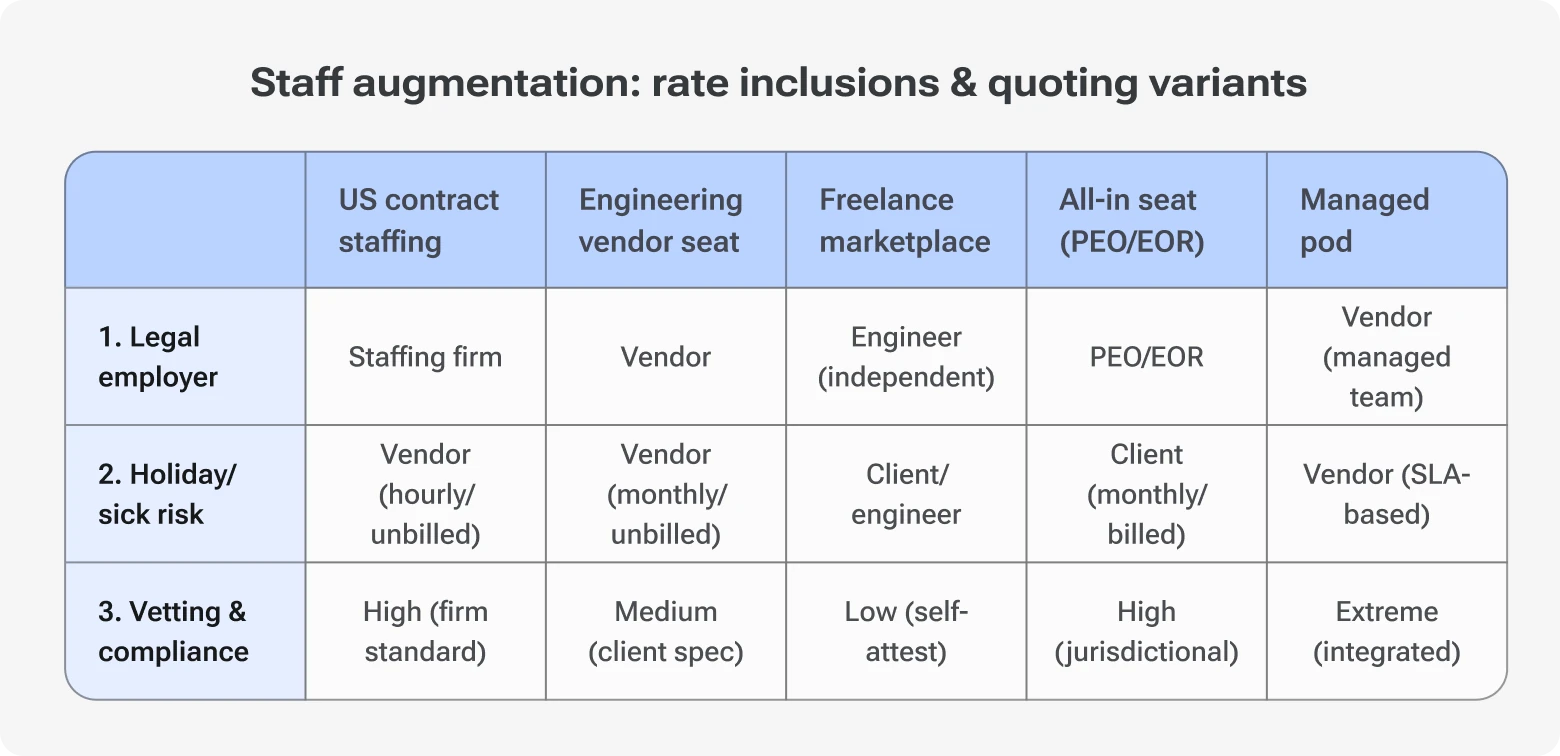
Five pricing variants sell under the same label:
US contract staffing: the agency employs or subcontracts the consultant, and the bill rate covers pay, payroll taxes and benefits. A significant majority of Kforce's roughly 7,800 consultants were its own employees at the end of 2025, per its Form 10-K.
Engineering vendor seat: the vendor employs or contracts the engineer, and the seat price must fund bench time between assignments and any replacement promise.
Freelance marketplace contract: the client buys an individual's hours; Arc says freelancers set their own rates. Vetting, continuity and classification risk shift toward the client.
All-in seat (PEO, EOR or agent of record): compensation, benefits administration and compliance bundled into one price.
Managed pod: adds a lead, QA engineer or delivery manager. Past one or two such roles it is outsourcing and should be priced that way.
Before comparing numbers, list what sits inside and outside each quote: equipment, paid-leave cover, replacement, account management, a team lead's time, security tooling and travel. Revelo's AI/ML salary page, for example, says its all-in figure covers compensation, PTO, holidays and Revelo's margin.
The pricing unit moves risk:
Monthly per seat: holiday and sick-day risk sits with the vendor. Local public holidays do not reduce the invoice.
Hourly: that risk sits with the engineer or the client, and every public holiday is an unbilled day.
The divisor: an $11,200 monthly seat implies $70/hr on 160 hours but $64.62 on 173.3 hours, a 7.7% gap from arithmetic alone. Ask which divisor a vendor used before converting.
Minimum engagement is a pricing term, not a footnote. Revelo runs month-to-month after a 14-day trial and takes a refundable deposit equal to one month of the engineer's pay, credited against the first invoice, per its Colombia salary page. When shortlisting staff augmentation services, ask each provider to name its variant, its hours divisor and its minimum term in writing. To normalize quotes to cost per productive hour, use the method in
Public-company filings give the onshore baseline that vendor estimates cannot. Kforce, which SIA ranks as the sixth-largest US technology temporary staffing firm, discloses three useful numbers:
Bill rate: its COO described a stable average of about $90 an hour over four years on the Q2 2026 call; the 10-K put it at about $89 in Q4 2025.
Assignment length: an average of 10 months in 2025.
Margin: Technology Flex gross margin of 26.8% in Q2 2026; consolidated Flex margin was 26.9%, per its Q2 release.
The worked arithmetic, derived from approximate disclosed averages rather than a Kforce rate card:
Direct cost = bill rate × (1 − gross margin) = $90 × 0.732 ≈ $65.88 an hour for pay, payroll taxes and benefits.
Markup on direct cost = margin ÷ (1 − margin) = 0.268 ÷ 0.732 ≈ 36.6%.
"US staffing firm" no longer means US-delivered. Kforce says its stable average bill rate offsets pricing pressure from a growing mix of consultants based outside the US, it opened a Pune delivery center in 2025, and its consulting work carries margins 400–600 basis points above traditional staff augmentation. Insight Global is opening a second India center. Request location-level rate cards, never a blended rate.
The market has turned. SIA's 2% revenue forecast follows three years of decline, Kforce's Technology Flex revenue grew 4.0% year over year in Q2 2026, and a net 35% of IT staffing firms in SIA's Pulse survey reported rising bill rates over the prior three months.
For the in-house comparison, US software developers earned a mean $148,100 in May 2025, or $71.20 per paid hour. Applying the BLS ECEC split for professional occupations (69.2% wages, 30.8% benefits) gives about $103 per hour worked, before recruiting and management time. Kforce's all-role technology average sits below that developer-specific figure, so compare like roles. Salary inputs live in Software Developer Salaries by Country.
Canada works as a benchmark market, not a savings destination: Arc puts Canadian senior freelancers at $80–$130 an hour against $95–$150 in the US.
Western Europe is a premium market for EU clients and a proximity option for US firms with European operations. Arc's senior freelance bands run $85–$140 in Germany, $80–$125 in the Netherlands, $78–$125 in the UK and $72–$118 in Sweden. Regulation shapes the seat price as much as salary does:
Germany: an embedded engineer taking daily direction from the client can fall under labor-leasing rules. The AÜG caps deployment to the same client at 18 consecutive months and lets collective agreements depart from equal pay only for the first nine months. Leasing disguised as a service contract can create an employment relationship with the client, according to employment lawyers.
United Kingdom: since April 2021, medium and large clients must issue a status determination for contractors working through intermediaries. Agency workers gain equal pay after 12 weeks, and employer National Insurance rose to 15% above £5,000 from April 2025.
Netherlands: the tax authority ended its enforcement moratorium on false self-employment on January 1, 2025, so long contractor seats carry reassessment risk.
The practical consequence: budget the nine-month, 18-month and 12-week triggers into a 12-month seat cost, not the opening rate. Overlap with US Eastern is about three hours from London and two from Berlin at standard local office hours.
Accelerance's Europe senior band ($64–$76) is the vendor anchor, with the labeling caveat above. Freelance bands run $40–$85 regionally, $35–$70 in Ukraine and $40–$80 in Kraków.
The engineer's contract form changes the stack more than the headline rate does. Just Join IT's salary data puts the Polish senior B2B median at PLN 24,780 a month (net invoice) against PLN 21,573 gross on employment:
Employment contract: the vendor adds roughly 20.5% in employer contributions, so the statutory layer is real.
B2B contract: the engineer pays their own contributions, so the vendor's statutory layer falls toward zero. Continuity then rests on the commercial contract, which makes notice periods and replacement terms more important.
Currency: EUR- or PLN-invoiced seats move with the exchange rate.
Ukraine needs continuity terms written for augmented seats. Demand has held: computer services exports reached $3.343 billion in H1 2026, up 4.1%, per National Bank of Ukraine data. Ask for tested backup power and connectivity per engineer, relocation options, and a replacement SLA that applies if an engineer is mobilized.
Overlap with US Eastern is one to two hours at standard local office hours: enough for a standup and a review handoff, not for full-day pairing. Anything more should be written into the SOW as shifted hours.
Vendor context, disclosed: Devico delivers from this region, with 250+ specialists across 14 engineer locations and a company-reported 4.4% turnover rate.
Latin America had the sharpest 2025 decline in Accelerance's data (7.1%), even as rising minimum wages pushed entry-level costs up. For US teams, the all-in seat is the common pricing form, and Revelo publishes both sides of it, drawn from medians of signed placements across 4,000+ engineers:
Mid-level: $58,000 median salary vs about $83,000 all-in (salary ≈ 70% of cost).
Senior: $66,000 vs about $94,000 (≈ 70%).
Senior AI/ML: $72,000 vs about $103,000 (≈ 70%), a 9% premium over the general senior median.
Colombia, mid-level: $60,000 vs about $86,000.
Converted to hourly, the senior all-in seat is $45.19 per contracted hour at 2,080 hours, or $53.41 per productive hour at an assumed 1,760. The salary portion is $31.73 and $37.50 respectively. Revelo's comparison with a "~$160,000" US senior hire and its 30–50% savings claim are vendor benchmarks and are attributed here, not restated as fact.
Who is the legal employer decides who carries the statutory layer, and one vendor's own pages show why buyers must ask. Revelo's regional guide describes an agent-of-record model in which engineers remain independent contractors; its AI/ML page describes PEO co-employment. Get the structure named in the contract. The stakes are concrete in Brazil, where a CLT employee carries employer social security of 20%, an 8% FGTS deposit and provisions for the 13th salary and vacation, per a 2026 cost guide; a PJ contract moves those charges off the payroll and onto the engineer.
Overlap is the product being bought. At standard local office hours, Mexico City, Bogotá, São Paulo and Buenos Aires share six to eight hours with US Eastern. That pays back for embedded standups and same-day code review. It adds little to well-specified async work, where Asian rates compete.
Accelerance's Asia band ($24–$31 junior, $31–$41 senior) is the lowest vendor pricing in its data, with effective rates down nearly 8% and South Asia (India, Pakistan, Bangladesh) as the price leader.
One pattern deserves a question, not a conclusion. The top of Asia's senior band is only 1.3 times the top of its junior band, against 1.9 times in Europe and 1.7 times in Latin America. Ask vendors what "senior" means on the CV they submit.
India: the widest quality spread. Arc puts Indian senior freelancers at $25–$60, while listed IT services firms, mid-size specialists and freelancers price as different products. Attrition is a seat-cost line: last-twelve-month attrition was 13.6% at TCS in the June 2026 quarter, with Infosys at about 13% and Wipro at 13.9% voluntary, per Zee Business. Every departure restarts ramp-up, so ask for tenure on the named engineer.
The GCC route: for multi-year, large-team needs, compare augmentation against building a Global Capability Center. India hosts 2,117 GCCs with 2.36 million staff, per the Nasscom-Zinnov FY2026 estimate.
Philippines: senior freelancers at $22–$50 an hour.
Vietnam: senior freelancers at $28–$60, and $28–$55 in Ho Chi Minh City.
At standard local office hours, none of these countries overlaps the US Eastern workday; India shares three and a half to four and a half hours with Central Europe. For US clients, async handoffs must be designed, or the rate advantage is spent on review latency.
Most rate guides skip Africa, and the public evidence is thinner here than in any other region. No vendor-survey band met this article's bar. Arc's freelance data puts the regional senior band at $25–$60 an hour, Nigeria at $25–$55 and Egypt at $22–$48. This article found no published sample of senior seats for Kenya or South Africa.
The honest read on senior depth is that buyers cannot verify it from public data, so verification moves into the vendor conversation: ask for named senior benches, tenure and prior US or EU client work.
Pay share matters here too. In 2019, TechCrunch reported that Andela received $50,000–$120,000 per developer and passed about one-third to the engineer, under the training-and-placement model it ran at the time.
Time zones: Lagos shares two to three hours with US Eastern and nearly a full day with Central Europe, which suits EU-hours teams. Nairobi and Cairo overlap US Eastern by an hour or less.
Currency: the naira and the Egyptian pound were both sharply devalued in 2023–2024. Confirm the invoice currency and who carries FX movement in engineer pay.
Continuity: ask the same power and connectivity questions as for Ukraine.
The Regional Rate Stack decomposes any staff augmentation bill rate into five layers, so buyers can negotiate the layer that is out of line rather than the headline number:
Layer 1, engineer pay: local gross pay for the seniority on the CV.
Layer 2, statutory employer cost: social contributions and mandated benefits. Near zero in B2B or contractor structures, which shifts continuity risk rather than removing cost.
Layer 3, delivery cost: equipment, paid-leave cover, bench time and amortized recruiting.
Layer 4, vendor SG&A: sales, account management, administration.
Layer 5, margin.
The single diagnostic number is pay share = Layer 1 ÷ bill rate. Keep margin and markup apart: a 26.8% gross margin is a 36.6% markup on direct cost, the most common confusion in rate negotiations.
Three worked senior seats from three business models; every non-disclosed input is labeled:
US contract staffing (Kforce average): $90/hr. Layers 1–2 are $65.88 (73.2%); Layers 3–5 are $24.12 (26.8%). Pay share is at most about 68% ($61.20), assuming employer FICA only; benefits push it lower.
Latin American all-in seat (Revelo senior): $45.19 per contracted hour. Layer 1 is $31.73 (70.2%); Layers 2–5 are $13.46 (29.8%), which Revelo does not split.
European vendor seat: assumes Accelerance's Europe senior midpoint ($70/hr), a Polish senior on employment pay, PLN 3.72 per dollar and 1,800 billed hours. Layer 1 is $38.66 (55.2%), Layer 2 is $7.92 (11.3%) and Layers 3–5 are $23.42 (33.5%). On a B2B contract at the same rate, pay share rises to 63.4% and Layers 3–5 take 36.6%.
A sanity check from engineering services filings: EPAM's 2025 revenue of $5.457 billion across about 56,600 delivery professionals is roughly $96,400 per head, per its Q4 release. Globant's $2.455 billion across 26,906 technology professionals is about $91,200, with a 37.9% adjusted gross margin, per its results. Both are proxies that blend non-augmentation work, onshore staff and utilization gaps, but they show engineering vendors keeping more gross margin than a US staffing firm's 26.8%.
The disclosed anchors cluster at a 55–70% pay share. The stack surfaces two flags:
Thin pay share: Layer 1 too small for the claimed seniority, a churn and substitution risk.
Fat overhead: Layers 4–5 large relative to what the vendor actually delivers, which is negotiable.
Decision rule: ask every vendor for pay share or markup in writing, compare stacks rather than rates.
Once the rate is agreed, these terms move 12-month cost:
Conversion fees: staffing firms charge to convert a contractor to a permanent hire; Kforce books this as conversion revenue within direct hire. Arc calls 20% of first-year salary the standard placement fee. Ask whether the fee declines with tenure.
Trials and replacement: Revelo offers a 14-day trial with no cancellation penalty afterward. Ask who pays for overlap hours when a replacement shadows the departing engineer.
Minimums and notice: asymmetric notice is a hidden cost. At a $15,600 monthly seat, 90 days' client notice against 30 days for the vendor is $31,200 of one-sided exposure.
Rate escalation: with a net 35% of US IT staffing firms reporting rising bill rates, cap annual increases, tie any CPI clause to a named index, and agree how currency movement is shared on non-USD invoices.
Volume and duration discounts: request in writing what a five-seat or 12-month commitment buys. No published discount percentage met this article's sourcing bar.
Enterprise program fees: Kforce's 10-K says MSP and VMS providers charge staffing firms 1–4% of revenue, costs that surface in bill rates. On a $90 seat billed for 1,800 hours, that is $1,620–$6,480 a year.
IP and non-solicitation: confirm the assignment chain from engineer to vendor to client. In the US, work by an independent contractor is not automatically work made for hire, so a written assignment is essential. Check that non-solicit clauses do not block conversion outside the fee schedule.
For seats running a year or more, model these terms line by line before signing. If you hire developers on a seat basis, ask for the terms and the Rate Stack in the same document.
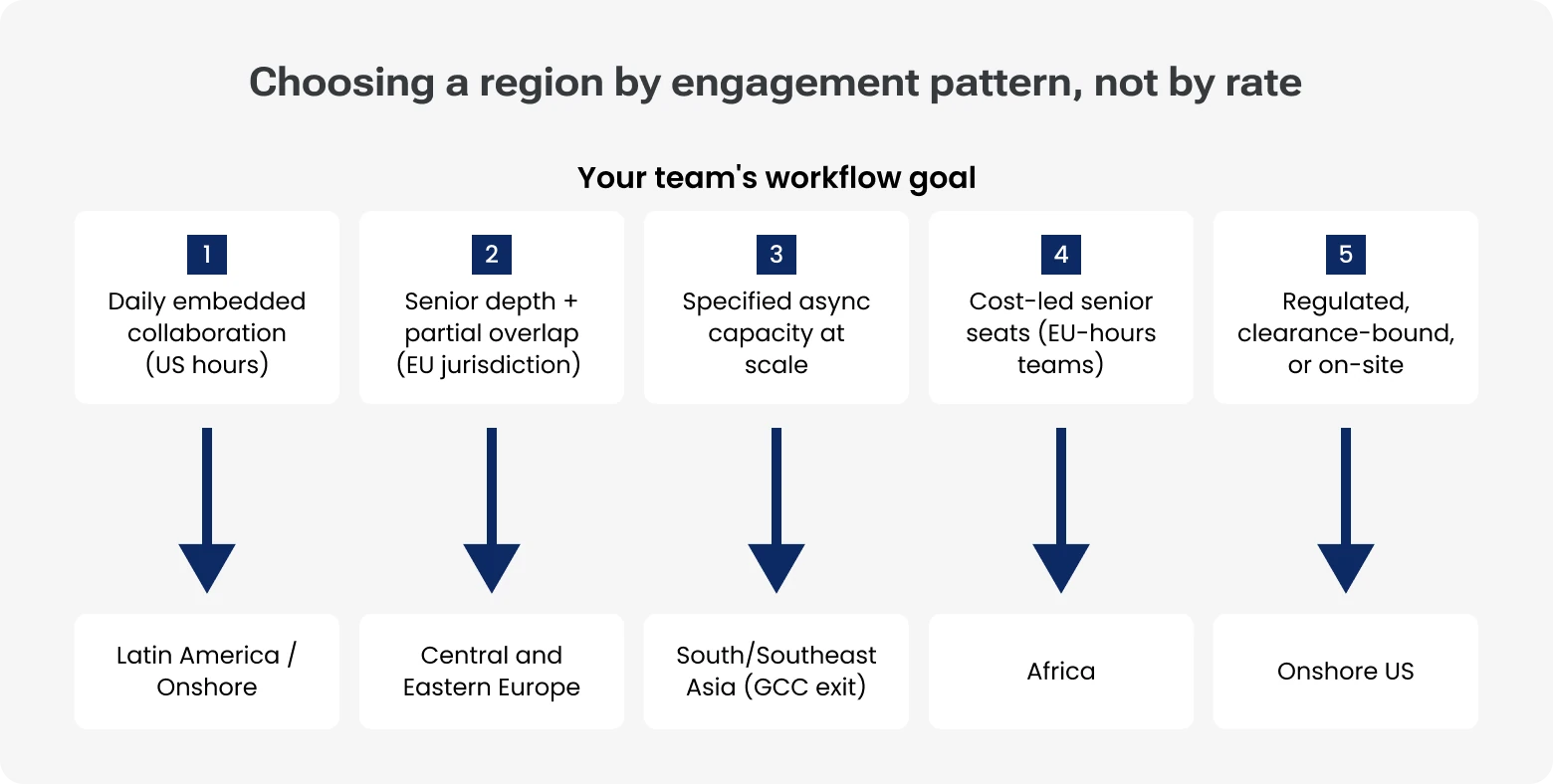
Match the region to how the work actually runs:
Embedded daily collaboration in US hours: Latin America or onshore.
Senior depth with partial overlap and EU jurisdiction: Central and Eastern Europe.
Well-specified async capacity at scale: South or Southeast Asia, with a GCC as the multi-year exit.
EU-hours teams or cost-led senior seats with tolerance for a shallower verified bench: Africa.
Regulated, clearance-bound or on-site work: onshore US contract staffing.
A one-week plan for a live staffing request: send one role specification to three vendors, ask each for its Rate Stack (pay share or markup), compare the contract terms above, then negotiate layers and terms instead of the headline rate. A vendor that will not show the stack has told you which layer to question.
It depends on the pricing unit. Hourly contracts bill extra hours as they occur, and the SOW decides whether a premium applies; a fixed monthly seat covers only the hours it defines. US staffing firms that employ consultants must follow wage-and-hour rules, and Kforce's 10-K flags overtime class actions as an industry risk. Agree on-call rates before the first incident.
Expect repricing. The statutory layer, tax exposure and time-zone overlap all change with the engineer's location, and moving into Germany or the UK can trigger the labor-leasing or off-payroll rules above. Require written consent for any change of work country.
Usually yes, per hour. Vendor overhead in Layers 3–5 is largely fixed per seat, so spreading it over fewer hours raises the hourly price. Check whether the contract sets a monthly hour minimum.
The public evidence covers some regions, not all. Revelo's Latin American senior AI/ML median runs 9% above its general senior median, and Arc's global senior AI/ML freelance band ($110–$190) sits well above front-end work ($55–$120). Ask for role-specific rates rather than applying a blanket multiplier.
Only if the contract allows it. Escalation caps, currency clauses and review dates set the terms. With US IT staffing firms reporting rising bill rates in 2026, buyers should lock escalation terms at signing rather than negotiate at renewal.
The client owns it only if the assignment chain is complete: engineer to vendor, and vendor to client. Revelo, for example, has engineers sign NDAs and IP assignments before day one. Confirm the same for every engineer and every subcontractor.