The Swedish Transport Agency knows firsthand — it’s better to vet a software development vendor twice than deal with the breaches later.
The governmental institution outsourced some IT operations to IBM, which subcontracted them to other EE teams. The Guardian’s investigation revealed: provider teams exposed sensitive data and triggered one of Sweden’s biggest security scandals.
We are not about to blame geography for this “untidy movement”, but rather weak vendor controls and (potentially) unclear screening criteria.
While modern tech leaders know the ROI of Eastern European developers is tangible and proven, many still think that if Romania is a great destination to outsource to, all providers will be worth their money.
Hire software developers in Romania
You won’t make this mistake again, will you? Because you’ve found this guide.
Below, we’ll break down the practical steps for vetting partners across Eastern Europe. We’ll also mention the red flags to spot potential overruns, brittle code, and risks.
Why vendor vetting matters more than ever
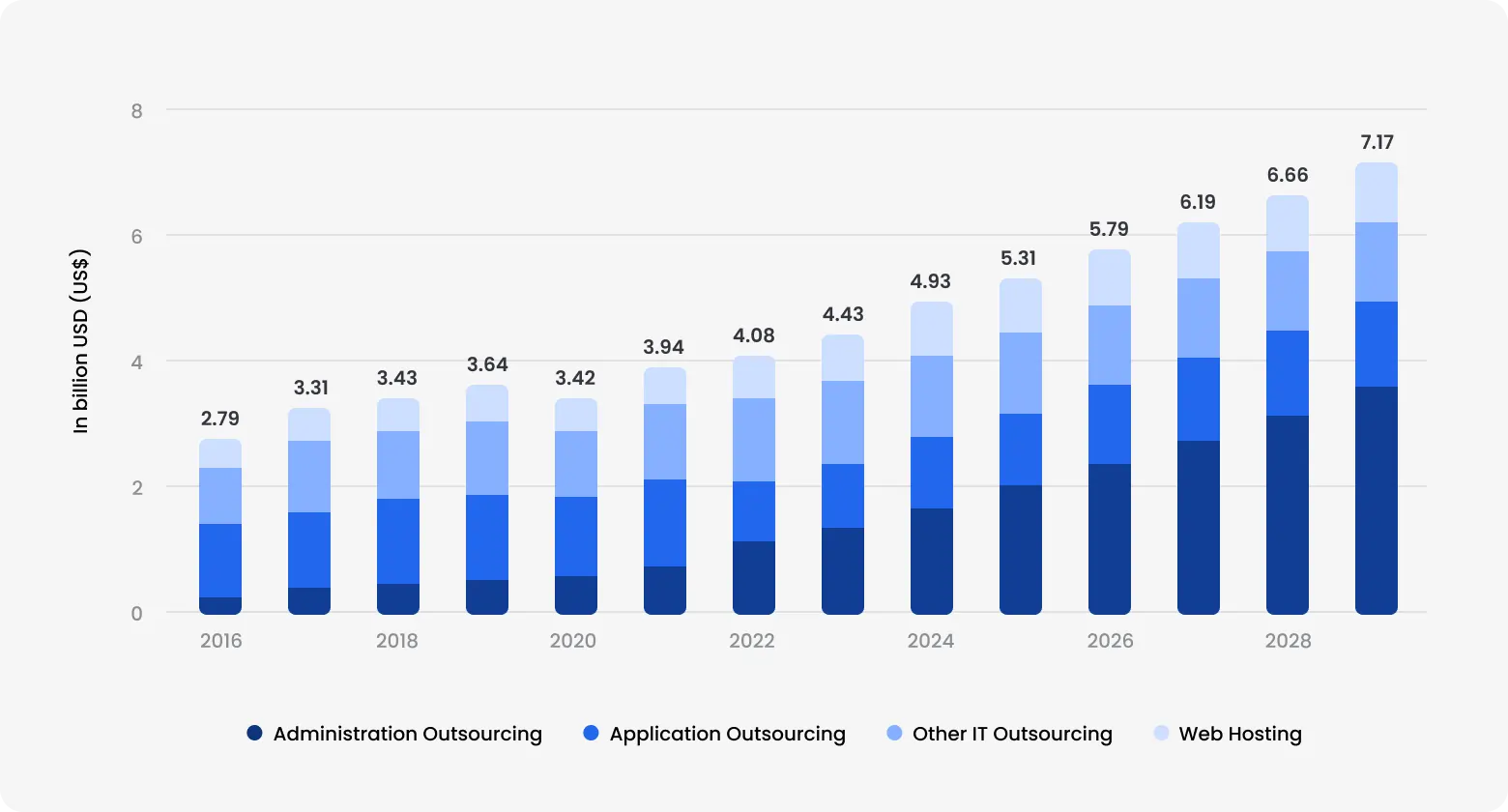
The global IT spending may grow by 7.9% from 2024 by the end of 2025, as per Gartner. Specifically, Eastern European ICT services are expected to hit 17.9 billion by 2029. That’s why we’ve witnessed so many new dev shops, specifically in Eastern Europe’s software outsourcing market.
In other words, you have more options than ever, but the noise-to-signal ratio is deafening.
On the other hand, you may point out the misleading “authority” of worldwide firms. Like IBM. In far 2014, the Australian government outsourced its payroll software to IBM. The project went from AUD 6.2 million to AUD 1.2 billion in budget and brought about court disputes.
The (un)hidden quality gap
The common take in the industry is to start a pilot project (yes, we advised this one as well). And it often makes sense. But modern “cost-cutting times” dictate tech leaders to vet software development vendors more thoroughly and not spend money on pilots later.
Mature vendors build with observability, automated testing, and long-term maintainability in mind.
Less experienced ones often write code that works in moderate conditions but fails under edge cases or high loads.
Example: The TSB Bank failure
TSB Bank migrated its customer data to a new platform built by a third-party partner without sufficient rigor in testing and oversight of the vendor.
The platform locked 1.9 million customers out of their accounts for weeks; 80,000 clients shut down their accounts, and the bank was forced to pay GBP 105.4M in regulatory fines. The total cost was about USD 400 million, including compensation for fraud (yes, fraudsters managed to exploit security gaps).
Main takeaway: The cost is not the primary factor. TSB had an adequate budget, but they still failed because they lacked a partner capable of delivering stability under pressure.
If the provider’s process is broken, your product will be too.
Checklist on how to evaluate a software vendor in Eastern Europe
If you want to hire developers in Eastern Europe, you can use the checklist below to ensure you won’t be misled by a polished surface and won’t be dealing with hidden gaps in the further process.
Technical expertise and stack fit
Your engineering needs come first, the provider’s capabilities second. That’s fair enough. Just change the order, and you’ll spend months compensating for mismatched skills.
What to look for: Do they have production-grade experience with your tech stack? Can they showcase recent and relevant code samples?
Key questions:
“We have the stack X. Can you walk me through the stack-related recent project?”
“Can I review code from your senior engineers?”
Red flag: You notice that your potential partner is a yes-sayer. If they agree to every framework, tool, and timeline you propose without pushing back or asking about trade-offs, they are just selling you bodies.
Industry experience
It’s quite obvious: If you are a newbie to a niche, you need to make heads or tails of it first. On the contrary, deep experience shortens delivery cycles and reduces risks, mistakes, and costs.
Your situation will likely have some nuances, but the general system, requirements, and industry processes remain.
Key questions:
“Have you built products that required [GDPR, HIPAA, PCI-DSS] compliance? How did you handle data encryption at rest and in transit?”
“What specific business metrics did your last project improve for the client?”
Red flag: Amnesia or such. They boast big clients in their portfolio but can't explain the ultra-specific problem they solved or can’t share the client feedback/contacts. If there was an NDA, they could at least try to find an alternative due diligence.
Team seniority
What to look for: Identify the actual team members and their respective seniority levels. Otherwise, bait and switch at its best.
Key questions:
“Who will be assigned from day one, and what is your retention rate for senior engineers over the last year?”
“Can I interview the developers who will be coding for my project?”
Red flag: ‘We’ll assign the team later’ shuffle.
Motivated and focused experts for up to 60% less than locals, delivered in days, not months
Delivery process
Eastern Europe’s software development outsourcing culture usually keeps projects predictable. When we hear “agile”, “cutting-edge”, and “AI-powered” from client-facing teams, we want to go into monk mode. Because jargon without operational detail brings about chaos, missed deadlines, and overusing the budget.
Key questions:
“How do you run sprints, QA cycles, and CI/CD pipelines? Will I have access to Jira board from day 1?”
“What tools do you use for version control, code review, retro, etc.?”
Red flag: Buzzwords that show no real workflow. And when a potential partner offers “weekly updates” on standups or via email.
Communication and time zone
Clarity and responsiveness are among the most highly valuable skills in business. That’s why many leaders hesitate when hiring remote developers in Eastern Europe. Yet, the region showed real maturity for years, and the time zone (UTC +2/UTC +3) only adds up to this.
What to look for: Strong English and structured reporting. Openness to reasonable changes.
Key questions:
“What’s our sync cadence?”
“How do your developers speak up if they see a flaw in the requirements?”
Red flag: A so-called Hero syndrome. They will always burn the midnight oil, building software, but in a couple of months, the entire team burns out, and the quality drops. Also, check their ability to bring up sensitive topics: if a new problem arises, a good provider will speak up and propose a solution proactively.
Security, compliance, and IP protection
There were thousands of breaches in 2025 so far (approximately 11 data losses per day), and even giants have been affected. Even large SaaS ecosystems have been affected, with incidents in Salesforce-related environments via third-party providers.
Considering the average cost of a data breach (USD 4.88M; 10% increase from the prior year), it makes sense to choose a dev partner in Eastern Europe that protects your data and shows how exactly they do this.
Key questions:
“How do you physically secure developer laptops and manage access rights (MDM, 2FA, etc.)?”
“What do your NDA and IP assignment policies look like? Can we make changes?”
Red flag: Incomplete IP clauses without clearly defined terms.
Client references, contacts, and repeat business
Actions speak louder than words, but some words are loud enough, too. If you can manage to get the contacts of the previous clients, this is gold. Also, pay attention to their resales: If clients come back to the potential partner, it’s a good sign. If this info is not under NDA, of course.
Key questions:
“Did any client leave you within the past year? Why did they leave you? Can you introduce me to them?”
“Can I speak to a current client with a similar project size?”
Red flag: Imbalance: when the provider has many textual reviews and can’t hand over any contacts.
Scalability and flexibility
This one is why Eastern European developers are valued so highly. From working bandwidth to project requirements, they usually go the extra mile to overdeliver.
But there is a thing — pay attention to quality. Scalability and flexibility are excellent characteristics, but speed and readiness for a change shouldn’t impact the end product.
Key questions:
“What is your bench size for [INSERT YOUR TECHNOLOGY]? Are there only engineers?”
“What about scaling down? Is it possible without penalties?”
Red flag: Rough and stiff providers may be very organized and consistent, but without flexibility, the project is doomed to failure.
Red flags when choosing a vendor
This may sound seditious, but the most dangerous risk is behavioural, not monetary or technical. We are living in the AI era, and even a schoolboy can fake a code sample.
What they can’t do for long is the working culture. Below is the Eastern Europe software outsourcing checklist, but it’s quite versatile, because working culture is a working culture, wherever we go.
Yes shop. Agree to every framework, tool, timeline, conditions, and are almost ready to marry you without trade-offs. If you feel like the candidate is selling you bodies, he probably is.
Amnesia. “We served Google, BMW, and the Martian ministry.” But if there is no proof and the provider can’t explain the ultra-specific problem they solved (or claim NDA restrictions every single time), you are likely watching a theatrical production.
“Bait and switch” shuffle. “We will assign the team later.” Hearing a similar take? Chances are, it raises a red flag.
Overusing jargon. Scrum, agile, and artificial intelligence — keep an eye on buzzwords in their speech. These words are quite normal, if they are used in the right context, not just to decorate the pitch.
Overestimating one's capabilities. Musk’s syndrome isn’t that good. Ambition is commendable, but if it’s unrealistic, it’s risky. Because chances are, there is poor management under the hood.
“Believe me, brother”. If the potential partner can’t provide a real reference who can speak to a challenge or difficulty they overcame, most likely it’s a trap.
Conclusion
The guide above is probably the shortest go-to instruction on how to choose a software development vendor in Eastern Europe or anywhere else.
But we can cut it even more. A bit abstract, but still: When hiring developers in Eastern Europe, keep it structured, transparent, and never fear open questions.
Use our Eastern Europe software outsourcing checklist to focus on what actually matters — delivery, technical fit, communication, and mature operations.
If you are ready to reduce risk and develop more robust software, book a call with Devico experts. We don’t promise to agree with everything, but we promise to not suggest resolutions before we know your needs inside out.
Great software starts with great people