React development

What to Look for in a React Development Partner
Nov 18th 26 - by Devico Team
How to vet a React development partner, from engineering depth and delivery process to rates, security, ownership, and a weighted scorecard.
Hire
Hire by role
Hire Front-end developers
Hire Back-end developers
Hire Full-stack developers
Hire Android developers
Hire iOS developers
Hire Mobile developers
Hire AI engineers
Hire by skill
Hire JavaScript developers
Hire React Native developers
Hire React.js developers
Hire .NET developers
Hire TypeScript developers
Hire Flutter developers
Hire Golang developers
Hire by country
Devs in Ukraine
Expirienced engineers with strong product focus and fast integration.
Devs in Poland
EU-based developers with reliable delivery and high standards.
Devs in Argentina
Senior engineers with strong technical depth and timezone alignment.

Outsourcing
November 17, 2026 - by Devico Team
Summarize with:
Picture three quotes for the same senior backend engineer: $38, $62 and $140 an hour. The scenario is illustrative, yet none of the numbers is wrong: the first is a freelancer's own rate, the second a nearshore vendor's billing rate, the third a US agency tier.
That is the core problem with software development hourly rates by country: published tables compare different products, so geography explains less of the gap than rate basis, seniority mix, invoice currency and the overhead you carry on your side.
This guide gives you a sourced 2026 benchmark for 17 countries with every figure labeled by basis, a floor test that flags quotes too low to staff a real senior engineer, and a five-step Effective Rate Normalizer that turns any quote into cost per productive hour.
Two market-wide anchors frame the country figures. In Techreviewer's 2026 survey of 127 providers, conducted in January–February 2026, the $30–$49 tier was the largest at 37.8% of firms, and about 90.5% billed under $100 an hour. Clutch's pricing guide, updated May 22, 2026, puts most listed companies at $24–$49. Both samples lean small: 40.9% of Techreviewer respondents work at 10–49-person firms and 0.8% at 1,000+ employee companies, so enterprise pricing is barely represented.
The country benchmark keeps three rate bases separate:
North America and Western Europe (no Accelerance band; onshore benchmark in the section below)
United States: senior freelancers at $95–$150/hr; vendor-published agency tiers run higher still.
Canada: senior freelancers at $80–$130/hr.
United Kingdom: senior freelancers at $78–$125/hr.
Germany: senior freelancers at $85–$140/hr.
Netherlands: senior freelancers at $80–$125/hr.
Portugal: no country-level figure; Arc's Western Europe band is $70–$120/hr.
Central and Eastern Europe (Accelerance Europe band: junior $31–$39, senior $64–$76; Arc Eastern Europe freelance band: $40–$85)
Poland: senior freelancers in Kraków at $40–$80/hr; the national senior B2B invoice median (Just Join IT) works out to about $40/hr across Poland's 2026 working hours.
Ukraine: senior freelancers at $35–$70/hr.
Romania: no country-level figure met this article's bar; price against the regional bands.
Czech Republic: no country-level figure met this article's bar; price against the regional bands.
Latin America (Accelerance band: junior $33–$45, senior $60–$75; Arc freelance band: $35–$75)
Mexico: about $54/hr all-in, from a $57,000 average take-home across seniority levels in Howdy's 2026 benchmarks.
Brazil: about $51/hr all-in, from a $54,000 average take-home, the lowest of Howdy's markets.
Argentina: about $61/hr all-in, from a $64,000 average take-home, the highest; Buenos Aires senior freelancers charge $38–$75/hr.
Colombia: about $54/hr all-in, from a $57,000 average take-home; Medellín senior freelancers charge $35–$65/hr.
Asia (Accelerance band: junior $24–$31, senior $31–$41; Arc freelance bands: South Asia $22–$55, Southeast Asia $28–$65)
India: senior freelancers at $25–$60/hr; vendor-published tiers put Indian agencies at roughly $25–$75/hr.
Philippines: senior freelancers at $22–$50/hr.
Vietnam: senior freelancers at $28–$60/hr; Southeast Asian agencies at roughly $25–$65/hr in vendor-published tables.
Compare rows only inside the same basis: a $64 vendor rate, a $54 all-in employment cost and a $40 freelance rate describe different purchases. And do not expect regions to converge at senior level. In Accelerance's bands the Europe–Asia gap is about 1.3× at junior midpoints but about 1.9× at senior midpoints, so seniority amplifies geography.
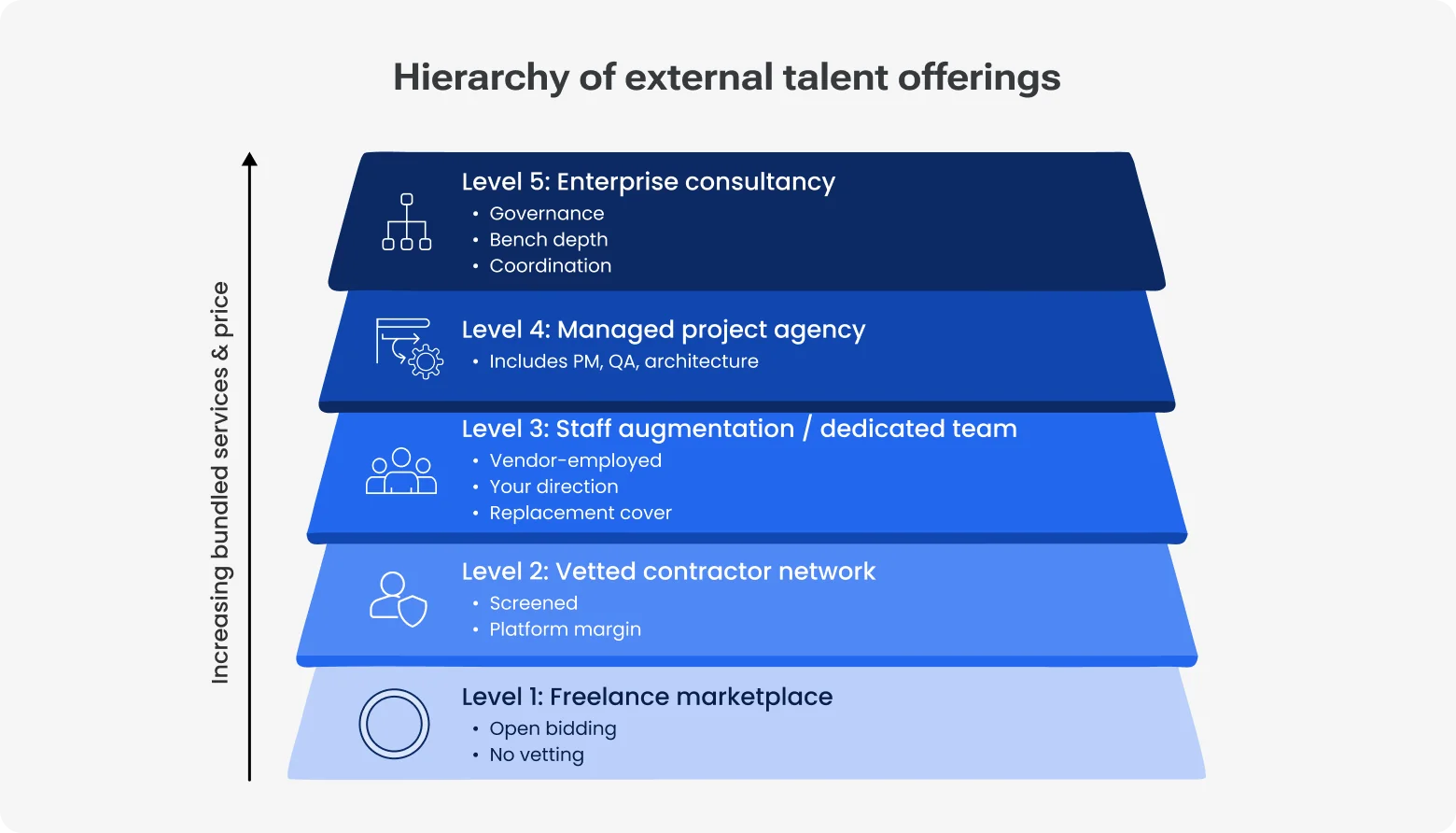
Most published "average rates" merge five different products into one number:
Freelance marketplace: open bidding, no vetting, widest quality variance.
Vetted contractor network: screened individuals; the platform adds a margin on top of the developer's rate.
Staff augmentation or dedicated team: engineers employed or contracted by a vendor, working under your direction, usually with replacement cover.
Managed project agency: delivery ownership, with PM, QA and architecture priced in. Buyers comparing software development outsourcing services are buying this bundle, not hours alone.
Enterprise consultancy: governance, bench depth and coordination sold alongside engineering.
Same geography, different product. Arc's US senior freelancers charge $95–$150 an hour, close to what a US employee costs per hour worked (see the next section), while vendor-published US tier tables compiled in FullStack's 2026 price guide put mid-market development firms at roughly $100–$300 and enterprise consultancies at $250–$500+. Even one engineer carries two prices: in Howdy's payroll data, take-home pay is only about 60% of what the client pays, with roughly a quarter covering benefits and local costs.
Even one publisher's cuts diverge. Arc puts the US and Canada at $82–$130 as a region, US seniors at $95–$150 and San Francisco seniors at $120–$180, and says its ranges blend survey data with marketplace and recruiter observations. Different cuts and methods explain it – and show why a single "Poland rate" misleads.
Seniority moves a quote more than country choice inside a region. In Howdy's 2026 payroll benchmarks, country averages across Latin America span only about $10,000 a year, from roughly $54,000 in Brazil to $64,000 in Argentina, while a senior engineer earns roughly twice what a junior earns in any of those countries. In practice, a seniority mismatch hidden in a quote costs more than picking the "wrong" country within the same region.
Survey composition skews results too: 26.8% of Techreviewer's respondents are US-based and 25.2% India-based. Add currency (USD-quoted versus EUR- or PLN-invoiced rates) and freshness (2023–2024 figures republished under 2026 titles), and a 2–4× spread for one country is normal. Convert every quote to a common basis before comparing, using the normalizer below.
An onshore contractor's rate and an employee's cost per hour worked are different numbers, because the latter includes benefits and paid leave. The BLS publishes both halves:
Wages: software developers (SOC 15-1252) earned a mean of $148,100 a year in May 2025, equal to $71.20 per paid hour, per the BLS OEWS release.
Benefit load: in the June 2026 ECEC release, private-industry compensation averaged $46.89 per hour worked, 30.0% of it benefits. For professional and related occupations, Table 4 shows $73.69 per hour worked, split 69.2% wages and 30.8% benefits, with paid leave alone at 9.2%.
Combined estimate: applying that split to the developer wage gives about $103 per hour worked, roughly $189,000 a year over about 1,836 hours. This is an estimate from two BLS series, not a published figure, and it excludes recruiting, equipment and management time.
Against that $103 benchmark, senior US freelancers charge $95–$150 an hour in Arc's data, on par with or above an employee's loaded cost while funding their own benefits and downtime. Vendor-published tier tables put boutique agencies at roughly $75–$250 and mid-market firms at $100–$300.
Canada, the UK, Germany and the Netherlands are benchmarks rather than savings destinations: their senior freelance ranges ($80–$130, $78–$125, $85–$140 and $80–$125) sit close to US pricing, and contract law adds cost. Since April 2021, medium and large UK clients must decide whether a contractor falls inside the off-payroll working rules (IR35), which pushes compliance cost into agency pricing. German clients running long, integrated freelancer engagements carry false self-employment (
Salary figures for these markets sit in the companion guide, Software Developer Salaries by Country, rather than being repeated here.
Poland. Senior engineers commonly invoice on B2B (self-employed) contracts, which sets the floor any vendor quote must clear. Just Join IT's 2025 salary data puts the senior B2B median at PLN 24,780 a month (net invoice, excluding VAT) against PLN 21,573 gross on an employment contract, a 14.9% B2B premium that widens to 26% at mid-level. Demand is recovering: No Fluff Jobs reported 44% more IT job offers in 2025 than in 2024, with applications per ad down 45%.
Ukraine. Judge continuity on evidence. National Bank of Ukraine data shows computer services exports of $6.66 billion in 2025, up 3.3% year over year, per Interfax-Ukraine, and $3.343 billion in the first half of 2026, up 4.1%, with the US buying $1.234 billion (36.9%), per the IT Ukraine Association. Ask vendors about backup power and connectivity per engineer, engineers already based abroad, multi-country delivery with named backups, and their last major outage.
Romania and the Czech Republic. Both offer EU jurisdiction. Neither has a country-level rate figure that met this article's bar, so price them against the regional bands and compare bench depth in your stack.
Currency. Many CEE vendors invoice in EUR. The euro rose 13.5% against the dollar in 2025 while the dollar index fell about 9.5%, its worst year since 2017. A rate held flat in euros became roughly 13% dearer for a US buyer.
Overlap. At standard office hours, Poland, the Czech Republic, Romania and Ukraine each overlap the US Eastern workday by about two hours. Daylight-saving mismatches add an hour for three weeks in spring (US March 8, EU March 29 in 2026) and one week in autumn.
Best for: senior-heavy teams needing EU jurisdiction and partial same-day collaboration. Not ideal for: all-day synchronous pairing with US teams. Main trade-off: higher rates than Asia for deeper senior benches and shorter review loops.
Accelerance recorded the sharpest regional decline here: rates fell 7.1% year over year in 2025, leaving juniors at $33–$45 and seniors at $60–$75. Nearshore still sits well above Asian price levels, and what the premium buys is overlap.
At standard office hours, Mexico City and Bogotá share six to eight hours with the US Eastern workday, and São Paulo and Buenos Aires seven to eight. A 2024 Organization Science study of 12,000+ employees found each extra hour of time-zone separation cut synchronous communication by 11%. FullStack, itself a nearshore vendor, argues that review latency, not code generation, is the AI-era bottleneck – a vendor view, but consistent with the productivity data below.
Mexico: a $57,000 average take-home in Howdy's data, level with Colombia; proximity and US business-culture overlap make it the default nearshore shortlist.
Brazil: the lowest Howdy country average, at about $54,000 take-home. A CLT employee costs roughly 70–80% above gross salary once INSS (~20%), FGTS (8%) and the mandatory 13th salary are counted, per Oyster HR, which is why seniors often work as PJ contractors and why courts reclassify disguised employment.
Argentina: the highest Howdy average, at about $64,000, with Buenos Aires senior freelancers at $38–$75/hr in Arc's data. The BCRA has run an exchange-rate band regime since April 11, 2025, with bands indexed to monthly inflation from January 1, 2026; year-over-year inflation stood at 31.5% in December 2025. Expect USD-denominated contracts and ask how the vendor pays engineers.
Colombia: a $57,000 average take-home, with Medellín senior freelancers at $35–$65/hr and a growing senior pool.
Senior bench depth varies more by country than rates do, so confirm how many engineers at the quoted level the vendor employs in your stack.
Best for: daily collaboration in US hours. Not ideal for: lowest-cost async capacity. Main trade-off: a premium over Asia that pays back only if your bottleneck is synchronous.
Asia remains the cost leader: Accelerance puts juniors at $24–$31 and seniors at $31–$41, after effective rates dropped nearly 8% in 2025.
India: the largest vendor pool, representing 25.2% of Techreviewer's respondents, and the widest quality spread. Large listed IT services firms and mid-size specialists price very differently; senior freelancers charge $25–$60/hr in Arc's data, and vendor-published tables show agencies at roughly $25–$75/hr.
Philippines: senior freelancers at $22–$50/hr, commonly used for dedicated teams and long-running support and QA work.
Vietnam: 3.9% of Techreviewer respondents; senior freelancers charge $28–$60/hr.
Overlap with US business hours is close to zero at standard local hours, so async operation is a requirement: written specs with acceptance criteria, end-of-day handoffs and overnight review queues with agreed turnaround. Shifted-hours staffing exists; price it explicitly.
Attrition is a cost line. TCS reported 13.6% LTM attrition in IT services for the June 2026 quarter, while Wipro reported 13.9% and HCLTech 12.7%, per Zee Business. Use listed-firm figures as a reference point and ask any vendor for tenure data on the accounts it proposes to staff yours from.
Best for: large, well-specified async scope. Not ideal for: ambiguous product work that needs daily decisions. Main trade-off: the lowest headline rate paired with the highest coordination and specification load.
The three largest datasets disagree on direction:
Accelerance (60 partners): single-digit declines in every major region, including Latin America −7.1%, Asia nearly −8% and Europe −4.4%.
Techreviewer (127 providers, January–February 2026): 48% held rates, 41.7% raised them slightly, 5.51% raised them significantly and only 4.72% cut them.
Arc (5,302 freelancers plus market observations): AI demand has pushed senior pricing up and widened the mid-to-senior gap, with senior freelance rates at $75–$150 globally against $40–$90 for mid-level.
All three can hold at once: Accelerance measures vendor rates, Techreviewer asks a US- and India-heavy sample how their own rates changed, and Arc tracks independent freelancers. Competition can squeeze vendor rates while senior freelance pricing rises, with vendor margin absorbing the gap.
AI is the stated driver, not a proven discount. In Techreviewer's survey, 77.2% of providers named AI tools as a driver of rising rates, up from 28.8% in 2023, and 85.8% adopted new AI tools to stay competitive while only 16.5% hired more developers. The best 2026 evidence on output comes from NBER working paper w35275, which tracks 100,000+ GitHub developers: autonomous coding agents raised commits by about 180%, but that gain shrank to about 50% for projects and about 30% for releases. More code does not automatically mean a cheaper project.
So ask where the vendor's AI efficiency went: a lower rate, a smaller team, a shorter timeline, or retained margin. If none of the first three changed, you are funding the fourth.
Currency often outweighs negotiation. The euro's 13.5% gain in 2025 was larger than any regional rate move Accelerance reported. For EUR-invoiced contracts, FX clauses matter more than a 3% rate concession.
Demand is rebounding, but Poland's 44% jump in offers reflects one job board's methodology; treat any single job-ad figure as directional.
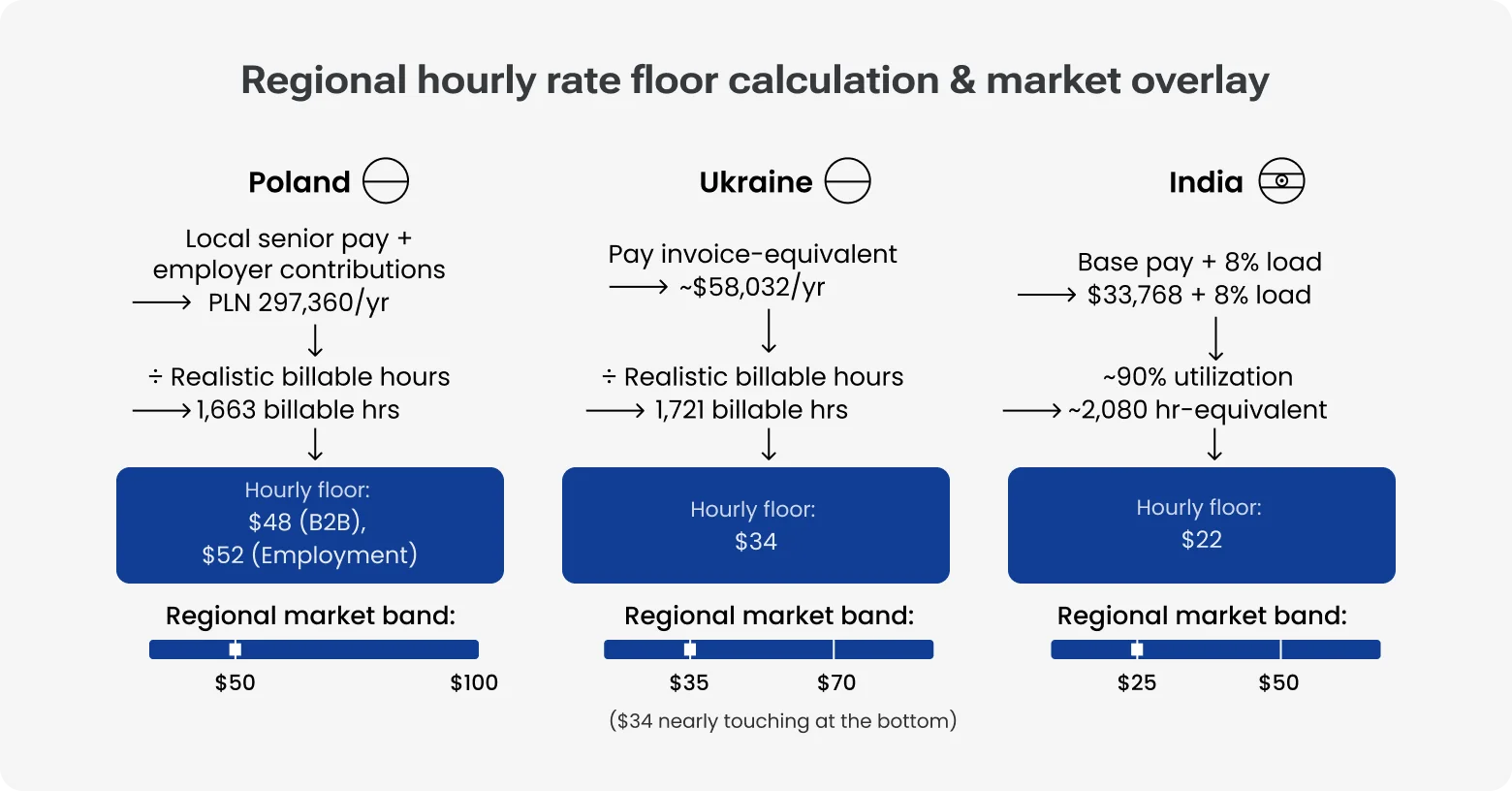
The test in one line: implied cost floor per hour = (local senior pay + employer contributions) ÷ realistic billable hours per year. A sustainable vendor rate must cover that floor plus bench, recruiting, sales, delivery management and margin. No primary source supports a universal markup multiplier, so treat markup as a variable you set.
Billable hours are country-specific: Poland has 2,008 working hours in 2026 after 14 statutory holidays, per 2026 working-time tables, so a global 2,080-hour year overstates capacity.
Worked example, with every input labeled:
Poland (B2B senior): PLN 24,780 a month net invoice (Just Join IT 2025 median), or PLN 297,360 a year. Assuming 20 paid days off and 90% utilization leaves about 1,663 billable hours. Floor: about PLN 179, or $48 at an assumed PLN 3.72 per dollar. On an employment contract, PLN 21,573 gross plus 20.48% employer contributions (ZUS rates) and 26 days' leave gives about $52.
Ukraine (FOP senior): $4,500 a month after tax (DOU, June 2026, via LIGA.net). A third-group FOP pays 5% single tax, 1% military levy and a UAH 1,902.34 monthly social contribution in 2026, per Buhplatforma, so the invoice must be about $4,836 a month. With 22 days off and 90% utilization (about 1,721 billable hours), the floor is about $34.
India (senior): $33,768 median total compensation in Levels.fyi data, which skews toward product companies. Assume an 8% employer load (provident fund at 12% of wages, which must be at least half of remuneration under the Labour Codes in force since November 21, 2025, per K&S Partners, plus gratuity), 30 days of holidays and leave, and 90% utilization. Floor: about $22, lower for services-firm seniors paid below this median.
Against the market, Accelerance's European senior band sits 33–58% above the Polish B2B floor, and Asia's senior band is 1.4–1.9× the Indian floor. The bottom of Arc's Ukrainian senior freelance band ($35) sits almost on the floor, so a vendor quoting $36 for a Ukrainian senior has almost nothing left to fund delivery.
A senior rate below the floor usually signals juniors staffed under senior titles, one engineer split across several clients, churn funded by constant rehiring, or a bait-and-switch after interviews.
Before you hire developers through any vendor, ask for seniority evidence on the named engineer and write a named-seniority clause into the contract.
The normalizer converts any hourly or monthly quote into effective cost per productive hour (ECPH), then compares it to the $103 US onshore benchmark.
Step 1 — Basis. List what the rate includes: PM, QA, DevOps, architecture oversight, replacement guarantee, bench cover. Add missing roles at their own rates. A quote for staff augmentation services often includes replacement and bench cover but not PM or QA; a managed agency usually includes both.
Step 2 — Hours. Convert monthly per-FTE prices using the hours actually delivered under the contract, not a 160- or 168-hour default. Subtract holidays and leave the client pays for but does not receive.
Step 3 — Currency and escalation. Note invoice currency, the annual escalation cap and any FX clause. Stress-test annual cost at ±10% currency movement.
Step 4 — Client-side overhead. Add onboarding ramp, internal management hours per engineer, and review latency driven by the overlap window.
Step 5 — Continuity and policy load. Add expected replacement cost from attrition, business-continuity gaps, withholding or tax exposure, and a HIRE Act scenario line.
Worked example. Three hypothetical quotes; every input is an illustrative assumption, not market data.
Quote A — India managed team: $32/hr on logged hours, PM and QA included, USD invoice.
Quote B — Poland staff augmentation: €5,200 per FTE-month for 160 contracted hours, PM and QA excluded, EUR invoice. Headline: about $38/hr at an assumed EUR/USD 1.17.
Quote C — Mexico vetted contractor: $50/hr, developer only, USD invoice.
Running the steps:
Step 1: B adds 10% for QA and delivery coverage, C adds 20% for QA, PM and self-managed replacement: A $32, B $41.80, C $60.
Step 2: B's monthly fee buys about 1,800 delivered hours after Polish holidays and 26 days' leave, not 1,920: B $44.60. A and C bill actual hours (1,760 a year assumed).
Step 3: a 10% euro stress lifts B to $49.10.
Step 4: a $120/hr loaded manager cost, 12/8/10 management hours per engineer-month, 12%/4%/0% review-latency drag and a four-week half-productivity ramp (+4.5%): A $47.30, B $59.70, C $70.90.
Step 5: replacements cost about 160 hours of output at assumed attrition of 13.6% (A, the TCS reference), 10% (B) and 20% (C), adding 0.9–1.8%.
Output: A $48 (0.47× the US benchmark), B $60 (0.59×), C $72 (0.70×). Every quote rose 44–59% above its headline – the budget moved far more than the ranking. Raising A's latency drag to 25% lifts it to $52, still below B.
HIRE Act scenario. If the bill passed as drafted, vendor payments would lose deductibility and carry a 25% excise tax while client-side overhead stayed deductible. After tax, A rises to 0.65× the US benchmark, B to 0.86× and C to 1.04× – costlier than an onshore employee. The ranking holds, because the bill targets offshore payments, not particular countries.
Decision rule: shortlist countries on ECPH and required overlap, never on headline rate alone.
The HIRE Act (S. 2976) would impose a 25% excise tax on outsourcing payments for services benefiting US consumers and deny deductions for those payments, per the congress.gov summary. Introduced by Sen. Bernie Moreno, it was referred to the Senate Finance Committee on October 6, 2025, which remains its latest recorded action: a proposal, not law. The circulated math assumes a 21% federal corporate rate and ignores state taxes: a $100 deductible payment costs about $79 after tax today and $125 under the bill, a 58% increase. As drafted, it has no carve-out for payments to foreign affiliates, per RSM.
Misclassification. Contracting individuals directly creates exposure under UK IR35, Poland's B2B rules and Brazil's PJ reclassification case law. An Employer of Record moves that risk but adds a fee line: Deel lists EOR from $599 per employee per month, or $7,188 a year, about 10% on a $70,000 salary.
Commercial terms that move total cost include escalation caps and their reference index, currency locks or FX-sharing bands, minimum terms and notice periods, replacement SLAs with a maximum gap, and named-seniority clauses tied to the interviewed engineer.
IP and data. Confirm IP assignment flows from each engineer through the vendor to you. For EU-to-US transfers, the EU–US Data Privacy Framework was upheld by the EU General Court on September 3, 2025, per Jones Day, though further litigation before the Court of Justice keeps it open to review. A vendor's SOC 2 report or ISO 27001 certification supports audit controls; it does not guarantee outcomes.
The decision starts with the operating model:
Daily collaboration in US hours: Latin America.
Senior depth, EU jurisdiction and partial overlap: Central and Eastern Europe.
Large, well-specified async scope: Asia.
Regulated, on-site or clearance-bound work: onshore.
Blended models often beat single-country choices: an onshore tech lead with nearshore or offshore capacity keeps decisions in US hours while pricing execution lower. For multi-year teams, Build-Operate-Transfer lets a vendor stand up a team and hand it over once stable.
A one-week plan:
Day 1–2: send one role spec to three vendors in different countries and require rate basis, inclusions and named seniority in the reply.
Day 3: run the floor test on each senior rate.
Day 4: normalize all three with ECPH, using your own management hours and overlap needs.
Day 5: negotiate on escalation caps, currency terms and replacement SLAs before discussing headline rate.
The strongest vendor response is a transparent rate breakdown that shows salary or invoice, contributions, bench and margin line by line. Ask for one before the first interview.
On headline vendor rates, Asia: Accelerance puts senior rates there at $31–$41 an hour. Cheapest headline is not cheapest delivered, though. Near-zero US overlap and specification overhead can lift effective cost by half, as the normalizer example shows.
A US developer employee costs about $103 per hour worked on BLS data. In the illustrative normalizer, offshore and nearshore quotes landed at 0.47–0.70× that benchmark after client-side overhead. Those are real savings, but smaller than a headline rate comparison suggests.
It depends on the rate basis. Managed agencies usually include PM and QA; staff augmentation and vetted contractors usually do not. List inclusions in writing and add missing roles at their own rates before comparing.
Inside a region, stack and seniority often matter more. Arc puts senior AI/ML freelancers at $110–$190 an hour against $55–$120 for front-end work, and Howdy finds seniors earn roughly twice what juniors do in every Latin American market while country averages differ by only about $10,000.
There is no statutory benchmark. Tie any escalation cap to a named wage or price index, and set it against evidence: 48% of Techreviewer's providers held rates for 2026. For EUR-invoiced contracts, agree how currency movement is shared, because 2025's 13.5% euro gain dwarfed typical rate increases.
Terms beat headline discounts: escalation caps, currency locks, replacement SLAs and named-seniority clauses. So does asking where AI efficiency went — rate, team size, timeline or margin — given that 77.2% of providers cite AI as a rate driver.
React development
Nov 18th 26 - by Devico Team
How to vet a React development partner, from engineering depth and delivery process to rates, security, ownership, and a weighted scorecard.
React development

Nov 16th 26 - by Devico Team
React and TypeScript best practices for scalable apps, from feature folders and state ownership to typed APIs and monorepo governance.
React development

Nov 13th 26 - by Devico Team
How to test large React applications at scale, with a confidence-based test pyramid, toolchain picks, and an ownership matrix for shared code.