Globalization is the hallmark of our time. Open your fridge, and you'll probably spot products imported from different countries. Open your Slack, and there you'll definitely find teammates from different corners of the world.
That's how businesses work today. Many tech companies ramp up their teams through outsourcing, particularly nearshore outsourcing. In fact, the nearshore software development services market is experiencing significant expansion and is expected to grow at a CAGR of 12% from 2025 to 2033.
Naturally, for companies based in the USA or Canada, the most popular nearshore destination is Latin America. The region offers time-zone overlap, top-notch talent, a strong digital ecosystem, and lower costs. But those benefits materialize only when management practices are intentionally designed for cross-border collaboration. Feel like you're not quite there yet? Read our guide that explains how to efficiently manage nearshore development teams in Latin America, covering key challenges, communication strategies, and best management practices.
Understanding nearshore outsourcing
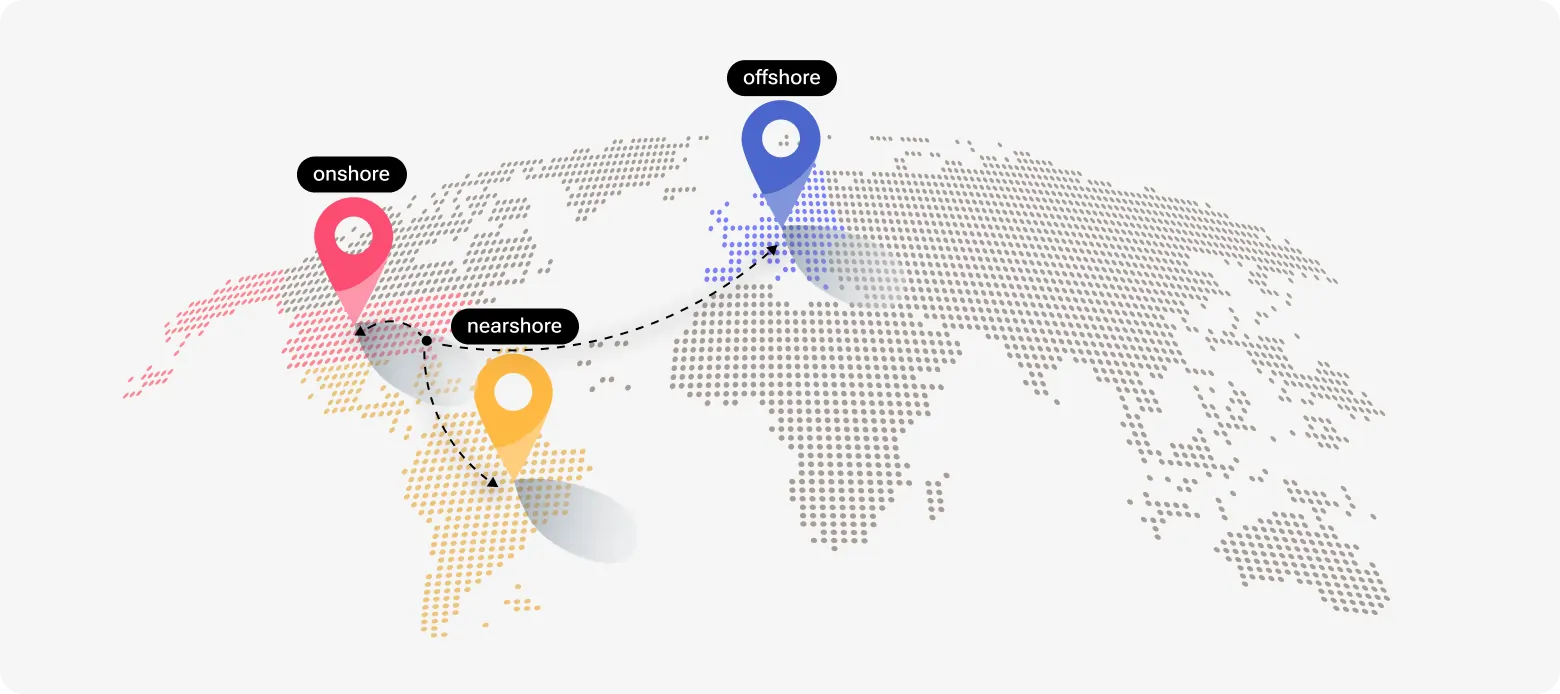
Depending on geography, companies can outsource tech staff in 3 different ways. First of all, a company can partner with an agency or dedicated teams elsewhere in its country. That's onshore outsourcing. The biggest upside here is the same culture, legal environment, and time zone. The tradeoff, of course, is cost.
To reduce costs, many companies look across the ocean, opting for offshore outsourcing. This model suggests working with teams in more distant locations, for instance, India or Eastern Europe for North American companies. While offshore outsourcing brings great savings, it also usually introduces process slowdown and more coordination effort because of a significant time zone difference.
Nearshore outsourcing is a sweet spot as it lets you extend your team with less expensive engineers in a nearby country, usually with a minimum or even zero time difference. Therefore, Mexico, Colombia, Argentina, Brazil, and Costa Rica are popular nearshore hubs for businesses in the USA and Canada.
The complete guide to software development outsourcing in Latin America
Onshore vs. nearshore vs. offshore
The real value of nearshore outsourcing isn't just lower costs or faster hiring, though both are nice bonuses. It's that distributed collaboration feels less distributed.
When managed well, nearshoring gives you:
4–8 hours of daily overlap
better cultural alignment
The model works especially well for Agile or Scrum teams. With a large workday overlap, teams can handle standups, sprint planning, backlog refinement, design reviews, and incident response in real time instead of pushing every dependency conversation into the next day. That possibility of same-day clarification immensely speeds up workflows.
So no wonder so many North American companies take advantage of nearshore development in Latin America. This is about convenience, efficiency, talent availability, and, of course, budget friendliness.
Common challenges when managing nearshore teams
As mentioned above, nearshore outsourcing in Latin America offers great conditions. Yet, companies that underestimate the management layer may still face difficulties over time. Here are the most common challenges:
Communication gaps
It's a big mistake to think that overlapping working hours automatically solve all communication issues. In fact, in many cases, problems come from not a time difference but from poor operating discipline.
The real danger often hides in:
unclear backlog priorities
vague acceptance criteria
undocumented architecture decisions and product requirements
The survey shows that 41% of developers cite unclear project requirements or scope changes and miscommunication with colleagues as the top reasons for redoing work.
So, all team members may be online at the same time, but if everyone walks away from sprint planning with a slightly different understanding of what needs to be done, this results in rework and slower speed.
Treating your external team like ticket executors
Excluding LatAm developers from roadmap discussions, design reviews, etc., and just assigning tasks to them is a bad approach.
At first, everything looks good: tickets move, velocity is satisfactory, and sprint dashboards stay green.
But over time, developers become task takers instead of problem solvers. They execute what is asked, not what is needed, and this is where delivery quality begins to slip.
When a nearshore team is cut off from the bigger picture, problem-solving fades, as well as ownership and innovation, even though they are so vital for long-term product success.
Yet, the damage is not limited to the development process itself. It also affects team motivation.
The best engineers in Latin America aren't excited about the role of ticket executors. They want the same things your in-house senior engineers want:
visibility into why something matters.
In fact, survey findings showed an interdependence between participation in decision-making and team performance, suggesting that PDM is a key component influencing team performance.
Cultural communication differences
Latin American engineers are often highly collaborative, thoughtful, and diplomatic communicators. That's a strength, but at the same time, this can result in unintentional softening of important risks, which can be a problem if your leadership listens for direct red flags only.
Blockers may be softened instead of escalated, and people may wait for permission before challenging the scope.
The best way to avoid this is to reward early risk surfacing instead of treating it negatively. Let the team know from the very beginning that raising a concern earns trust instead of blame.
Weak onboarding
You cannot expect a fast contribution from a nearshore team that gets from you only Jira access and a kickoff call.
For external engineers to become productive quickly, onboarding should include:
architecture walkthroughs
domain-specific edge cases
Without this, even top senior engineers spend their first month reconstructing the project's logic from breadcrumbs. You, in turn, lose time and money, and this isn't a talent issue but an onboarding issue.
🎧Listen to the Devico Breakfast Bar episode with Tony Jamous, co-founder and CEO at Oyster, who shares how to cultivate a strong remote work culture for sustainable growth
Hire software developers in Latin America
The best practices for managing a nearshore development team in Latin America
Nearshore team management may not always be smooth, yet if you know the key pitfalls and have prepared for them, it becomes far less stressful.
The best practices that we share below are just a part of that preparation.
1. Building one blended team
If you are aiming for long-term results, avoid an 'us vs. them' structure, where your in-house engineers discuss plans and trade-offs while the LatAm team only receives implementation tickets.
Having these two disconnected realities, you'll eventually struggle with low morale and a lack of problem-solving, ownership, and innovation within the LatAm team. Nearshore engineers become less autonomous, which negatively impacts productivity, as a neurophysiology study showed.
The best model is setting up a blended product squad with shared
This way, everyone works toward the same outcomes, participates in the same discussions, and is accountable for the same results.
By making no distinction between local and external engineers, you'll feel nearshoring less like outsourcing and more like scaling. This improves trust, speed, and product understanding.
2. Using time overlap for synchronous decision-making, not reporting
One of the biggest strategic advantages of nearshore software development in Latin America is real-time collaboration.
Yet, it's often underused.
Many teams fill overlap hours with status updates and routine reporting, which can actually be easily handled asynchronously. As a result, the most valuable part of the workday is spent on low-impact communication.
To get more efficient, keep decision-heavy work live.
Instead of passive updates, use your shared hours for:
release go/no-go decisions
production incident handling
When teams resolve issues while the context is still fresh, they avoid unnecessary back-and-forth, reduce misalignment, and keep work moving without unnecessary delays.
It's worth remembering that in nearshore collaboration, speed doesn't come from working more hours but from making the right decisions at the right time, together.
3. Making expectations impossible to misread
This rule can be applied to managing in-house and nearshore teams, as both thrive on clarity. Ambiguity, on the contrary, is a time eater and cost driver. Productivity Coach Ciara Conlon names lack of clarity as one of the chief sources of dysfunctional and poor performance.
To gain maximum efficiency, everyone on the team should have a shared understanding of 'done.' The best way to ensure this is to document the non-negotiables, like the following:
deployment approval rules
Along with this, we'd advise you to provide examples of excellent work instead of only documenting rules. The thing is that people replicate patterns much faster than pure policies. That's why a well-written ticket, a clear PR description, or a thoughtful incident postmortem shows the expected level of detail much better than a checklist ever could.
Yet, even with comprehensive documentation, edge cases will show up, and your team should be ready for the situations when things aren't clear. So they should know when to proceed, pause, or escalate.
It helps to define in advance:
when to move forward independently and when to ask for clarification
how quickly blockers should be raised
who makes the final call in ambiguous situations
what level of risk is acceptable without additional approval
All in all, the goal is to eliminate guesswork. The less your remote development teams in Latin America have to assume, the faster and more efficiently they deliver.
4. Putting technical leadership on both sides
When it comes to a dedicated team or project-based outsourcing in Latin America, having tech leadership internally and on the nearshore team's side is the easiest way for you to keep management under control.
With an internal EM or Head of Engineering and a local nearshore tech lead or delivery lead in LatAm, you can ensure maximum efficiency.
The idea isn't just introducing two-layer leadership, but splitting responsibilities between them properly.
The mission of an internal tech lead is to see the big picture and monitor whether the nearshore team builds the right product while taking into account the long-term goals.
Their responsibilities usually cover:
defining tech direction and architecture
coordinating engineering work with product goals
setting priorities and success metrics
making final decisions on complex or high-impact tech trade-offs
The nearshore tech lead, in turn, is closer to execution and is accountable for:
managing day-to-day tasks based on high-level direction
Identifying delivery risks
clarifying vague requirements
keeping feedback loops fast
Thanks to internal leadership focusing on strategy and nearshore leadership handling execution and team dynamics, decisions don't bottleneck, communication becomes more efficient, and issues get resolved faster.
What you should know before outsourcing to Latin America
5. Measuring performance and productivity
When your nearshore LatAm team has gotten onboarded, it's time to initiate performance tracking. The key thing here is to do this without turning management into micromanagement. That's actually where companies often fail.
First of all, we recommend you avoid tracking individual metrics. In nearshore settings, this quickly results in distrust and internal competition. Engineers subconsciously start optimizing for visibility rather than impact. This hardly ensures better results.
A more efficient approach is to measure performance at the team level. In this case, folks instinctively focus on common goals, delivering faster, introducing fewer defects, and improving release stability. Moreover, this also fosters collaboration instead of competition, making the atmosphere in distributed development teams more friendly.
So, which metrics should you actually track? Use a mix of delivery and quality metrics, such as:
velocity -- the volume of work completed within a sprint
lead time -- the total duration from a task being defined to it reaching production
cycle time -- the time a task spends in active development
deployment frequency -- the regularity of production releases
escaped defects -- the number of issues identified after release
MTTR (mean time to recovery) -- the time required to restore normal operation after a production issue
rework ratio -- the share of work that needs to be revised or redone
The important nuance is evaluating all these metrics together, not individually. Only this way patterns get visible.
For example, a team can close a lot of tickets but still struggle with long lead times. Or they can release frequently but witness a rise in escaped defects. Looking at the big picture helps avoid wrong conclusions and keep discussions reality-based.
6. Making ownership visible
Define ownership beyond delivery, and your nearshore team will have higher performance.
Unfortunately, it's a common practice when responsibility ends at merge completion. Once the code is in production, the feature becomes someone else's problem. That's where gaps appear.
To avoid this, ownership needs to be explicit and extend past release. It should be clear who is responsible for:
customer-reported defects
When ownership goes beyond deployment, behavior changes. Engineers start thinking more carefully about edge cases before release. They write clearer documentation as well as pay more attention to observability and logging. And when something goes wrong, there is no need to pull them in -- they are already aware and involved.
Introduce this approach, and you'll notice improvement in both quality and accountability.
7. Investing in relationship capital
Latin American engineers are often highly collaborative and loyal when treated as long-term partners, not just as external contributors
You see, people aren't robots. Even in highly technical environments, day-to-day collaboration is shaped by common human factors like trust, familiarity, and the comfort to speak up when something goes wrong. In these terms, simple practices can improve interpersonal communication in distributed development teams. For example, you can introduce:
cross-team learning sessions
in-person quarterly visits
public recognition in company meetings
It's a well-known fact: when people know each other even a little outside of daily work, communication becomes more relaxed. That's how trust and psychological safety gradually build. Questions get asked more easily, feedback becomes more direct, and issues are raised before they turn into blockers.
The research revealed that teams with high psychological safety have:
So, invest in relationships, and it will pay off in delivery, not just team mood.
Conclusion
Latin America offers exceptional tech talent density for North American companies. Add to this cost savings and time-zone overlap, and you get a great combo for nearshore software development.
However, these advantages work only when management is done right.
Of course, managing nearshore teams is easier than offshore, but it still requires discipline. A lot of factors matter here, from clear communication and space for autonomous decision-making to building trust with external engineers.
If you consider software development outsourcing in Latin America, Devico can help you access top talent, choose the right collaboration model, structure a team properly, and put the right management practices in place to make nearshore development as smooth as possible.
Motivated and focused experts for up to 60% less than locals, delivered in days, not months