9.8 million people were working in the ICT industry in 2023 across the EU. You may say that Westerns hold primacy, with Sweden having the biggest share, and you’ll be right. Partially.
Because if we consider at least the core Central and Eastern European countries, we’ll get an extremely rising share of that pool.
Many tech leaders across Western countries choose IT outsourcing in Eastern Europe – Poland, Ukraine, Romania, and others – proving the region’s fame for fintech backends, knack for cybersecurity, and experiments with emerging technologies.
These countries are losing their ground as “cheap labor” and gaining ground as a balanced and wise choice. Polish providers are GDPR-compliant and have reasonable rates, 35-70 USD/hour for mid-level engineers. Romania embodies a promising investment as this hub is making a headway. And Ukraine teaches proper and missile-proven BCPs.
A CTO who treats Eastern European outsourcing as just a “low-cost” option will overpay in rework and mis-hires. A CTO who understands the “tones and shades” of countries, vendor types, and commercial models will reduce time to production and cut total costs.
Read further to learn everything you need before outsourcing software development to Eastern Europe: the benefits, actual rates, and potential risks.
Motivated and focused experts for up to 60% less than locals, delivered in days, not months
Why Eastern Europe is a global outsourcing hotspot
The first reason is a deep, educated talent pool, and the second is proven delivery maturity. The regional leaders understand that their main leg-up in recent years was software development. And outsourcing in Eastern Europe hugely depends on STEM education, R&D infrastructure, and the ability to overdeliver.
Education past still impacts the modern workforce
The system runs on direct partnerships. Large tech employers understand that without skilled youth their business is doomed to failure. That’s why they invest in university graduates early: create bootcamps and offer comprehensive internships.
Another side of this is university rankings. Like the following one.
-
Charles University in Prague (Czech Republic): #265 globally
-
University of Warsaw (Poland): #271 globally
-
Czech Technical University in Prague (Czech Republic): #416 globally
-
Warsaw University of Technology (Poland): #487 globally
-
Babes-Bolyai University (Romania): #761-770 globally
5 popular private tech schools:
-
EPAM Campus (entire Eastern Europe): Courses in Java, .NET, JavaScript/Front-End, Automated Testing, DevOps, Business Analysis, and more. Students can read blogs and self-study materials, choose relevant internships, or dive into a practical project.
-
Codecool (Hungary, Poland, Romania): Apprenticeship model, guided by mentors, covers Linux, Python, JavaScript, HTML, Java, C#.
-
Mate Academy (Ukraine, Poland): Free ICT courses with an afterpay system: if you’re hired, you have to pay from your salary.
-
42 Prague (Czech Republic): Free-of-charge curriculum based on a peer-to-peer learning model with gamification.
-
Coders Lab (Poland, Romania): Full-stack web development, software testing, and other ICT courses.
English as-a-second-but-strong-language
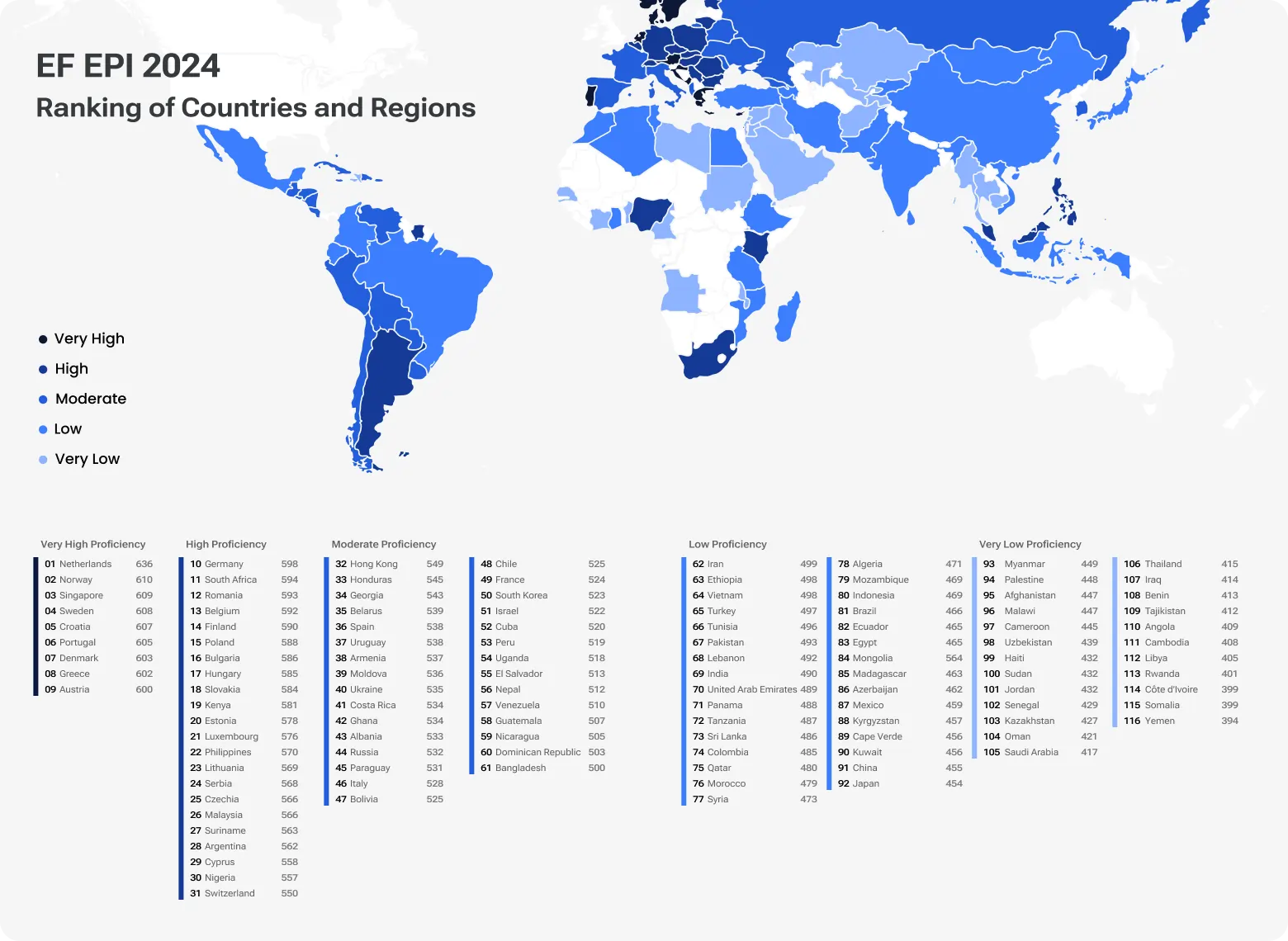
The EF English Proficiency Index 2024 includes Poland (#15), Romania (#12), and Hungary (#17) in the world’s most proficient countries.
This means more team members on the provider’s end will easily communicate, understand the project deeper, and will be able to express the nuanced approach to even a unique solution.
Cultural compatibility and time zone
Another aspect you may need to accept is the working culture in Eastern Europe. Software outsourcing implies people with different norms and understanding of the finished work.
With EE, this is much simpler since the region commonly shares professional culture with Western EU and US companies. Easier to predict, faster to strike a deal on any matter.
On time zones. Eastern Europe is 1-2 hours behind Western countries and is 6-8 hours behind the East Coast US. Prepare yourself for both synchronous and asynchronous work.
Mature vendor ecosystem
For several years, software development outsourcing in Eastern Europe has been a complete, “self-reliant” market. Not a freelancer marketplace, not unconnected companies without consistent working patterns.
The regional outsourcing industry has a leg up over the Western one: the local market has 3.9 ICT companies per 1,000 residents (Western Europe has 2.1). Additionally, many firms are certified under ISO 9001 and 27001. Eventually, this translates into structured engineering processes, transparent pricing, and predictable scaling.
What you need to know before you start
Once a small automation team in Romania scaled into a globally recognized company. Forrester titled it a leader of the RPA market. And all this is made possible by a proper understanding of the local market. UiPath’s story proves that “cheap vs expensive” considerations are too limited and can’t contain the range of local nuances and strengths.
It’s not a single market
Eastern European outsourcing is not a single product or service, it has nuances, shades, and ranges. Poland, Romania, Ukraine, Bulgaria, the Czech Republic each have different contractor markets, legal regimes, tax models, and pitfalls in labor laws.
You have your beacon: low sticker price, culture similarity, specific stack expertise, or any other aspects. So, your task now is to dive deeper into local markets to make things match. Otherwise, there are reworks, delays, and a bloated total cost of ownership.
Pay special attention to legal and commercial variance — contractor B2B models, employment laws, and IP assignment practices differ across EU members and especially non-EU markets.
Developer rates are widely rising
Senior engineers will cost you USD 50-90 per hour in mature companies. Mid-level rates are clustering in the USD 25-55 band. You can rely on cheaper juniors, but they require heavier management and double-checks. Another factor is taxes. Poland has a 19% VAT, and Ukraine has a 5% IT special legal regimen.
Here are some practical differences: Poland and the Czech Republic are at the higher end, while Moldova and some Ukrainian cities still remain more affordable. What is stable is that rates depend on stack, seniority, and vendor size.
Geopolitical risks exist (spoiler: they are manageable)
Russian aggression creates real risk: Many Western tech leaders think Russia won’t dare escalate its offensive. Yet, their drones have already entered the airspace of EU countries several times. So, any Western client should be prepared for potential disruption and supply constraints.
How to prepare: Probe a written business continuity plan, ask vendors for geo-redundant staffing (teams in 2+ Eastern European countries), verify backup power/internet arrangements, and include explicit clauses for force majeure and continuity SLAs.
This is not just about ensuring stability. This way, you rather execute a reality check and test the provider’s accurate perception of the situation.
Culture fit still matters
You’ll likely have no difficulties in mutual understanding with service teams as Eastern Europe’s outsourcing companies align well with Western business culture.
Locals are well-educated, prefer direct, task-oriented communication, and are used to Agile alongside other methodologies.
Additionally, language mastery. The EF English Proficiency Index 2024 proves that key outsourcing hubs in the region have sufficient proficiency to do business with American, British, and Western European companies.
A key nuance to consider before outsourcing to Eastern Europe is that an engineer-led culture is generally preferred. If you asked us about their working values, we’d list technical clarity, explicit acceptance criteria, and full ownership.
So, prepare your product/project managers to provide explicit requirements and documented acceptance tests.
Vendor maturity ranges
The local market has been operating for decades, that’s why you will find any level of delivering maturity here, from two-person consultancies to large ISO-certified delivery centers. Global tech providers ensure consistent delivery and, which is also important, process perfection: SLAs, security compliance, QA pipelines, ramp capability — when you pay, you get accordingly.
Make sure to check the following:
Proven multi-year client relationships
Published KPIs on delivery velocity and defect rates
Also, it’s always a good idea to ask for a recent case study showing ramp from 2 to 20 engineers (target is ~90 days), a sample onboarding plan, and retention metrics for the roles you care about.
Common mistakes to avoid
We can’t help but admit: even if you hire a well-known firm, the project can fail. The public sector healthcare provider, Queensland Health Australia, outsourced app development to IBM.
The initial ~ USD 6 million budget was exceeded by the end of the year. IBM had “slightly adjusted” it to USD 27 million. 4,5x rise-up — not bad, innit?
Things went even worse when they started delivering. Eventually, a $1.2 billion cost with over 35,000 payroll mistakes.
Below are common pitfalls to consider before IT outsourcing, whether in Eastern Europe or other regions.
Choosing purely based on price
We all have to cut costs, not a walk in the park in today’s economy. Yet, the lowest bid often brings about subpar code and hidden costs.
A conditional 30 USD/hr team saves upfront but spends double on fixes for sloppy components. We notice rates in Eastern Europe are rising, averaging USD 40-80 per hour.
Tip: Always benchmark against delivery history. Compare rates with defects or release circles.
Not validating the provider’s technical leadership
Don’t skip the leadership check and their managing style. This hugely impacts development teams: how quick they are on the uptake, how motivated they are, what the level of burnout risk. So ask for lead bios and evaluate past projects through leadership lenses. Only 14% of employees fully understand the direction of their company. How can they understand your goals and strategy if they can’t make heads or tails in their own companies?
Ignoring the timezone overlap needs
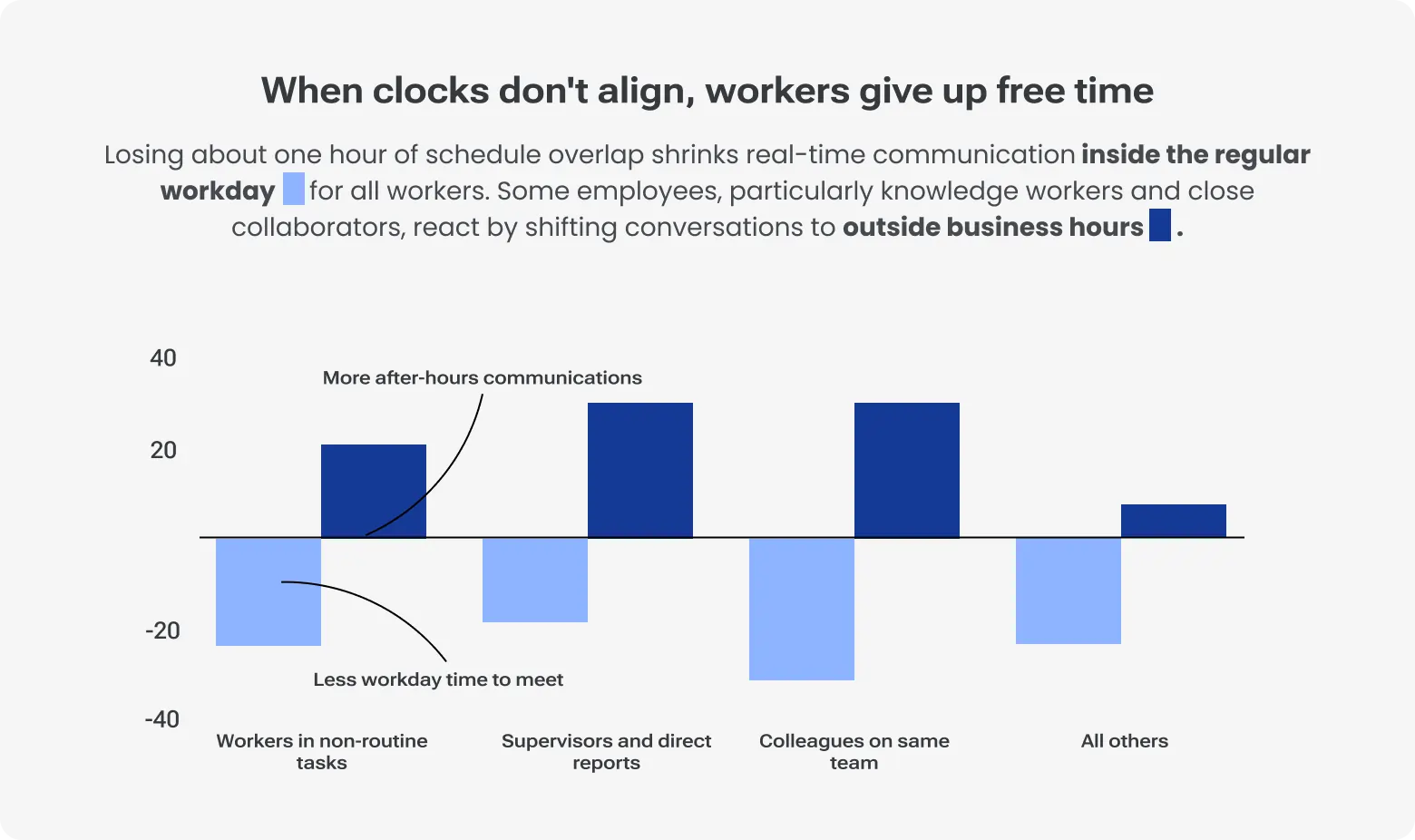
Harvard Business School made research on how time zone differences impact project outcomes. The throughline of all their findings is that even a one-hour gap can make a big difference.
Typical situation is when 57% of synchronous communication is usually within employees’ business hours, and 43% when at least one employee is working outside of local business hours.
This aspect seems minor until the process breaks down. Slack bots and recorded meetings are great aids, though. At the very least, you can start small: real-time for brainstorming and asynchronous for code pushes.
Not securing IP or GDPR compliance
Contracting parties must implement data-transfer safeguards and DPAs when they transfer personal data beyond the European Union.
So, your go-to strategy is to require:
DPA aligned to Article 28 GDPR
An International Data Transfer mechanism (SCCs/IDTA/adequacy)
Explicit IP assignment language
Security certification (ISO 27001 or SOC 2)
And the first baby step is to ask yourself, “Is my data safe?”.
Uncertain ownership model
This simply leads to control chaos. Staff augmentation gives control but demands management, and full-fledged outsourcing often lacks accountability. Try to mix: staff aug for core teams and other models for speed.
What to ask before signing an outsourcing contract
Roast potential partners on weaknesses. We’ve listed some questions and tips to help CTOs and founders spot red flags early. Enjoy:
- Do you provide dedicated or blended teams?
Ask for proof because we've all been there: when the provider sells a dedicated team, and then you bump into their listing on Upwork.
Tip: Don’t turn down blended teams, they can also come into their own sometimes. Push for dedicated on complex stacks like AI.
- How do you ensure knowledge transfer and team retention?
Tip: Ideally, target a 90%+ retention rate with weekly docs and shadow sessions.
- Can I speak with a current client?
It’s a common story to have a conversation with past clients. But only real refs beat polished testimonials.
Tip: Ask directly, “How's issue resolution?” and similar ones. Don’t be shy, as this is your money.
- How fast can you scale the team up or down?
Eastern European outsourcing contracts typically allow 2-week adjustments.
Tip: Test with a pilot to check flexibility. Add 8 developers or remove 3 of them and check the provider’s behaviour. Have they become irritable or just quickly adjusted to your inquiry and posed relevant suggestions (e.g., to add a QA Engineer or an autonomous testing tool to the extended team)?
- How exactly do you handle delivery risk and scope changes?
Reject ambiguous answers and only believe in documented facts.
Tip: Insisting on risk registers and biweekly reviews helps avoid overruns.
Conclusion
Statista expects the EE’s outsourcing market to grow by 6.8% every year over the next 5 years. IT outsourcing in Eastern Europe has several advantages in 2025: a balance of cost and quality, language fluency, and Western business culture alignment.
If you are ready to consider outsourcing software development to Eastern Europe, remember that cheaper rates don’t mean higher ROI. Factor in tech stack, provider maturity, governance models, and that Devico offers a free 30-min call to all who are ready for a level-up.
Great software starts with great people