Offshore and nearshore hiring is hard to ignore. Lower costs, access to global talent, and faster scaling make it a compelling lever for growth.
What gives leaders pause are the failure stories, slow delivery, quality issues, and operational friction. Not because the model is flawed, but because evaluation is.
Most problems trace back to weak screening: hiring for technical skills alone while overlooking communication, autonomy, ownership, and cultural fit.
This guide provides a practical, end-to-end checklist for evaluating offshore engineers, so you can hire with confidence and build teams that actually deliver.
Motivated and focused experts for up to 60% less than locals, delivered in days, not months
Why proper evaluation of offshore teams is a must
How many poor internal hires have you had? Probably at least a few. Research shows that 74% of employers admit to hiring the wrong candidate, and nearly 60% of bad hires happened because employees didn’t meet the quality standards of organizations.
Even when doubts creep in, many managers still give a candidate a chance, thinking, ‘It’s fine. I’ll keep an eye on them. If something goes wrong, I can step in and fix it.’
With offshore developers, that trick doesn’t work. Things you can sometimes get away with in a co-located team become painful very quickly when distance and time zone differences come into play. You can’t casually course-correct in a hallway chat or jump on an impromptu call every time something feels off.
That’s exactly why proper evaluation matters so much here. Not because offshore engineers are less capable, but because the setup leaves far less room for error.
1. Distance amplifies poor communication
When teams work in the same office, unclear communication is less noticeable. Someone overhears a conversation, asks a quick follow-up question, and fixes a misunderstanding before it causes damage. If an offshore developer isn’t comfortable asking clarifying questions, writing prompt updates, or flagging uncertainty early, distance will quickly expose it.
2. Time zone differences add value to the ability to work autonomously
Time zone gaps multiply every delay. When an offshore developer waits for approval on every trivial change, requires step-by-step instructions, and cannot make decisions independently, work simply halts. Look for a proactive and autonomous engineer who uses common sense, project context, and basic research to find solutions and make work decisions on their own.
3. Quality issues take longer to fix
In internal teams, quality problems are usually addressed quite quickly thanks to short feedback loops and fast clarifications. Offshore, that dynamic changes. A single bug discovered later in the development process may require multiple explanations across time zones, long asynchronous message threads, and a few days of rework. Therefore, during outsourcing engineer vetting, check if a candidate thinks about quality, edge cases, testing, and failure scenarios upfront.
4. Junior engineers can hide behind vendors
Here’s an uncomfortable truth: some offshore vendors are very good at selling. Slide decks look professional, case studies sound impressive, and promises are confident. But once the work on a project starts, it turns out the person actually doing the job is more junior than expected. Here is a trick: while senior people participate in sales calls, junior engineers handle day-to-day delivery. A structured staff augmentation evaluation prevents this, allowing you to understand who will really be writing the code, how they think, what they can handle, and where the knowledge gaps are.
5. Misalignment affects the entire delivery chain
As a rule, misalignment rarely stays local. One offshore engineer who doesn’t fully understand their role, responsibilities, or level of ownership can slow down far more than their own progress. Not being able to complete their task or introducing an issue, they can pause the work of adjacent teams, necessitate engagement of senior engineers, and eventually stretch delivery timelines.
Again, a thorough staff augmentation evaluation is your best way to avoid this trouble. And while there is a common misconception that it implies a lack of trust, in reality, it helps:
Reduce uncertainty on both sides
Create healthier working relationships
Mitigates possible risks early on.
The hidden costs of working with bad staff augmentation partners
Overview of the offshore developer hiring checklist
A checklist? Who needs it? Actually, everyone who wants to spot gaps in the experience of a potential offshore team member before they turn into delays, quality issues, or hidden dependencies. A good checklist helps you evaluate not just what a developer knows, but how they work, how they think, and how they behave in stressful situations.
An offshore engineering interview isn’t just about confirming that someone can write code. It’s about mitigating all possible risks that can impact delivery. A comprehensive evaluation checklist makes you look beyond polished résumés and well-rehearsed self-introductions, assessing how a person will actually perform once the real work starts and challenges come up.
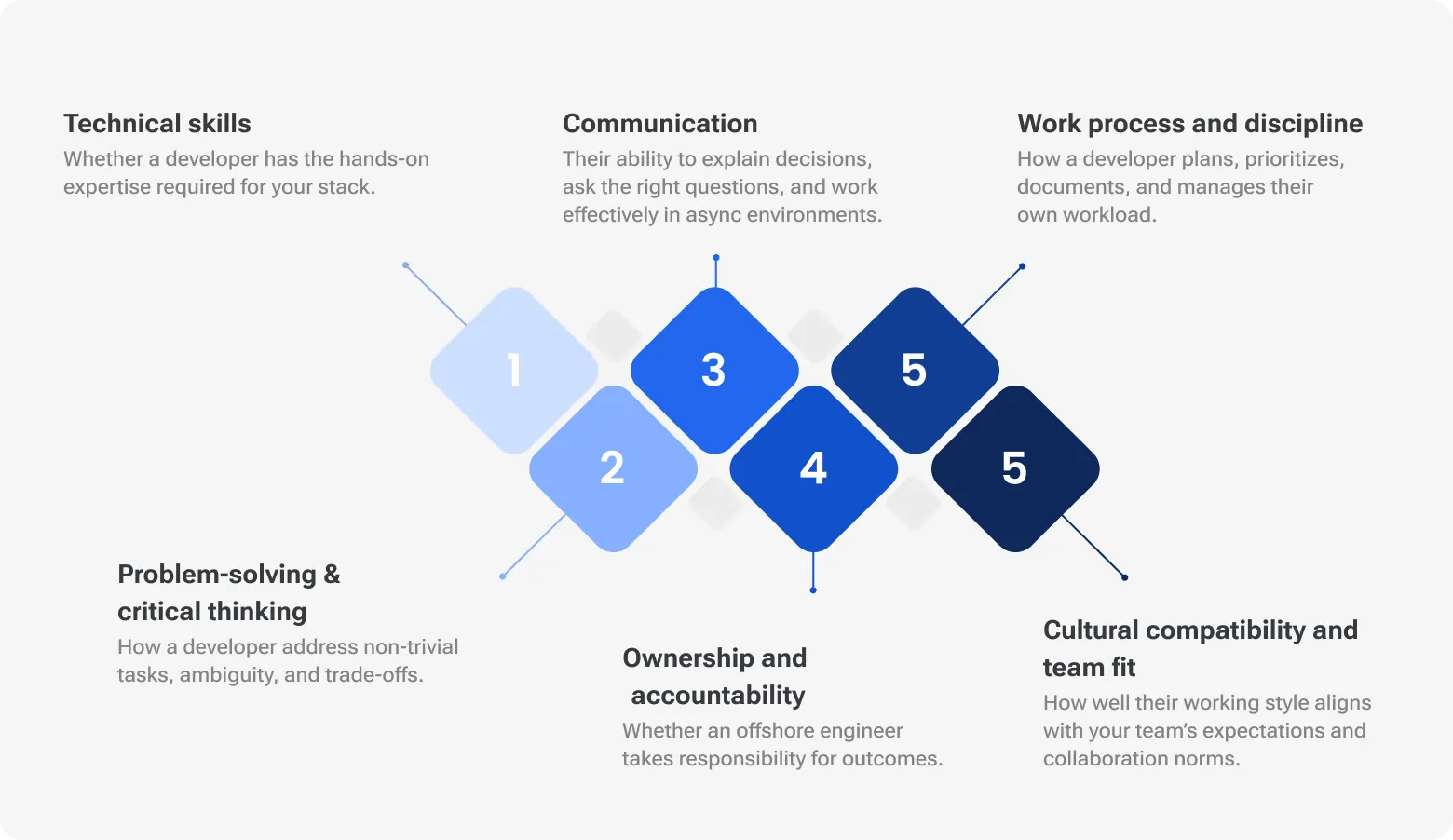
The checklist we’ve prepared is organized into six core categories that we find essential when evaluating remote engineers:
Each category targets a specific and very common risk in offshore setups. In the sections below, we’ll review these categories in detail, explaining what to assess and how.
1. Technical skills (core checks)
We’d like to start with the basics – technical skills. This is the foundation no one would skip checking. Yet, it requires a thoughtful approach to understand whether a person can actually develop and maintain software, not just talk about it confidently.
A technical interview with offshore developers should include the following checks.
Real coding test (without the trivia)
Based on our experience, we can say that it’s better not to offer theoretical puzzles and whiteboard brainteasers. They rarely match real work. Instead, give a task similar to something from your backlog:
an API change with edge cases
Your goal isn’t to assess how fast a developer types but to understand how they approach the task and deal with uncertainty.
Pay attention to whether the candidate:
asks clarifying questions
can read and understand existing code
writes clean, structured code
makes safe, minimal changes instead of rewriting everything
can write basic tests and debug issues when something doesn’t work.
GitHub or real code sample review
If a candidate has public repositories or can share past code, never skip a chance to review it. That’s where you can detect patterns.
Pay attention to:
test coverage (or lack of it)
commit history and messages
how complex logic is implemented
Even a small codebase can tell you a lot about the way someone thinks.
Discussion of past architecture decisions
Asking which patterns a candidate knows is a bad idea. Instead, inquire what they’ve actually done.
The following questions may be useful:
Can you tell me about a system you helped design?
What part of that system did you personally own?
What was the most important technical decision you made, and what constraints influenced it?
What alternatives did you consider, and why did you reject them?
Did anything go wrong? How did you solve it?
What would you do differently today?
The engineer’s answers to these questions will help you understand if they’ve made real architectural decisions or mainly followed existing designs.
Check for understanding trade-offs (not just tools)
Apart from telling what tools they’ve used, top engineers can also explain why they chose one over another and under which circumstances that decision made sense.
Make sure to ask questions like:
Why did you pick this database or framework?
Why not a monolith/microservices/managed service?
What trade-offs did that decision introduce?
What would you do differently today, and why?
There’s rarely a single correct answer. Yet, the reasoning should fit the context: team size, timelines, budget, expected load, and long-term maintenance.
Validation of familiarity with your tech stack
A 100% stack match isn’t needed, but you should make sure there is a solid overlap in the areas that matter most for your project.
Clarify:
which tools and frameworks an engineer has used in production
what they’ve only touched briefly
which parts of the stack they’ve never worked with
Strong engineers can explain how they used a tool, what problems it solved, and where it caused pain. Honesty here is a good sign, while overconfidence paired with vague answers isn’t.
Talking about CI/CD, testing, and branching
Understanding how code reaches production from a developer’s laptop and what can stop it along the way can eliminate many problems in the delivery pipeline.
Check if your candidate is comfortable explaining:
how code moves from commit to production
what testing levels they’re used to (unit, integration, e2e) and when each runs
how branches, reviews, and releases are handled
what happens when a build fails, or tests break
Good engineers can talk about safeguards, quality gates, and pain points without hiding behind general phrases.
Check of refactoring and debugging skills
Shipping new code is pretty easy. Cleaning up old code and fixing broken things is the real job, especially in legacy products.
Some useful questions that can be asked to verify these skills:
What is the ugliest bug you’ve fixed? How did you track it down?
How do you approach refactoring risky areas?
What safeguards do you put in place before changing existing code?
When do you stop refactoring and move on?
This way, you’ll see the difference between engineers who only build new things and those who can safely maintain and evolve real systems.
Asking to explain a system end-to-end
In fact, this is one of the most revealing questions you can ask a candidate.
Have them walk you through:
how it scales (or doesn’t)
The answer will let you know whether a developer truly owned the system or just worked on a small piece of it.
Signal to watch for:
At Devico, we’ve interviewed hundreds of engineers and can tell you for sure: senior engineers speak in specifics. They name technologies, constraints, mistakes, and numbers. Vague phrases like ‘best practices' or ‘industry standards’ usually signal weaker profiles.
2. Problem-solving and critical thinking
These two qualities – problem-solving and critical thinking – are important for every developer, particularly an offshore one who has no one to hover over their shoulder and give some tips.
If you’d like to bring in proactive contributors rather than reactive coders, during a coding test based on real-world scenarios, also evaluate the following:
Breaking down the problem: Look for a structured approach with subproblems, task sequencing, and recognized constraints.
Ability to handle uncertainty: When requirements are missing, high performers keep moving instead of waiting.
Creativity vs. over-engineering: Provided solutions should be clever but practical, not unnecessarily complex.
Decision-making: Make sure a candidate can make safe, informed choices without constant direction.
Structured thinking: Watch for pseudo-code, diagrams, or clear logical explanations.
In offshore setups, strong problem-solving and critical thinking allow developers to work independently, which is a must for keeping up with delivery timelines.
3. Communication and collaboration
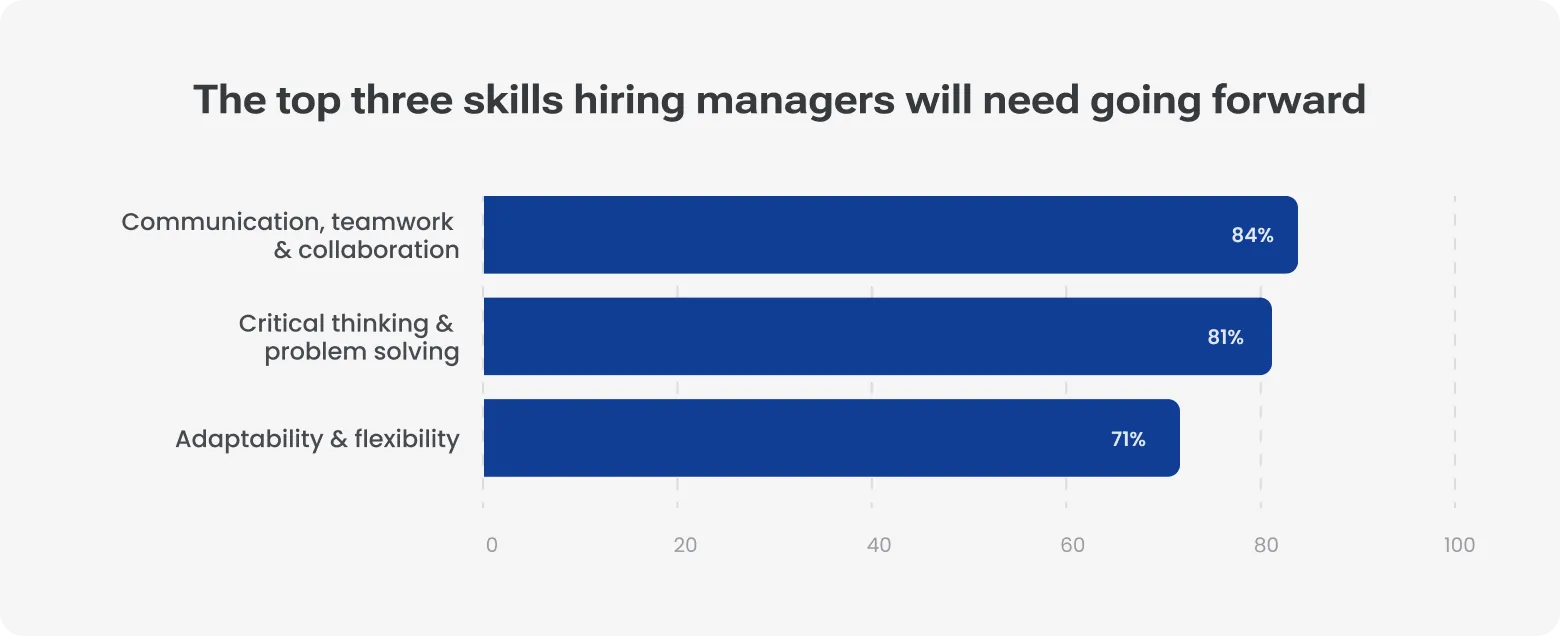
Inefficient communication is a problem for any team, yet when working with offshore developers, it’s a catastrophe. Delays, misaligned work, and costly rework are the consequences you will have to handle. That’s why you should always evaluate remote engineers for how they communicate.
Source: The Hays 2025 Skills Report
Here’s what to look for:
A good command of English: During an interview, make sure a developer can give clear, concise answers in English so that the team can understand them without guessing.
Ability to explain complex topics simply: Your candidate may not be as oratorical as Cicero, but they should be able to take a tricky concept and make it understandable to someone outside their immediate expertise.
Proactive clarification questions: While independent work matters, in critical cases, good engineers ask questions early rather than assuming and creating rework.
Listening skills: Polite nodding isn’t enough. Check if a candidate gets instructions, feedback, and context right.
Transparency about unknowns: Strong candidates admit what they don’t know and outline how they’ll find the answer.
Comfort giving and receiving feedback: Collaboration is two-way. A developer needs to take feedback without defensiveness and offer it constructively.
Ability to communicate asynchronously: Offshore work often happens across time zones. Clear documentation, structured messages, and status updates should be the norm.
Stats show that collaborative teams report 50% fewer errors, which is a good reason to carefully assess communication and teamwork in offshore hires.
4. Ownership and accountability
Let’s admit that ownership often sets apart an average offshore engineer from one you can really rely on. With distance and limited overlap, you need people who see your product as their responsibility, not just a list of tasks.
Pay attention to the following aspects:
Approach to deadlines and responsibility: Look for a candidate who, when talking about missed deadlines, explains what they did to recover and doesn’t shift blame to circumstances or requirements.
Owning a feature end-to-end: Make sure the developer’s track record includes taking a feature from idea to production.
Proactivity in identifying risks early: Voicing concerns, technical debt, or unclear requirements before they become incidents is what you can expect from a good engineer.
The way production issues are handled: Listen to how candidates describe production bugs. Panic or finger-pointing tells you a lot, and none of it is good.
Willingness to challenge unclear requirements: Ownership also suggests asking uncomfortable questions. Engineers who blindly implement vague requirements pose a risk for project success.
No blaming others, no hiding problems: High performers acknowledge mistakes, flag issues early, and focus on solutions instead of excuses.
The quickest way to evaluate a developer’s sense of ownership is to simply ask, ‘What does ownership mean to you?” The best answer should touch on not only timely task delivery but also quality and long-term impact.
5. Work process and delivery discipline
With an efficient delivery process, distributed teams move in the same direction, without micromanagement or ongoing corrections. That’s why you’d better check in advance what workflows candidates have followed and what practices they’ve used.
Things to assess:
Agile experience: Knowing rhythms, roles, and ceremonies, an offshore developer should take to working in Scrum and Kanban teams like a duck to water.
Understanding of sprints, estimates, and planning: Check if your candidate can estimate work realistically, commit responsibly, and quickly adapt if requirements change.
Approach to documentation: The ability to create clear documentation promptly is a great advantage.
Code review habits: Ask how a developer reviews others’ code and what they expect in return. Thoughtful reviews are what you need.
Familiarity with QA processes: Make sure a candidate understands how testing integrates into delivery, respects QA input, and doesn’t consider bugs as someone else’s problem.
Following a branching strategy: Whether it’s Git Flow, trunk-based development, or a custom approach, a developer should be able to work within specified version-control rules.
Alignment with PM, QA, and Design: Clarifying scope, respecting dependencies, and syncing early are essential elements of the delivery discipline in cross-functional collaboration, and your engineer should be used to working this way.
Comfort with async rituals: Status updates, demos via Loom, structured Slack messages, and shared knowledge in Notion or Confluence should be habits executed without reminders.
The check of this kind is important because teams with strong delivery discipline experience less day-to-day stress, fewer last-minute delays, and smoother delivery.
6. Cultural compatibility and team fit
Our experience proves that technical skills alone aren't enough for success. How a remote engineer interacts with teammates is equally important.
Cultural compatibility and team fit are drivers of long-term performance and collaboration.
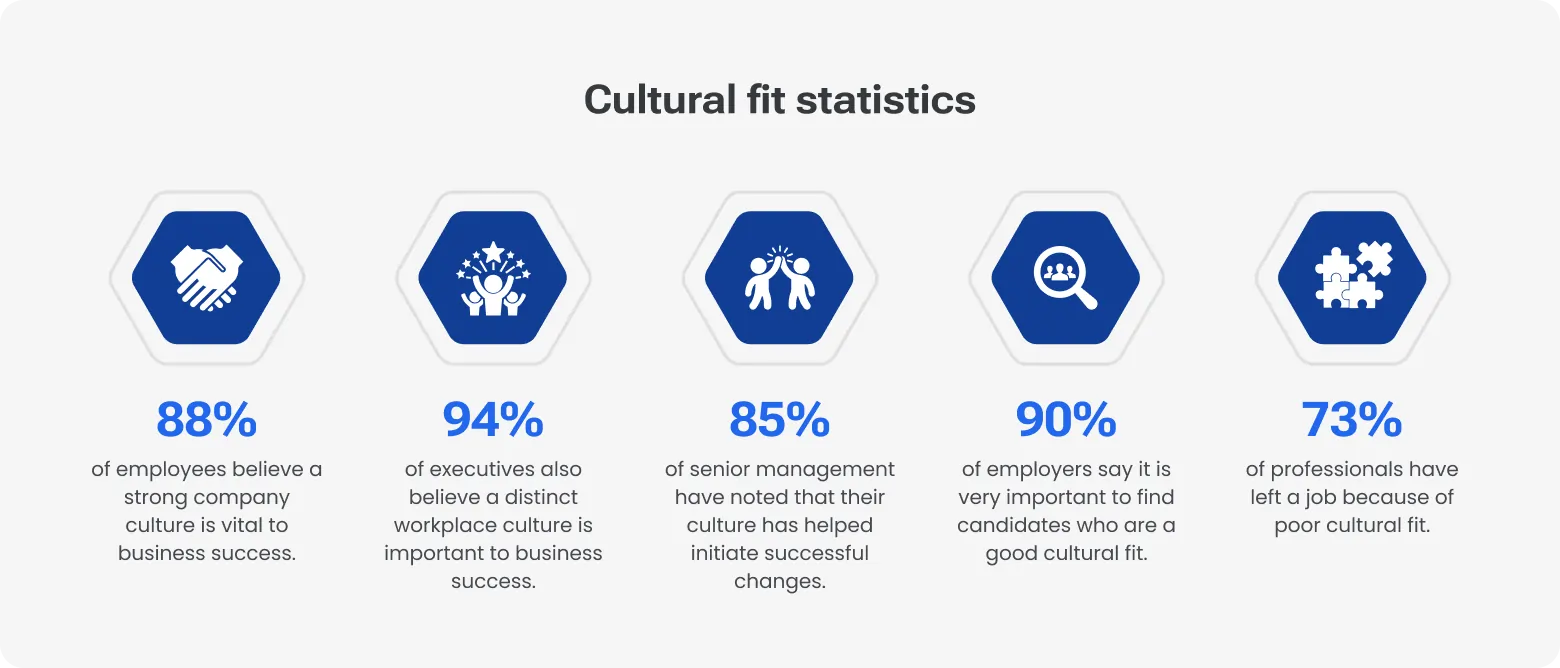
Why cultural fit matters in hiring and team performance
Source: ASW Global
Criteria you need to evaluate:
Work style alignment: Some engineers love strict routines. Others prefer flexibility. Both variants are totally ok, but make sure your candidate’s preferences match your team’s work style.
Reaction to feedback: Good developers view feedback as useful information for self-improvement, not a personal attack. If they get defensive or take offense, that’s a warning sign.
Collaboration style: Responsiveness, clear communication, transparency, and a willingness to share knowledge and collaborate with team members are what you should look for in your potential offshore developer.
Product mindset: If an engineer tries to understand users' needs, trade-offs, and business goals and pains, this is a great advantage. This way, they see the bigger picture that helps find better tech solutions.
Expectations about work-life balance: Be upfront about your availability and overlap requirements, and make sure the candidate is comfortable with them.
Integration with team rituals: Daily stand-ups, code reviews, async updates, and documentation – all of these are part of your team culture. Make sure your candidate can jump in and keep up.
Solid tech skills are a great and essential foundation for every developer, but cultural fit is also needed to ensure thriving, efficiency, and productivity. Therefore, never neglect a check for it.
Red flags. When to reject immediately
Of course, some warning signs are negotiable, but we’d like to go through those that aren’t. If you spot any of the following, walk away at once – this will save you time, effort, and money.
Vague or generic answers: If a candidate can’t speak to specifics, they probably haven’t done much hands-on work.
Difficulty explaining past experience: Struggling to describe projects, approaches, mistakes, and decisions is a red flag. Rich experience comes with an abundance of stories.
Poor English: Without a workable level of English, an engineer can’t contribute effectively and blocks others.
No questions asked: Engineers who don’t ask clarifying or thoughtful questions may struggle to work independently.
Overconfidence without detail: If you hear big claims with no details, this is usually a sign of someone who looks busy but doesn’t deliver.
No GitHub or code samples: If there’s nothing to show, it’s impossible to verify real skills.
Inability to explain trade-offs: Good developers know why they made certain choices and can explain the reasoning behind them.
Zero ownership mindset: If a developer blames others, hides problems, or avoids responsibility, they’re unlikely to add much value to your team
Discomfort with async communication: Offshore work runs on async updates. If a candidate is uncomfortable with that, things will slow down fast.
These are things you can’t fix with training or onboarding, so watch for them during interviews to avoid getting burned later.
When NOT to use staff augmentation
Bonus: Vendor-specific checks
How to hire offshore developers effortlessly? Of course, by partnering with a trusted vendor. If an outsourcing partner is diligent, you face far fewer problems and risks, especially when it comes to bringing in whole offshore teams, not just one or two developers.
With this in mind, we’d like to highlight what you need to pay attention to when selecting a vendor:
1. Does the vendor rotate engineers often?
Find out how often the vendor rotates people on projects. Frequent switches can kill continuity and slow progress.
2. Do you meet the actual developer, not a proxy?
Make sure you’re talking to a person who will actually work on your project, not a sales rep or a ‘proxy’ who knows all the right words.
3. Is there a clear replacement policy?
When someone leaves mid-project, this can bring chaos. To avoid this, ask if a vendor has a clear backup plan in place.
4. Do they support onboarding and documentation?
Good vendors help engineers get up to speed quickly and provide proper documentation. If they don’t, expect delays.
5. Are engineering leads / delivery managers provided?
Check if your vendor can provide a lead or delivery manager who’s ready to step in when things get tricky. Even great developers hit walls sometimes, and a good lead keeps the project moving.
6. Are CVs real or generic?
Pay attention to the style and content of the provided CV. Polished, cookie-cutter resumes can hide junior developers. Look closely at actual projects, roles, responsibilities, and contributions. To clear up doubts, insist on arranging a quick video chat to make sure you’re really getting the right person.
Vendor checks like these are your insurance. Some effort here saves you many headaches later.
Final thoughts
Strong offshore teams are built, not found. They come from structured evaluation, not rushed hiring.
Spending more time upfront pays off in speed, quality, and stability. Cutting corners costs more later.
A clear checklist helps, but the process is faster and safer with a partner who vets candidates properly from the start. At Devico, we assess both technical and soft skills and support interviews, tests, or PoCs to ensure the right fit.
Great software starts with great people