Now and then, companies face temporary skill needs. A product scales faster than expected. A key engineer goes on maternity leave. A new feature requires expertise that no one on the team has.
As a rule, in this case, they have two options: to bring in a contractor from a staff augmentation company or look for an independent contractor, a freelancer, via one of the numerous tech hiring platforms that are available today.
Is there any difference? Sure. Nuances lie in accountability, quality, risk exposure, etc. If you’re on the fence, read on to understand which approach makes the most sense for you.
What is staff augmentation?
Staff augmentation is one of the most widely used outsourcing models that implies getting from a vendor like Devico the talent you require to cover your current needs.
You describe what you want – let’s say, a senior Node.js developer with extensive fintech experience – and the outsourcing vendor sources, vets, and offers candidates who match your requirements. On approval, the engineer joins your existing team, integrates into your workflows, participates in your standups, follows your instructions, and reports as any other internal team member would.
Motivated and focused experts for up to 60% less than locals, delivered in days, not months
In fact, the external engineers work as usual team members but remain employed by your vendor.
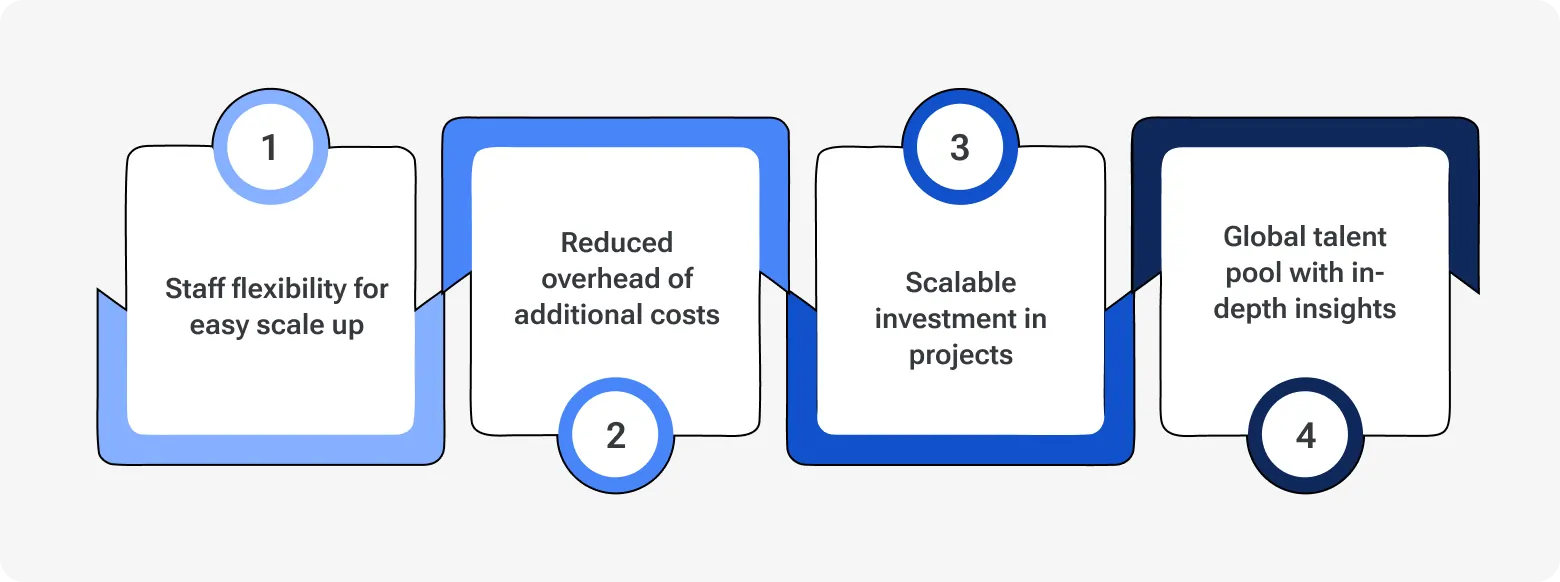
Staff augmentation benefits
As a rule, outsourcing engineering talent looks like this:
You define the skill gap and timeline.
Your provider screens and presents pre-vetted engineers.
You interview and approve the candidate.
The engineer gets onboarded and works full-time (or part-time if that’s what you need).
The vendor handles payroll, HR, compliance, and replacements.
You pay monthly invoices based on the number of working hours.
As you see, there is a clear distinction of responsibilities: you manage the day-to-day work while the vendor is accountable for employment and continuity, but not all partners deliver the same level of reliability.
Tech companies usually choose staff augmentation when the need is temporary.
For example:
You’re building a new product module that will run for about 10-12 months.
You lack in-house expertise in a specific tech stack.
You don’t want to commit to a permanent headcount.
Unlike hiring a random freelancer, staff augmentation is structured around stability and sustained contribution. Every engineer is selected not just for skills but for long-term engagement potential. If someone leaves, the vendor is responsible for quick replacement. There is accountability and structure, which makes the model very flexible but not chaotic.
Using staff augmentation for software maintenance: Full guide
What is a tech hiring platform?
A tech hiring platform can be defined as a marketplace that connects companies with individual engineers – freelancers, contractors, or sometimes full-time candidates. Usually, it comes with built-in tools for searching, filtering, messaging, and hiring.
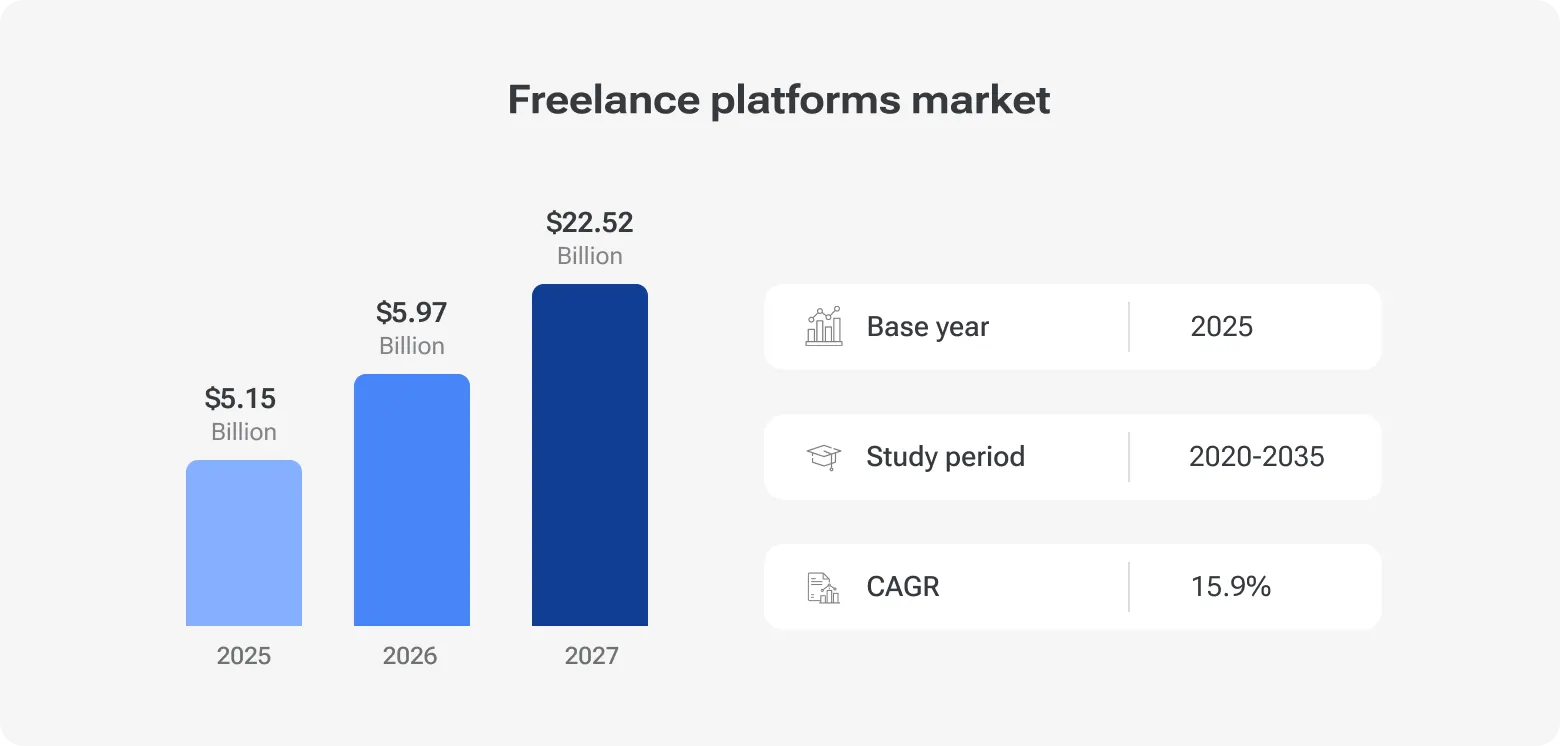
Source: Global Growth Insights
Toptal, Upwork, Fiverr, and Lemon.io are some of the most popular tech hiring platforms that provide fast access to global tech talent.
In fact, about 61% of companies work with freelancers, and 58% of professionals depend on digital platforms.
Interaction with such platforms usually looks this way:
You post a job or browse profiles.
You review portfolios, experience, and ratings.
You conduct interviews yourself.
You negotiate terms and rates.
You manage the engineer directly.
Pros and cons of hiring platforms for engineering
Transparent hourly pricing
Hidden costs (sourcing, hiring, potential rework)
Some platforms pre-vet candidates. Some use algorithms to match you. Some offer trial periods. But once you hire someone, the responsibility shifts entirely to you.
Tech hiring platforms are especially popular among early-stage startups, bootstrapped teams, and companies testing an idea before scaling. For some managers, this is an attractive option because of the following:
If you need a developer for a small feature, a short-term fix, or a very specific micro-task, platforms can be efficient.
Yet, it’s worth remembering that those solutions have a goal to facilitate the introduction, not the outcome. Therefore, there is a whole range of risks you should be aware of:
Quality can vary significantly.
Engineers may juggle multiple clients.
Long-term commitment is uncertain.
If someone leaves mid-sprint, you start over.
There is no structural accountability layer behind the individual.
Along with flexibility, you get the delivery risk. And that becomes critical if you can’t afford unexpected 'surprises.'
Staff augmentation vs. tech hiring platforms
Both options – staff augmentation and tech hiring platforms – help to solve the same problem: you need technical talent, and you need it fast.
Still, the way they approach it, as well as what happens after the contract is signed, is very different.
Tech hiring platforms give you access to individual engineers. Staff augmentation, in turn, gives you engineers backed by a vendor – a trustworthy vendor if you’ve done a bit of legwork.
The differences lie in everything: hiring speed, cost predictability, delivery risk, turnover exposure, etc.
Quick comparison: Staff augmentation vs. freelance platforms
Criteria
Staff augmentation company
Tech hiring platform
It's your responsibility, but matching tools help
Multi-stage, skill-tested, and culture-fit checked
Often lighter or profile-based
Very fast (hours to days)
You manage day-to-day work while the vendor supports coordination
You manage everything on your own
Delivery is on you, yet the vendor holds responsibility for talent quality and continuity
Let’s discuss the difference between staff augmentation and tech hiring platforms in detail.
Talent sourcing
On platforms like Upwork or Toptal, you gain access to the abundance of engineers. Some of them are fantastic, some are average, and some look great just on profile.
As a result, you need to sort out real talent from the crowd. Take your time to review numerous profiles, conduct interviews, validate technical expertise, and assess soft skills.
If you misjudge, it’s your mistake.
With a staff augmentation partner, sourcing is structured. Candidates go through the vendor’s internal technical validation, English evaluation, and often a real project simulation before you ever see them.
Let’s say you need a senior React engineer with experience in healthcare. A platform will give you 40+ profiles to evaluate. An augmentation partner will provide 2–3 already cherry-picked options.
The difference here isn’t talent availability but filtration responsibility.
Screening & vetting
Most hiring platforms provide profiles, ratings, and past client feedback as key criteria for your choice. That can work, but not in all cases.
A five-star rating doesn’t always mean architectural thinking, as well as a polished profile doesn’t guarantee continuity of services.
Augmentation companies usually carry out several rounds of interviews before introducing candidates to you. By controlling quality upfront, they protect their reputation.
If your product is at the MVP stage, profile-based vetting may be fine. However, when you’re handling production traffic, lighter screening increases risk.
Staff augmentation vs fractional CTO / fractional engineering teams
Speed of hiring
Using platforms, you can engage someone very quickly, which is a great advantage when time is limited. For example, Upwork clients find the right hire in 3 days, on average.
Yet, the speed of hiring isn’t the same as the speed of stable contribution.
According to research by Fiverr Workspace, 70% of freelancers work on 2 to 4 projects simultaneously. Some handle even more projects at once. Therefore, they adjust availability dynamically and quickly exit if a better contract appears.
For example, you hire a freelancer quickly to speed up a sprint. Three weeks later, they may reduce hours due to another client. As a result, your velocity drops. Think twice if you can handle this risk.
A staff augmentation company can provide talent within several days or a few weeks. But you can be confident that they are assigned full-time to your project only, which is why they are always aligned with your roadmap.
So while speed gets you started, predictability is what keeps you moving.
Contracting & payroll
Our tech hiring platform comparison to staff augmentation wouldn’t be complete without this aspect. With freelancers, even those hired through platforms, you often have to handle the following:
Compliance concerns (especially cross-border)
Sure, it may not feel difficult with 1 contractor. But if you have 3–5 contractors, it becomes a time-consuming chore.
When you opt for staff augmentation, the vendor takes care of billing, contracts, compliance, etc. This way, you can focus on delivery, not administration.
Turnover risk & replacement
Gig platforms are designed for flexibility. But flexibility works both ways.
If a better-paying contract comes along, a freelancer’s priorities can change. If their interest in the project fades, engagement quietly drops off. And if they leave in the middle of a sprint, you’re suddenly back to the hiring process, putting aside other tasks.
Remote engineering hiring platforms usually don’t provide a structured replacement guarantee. You’re on your own to fill the gap.
Staff augmentation providers usually take care of employee retention, which is why turnover risk is lower here – at Devico, the turnover rate is just 4.4%. Even if someone goes away, they’re contractually responsible for providing a pre-vetted replacement to minimize disruption.
Apart from resolving staffing issues, that kind of backup protects delivery timelines and reduces pressure on internal teams.
Management effort
The burden of management lies on your internal leads in both cases. They assign tasks to external specialists, check results, run sync meetings, and monitor performance. The difference shows up when something goes wrong.
If you hire through a platform, your managers solve problems on their own, be it a performance drop or a broken deadline.
With staff augmentation, you get from the vendor not only an engineer but also a delivery manager or customer success manager who steps in when you face a problem. If expectations aren’t met or performance needs adjustment, you don’t deal with it alone. You have a partner responsible for stabilizing the situation before it affects delivery.
Of course, this doesn’t reduce your management effort, but it lets you nip talent-related problems in the bud.
Accountability
The most important distinction between software developer hiring platforms and staff augmentation lies in accountability.
If you use a platform, accountability is fully yours. Such solutions are designed to find the match, not to guarantee the outcome.
With augmentation, responsibility is kind of layered. You own the delivery process, whereas the vendor is accountable for talent quality and continuity.
This way, staff augmentation companies have skin in the game. They are interested in good outcomes as well as you are.
Choosing between tech hiring platforms and augmentation vendors
At some point, this stops being a sourcing question and becomes a sleep question. What to go with – a tech hiring platform or staff augmentation?
Both options can bring skilled engineers into your team. The key difference is how much turbulence you’re prepared to deal with.
Let’s make your decision practical.
When staff augmentation is the better move
Let’s start with when to use staff augmentation instead of hiring platforms. As you know, staff augmentation has been used by tech companies of all sizes all around the world for years. It proves to be an efficient strategy to address a talent gap or a need for urgent extension.
Opt for this approach if:
You don’t have time for long sourcing cycles.
You want thorough pre-vetting handled externally.
You’d like to ensure continuity, avoiding turnover.
The engagement will last at least 6 months with a potential extension.
You expect a replacement guarantee written into the contract.
Your team already works at high intensity and cannot tackle possible rework.
In general, staff augmentation is suitable when stability is as important as speed.
Avoid operational and HR hassle and the constant threat of attrition with your own R+D department from Devico
When tech hiring platforms are a good option
Tech hiring platforms are indeed helpful, especially when you need high speed and flexibility without long-term commitment.
Opt for a platform if:
You need help with a well-defined and short-term task.
Your internal team has time for sourcing and interviewing.
You’re comfortable with managing administrative tasks.
You can close your eyes to occasional disruptions without strategic damage.
You prefer maximum flexibility over structure and continuity.
You’re okay replacing someone yourself if needed.
Internal tech leadership is strong and not overloaded.
Using a platform can save time and sometimes reduce hourly costs. But it comes with a setback. Be ready that surprises may happen when you don’t expect them, and you will have to resolve them on your own.
Conclusion
This decision is not really about hiring. It is about how much risk you are willing to take on.
Tech hiring platforms give you speed, flexibility, and access to global talent, but they also place full responsibility on your team. If something breaks, you fix it. If someone leaves, you start over.
Staff augmentation works differently. You don’t just get an engineer, you get a structure behind them. Vetting is handled, continuity is protected, and replacements are managed without disrupting your delivery.
Platforms can be effective for short-term tasks where flexibility matters more than stability. But when your product, timelines, and reputation are on the line, predictability becomes more important than speed.
That’s where Devico comes in. We don’t just provide engineers, we stand behind them.