Every team hits a bottleneck. Sometimes it’s a lack of hands. Sometimes it’s a lack of direction.
These problems look similar. They aren’t, and solving them the same way is expensive.
Staff augmentation adds execution.
A fractional CTO adds leadership.
A fractional engineering team adds both.
Choosing the wrong model doesn’t just slow delivery, it blurs ownership and multiplies risk.
This article breaks down when each model actually works and how to choose the one that fits your real constraint.
What is staff augmentation?
Among the three outsourcing models in question, staff augmentation is the most popular.
You bring in an external expert – a developer, QA, DevOps, or security specialist – plug them into your in-house team, and they work under your management. They join your stand-ups, follow your sprint cycles, use your Git workflows, and build according to your standards. From the outside, they look almost like your own employees, except they’re technically not on your payroll. That’s staff augmentation.
What you buy here is capacity – execution power.
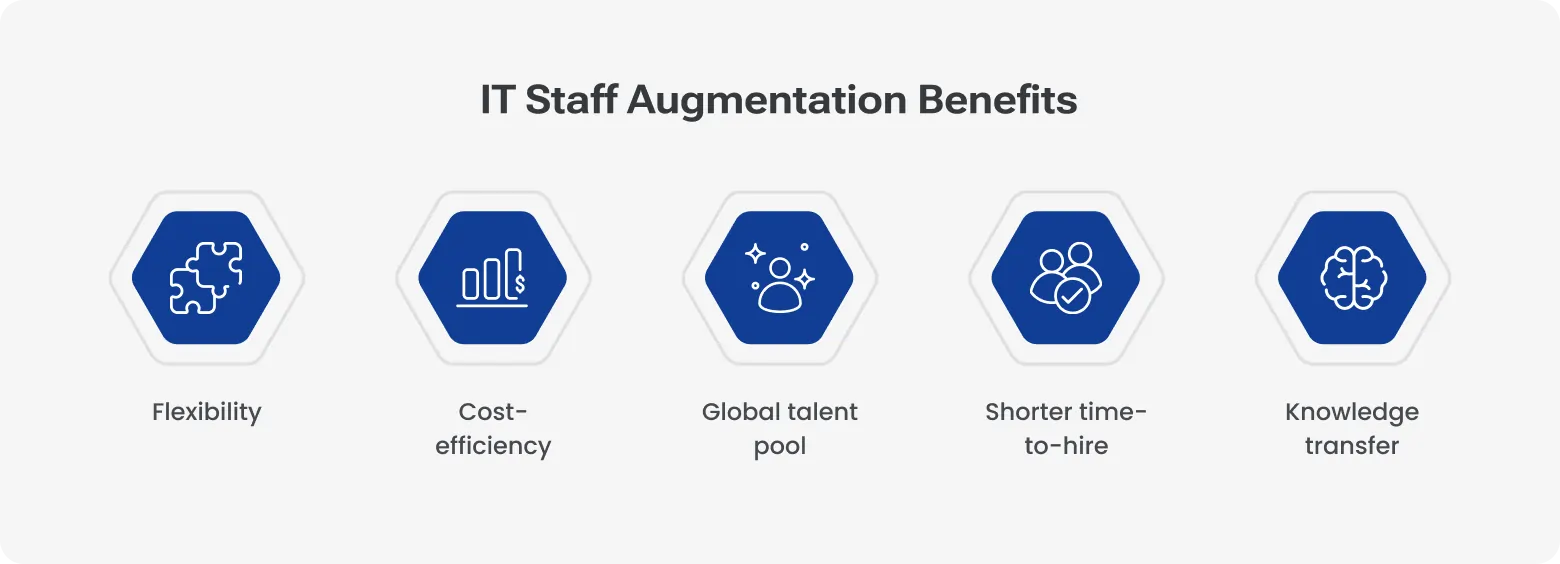
When the model works, it brings numerous benefits:
If someone isn’t a fit, replacement is faster than traditional hiring.
As 74% of employers say they are struggling to find the skilled talent they need, staff augmentation is gaining popularity. Yet, it’s worth noting that the model is efficient only when your internal foundation is solid.
Motivated and focused experts for up to 60% less than locals, delivered in days, not months
What is a fractional CTO?
When something strategic is either unclear or fragile, extra hands won’t help. What you really need is a techy brain. This is where a fractional CTO can come in.
A fractional CTO is a senior technologist who steps into your company part-time – a few days a week, a few days a month, or on a project basis – to bring strategic alignment.
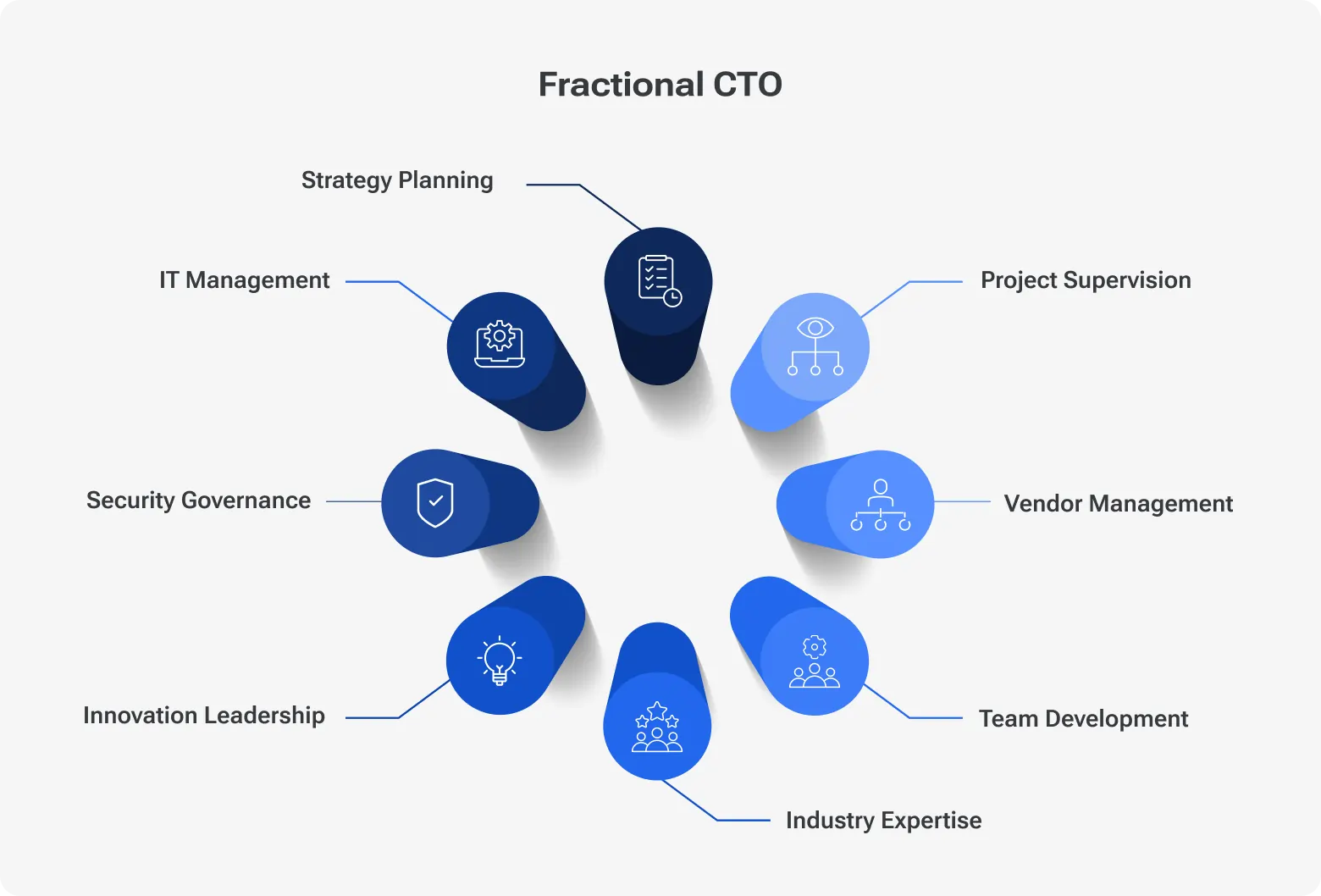
Usually, their scope of responsibilities covers:
Strategic technical leadership
Setting engineering standards
Roadmap shaping & prioritization
Designing a team structure
Risk & compliance oversight
Coaching internal developers
Helping scale delivery processes
Also, it’s equally important to understand what a fractional CTO doesn’t do:
They don’t fix execution bottlenecks themselves.
They don’t rewrite your codebase.
They don’t usually run daily stand-ups.
They don’t manage engineers full-time.
Fractional CTO services put signposts along the road while your team drives the vehicle. With 30% of tech professionals admitting that unclear goals slow them down, the help of a fractional CTO can be a project-saver.
What is a fractional engineering team?
A fractional engineering team is quite different from the other two models. In this case, a vendor provides not an individual specialist or a few of them but a self-contained delivery unit.
This small, cross-functional, coordinated team usually includes developers, QA, maybe DevOps, and often a tech lead who keeps everything on track.
Key benefit? Well, instead of managing individuals, you just align outcomes. Just as important is time efficiency. You get a fully assembled, ready-to-deliver team within days, while the average in-house time to hire for developers is around 41 days, and for the slowest 10% of roles, it can take up to 82 days.
With a fractional engineering team, you typically define:
From there, the team handles day-to-day coordination, internal communication, technical decisions, and delivery execution on its own.
You may engage such a team to
Build a new product or feature from scratch
Modernize a legacy module
Run a parallel delivery stream while your internal team focuses elsewhere
However, the fractional engineering team model requires defined goals. You know, autonomy works only when expectations are clear. Therefore, if the scope shifts daily, friction appears.
Avoid operational and HR hassle and the constant threat of attrition with your own R+D department from Devico
Staff augmentation vs. fractional CTO vs. fractional engineering teams
It’s not enough just to define the models. Let’s look at how they differ in practice against various criteria like ownership, responsibility, management effort, cost structure, etc.
Below is a table that presents a high-level comparison.
Quick comparison: staff augmentation vs. fractional engineering team vs. fractional CTO
Dimension
Staff Augmentation
Fractional CTO
Fractional Engineering Team
Coordinated delivery unit
Executes direction + manages process
Retainer (monthly advisory fee)
Fixed monthly team budget
Almost immediate capacity boost
Strategic clarity in 2–6 weeks
Fastest full-team delivery without hiring
Now, we’d recommend having a closer look at key differences and explaining what they mean in reality.
1. Leadership vs execution
This is the key criterion.
Staff augmentation → execution only.
Using this model, you onboard more people to do the work, i.e., to implement what your leadership has decided.
Fractional CTO → leadership only.
Engineering leadership outsourcing, on the contrary, doesn’t scale your development capacity. A fractional CTO’s mission is to think, plan, and guide your team. This is the major difference between a fractional CTO and staff augmentation.
Fractional engineering team → both.
Here, you get execution with embedded technical coordination. Hands and a steering mechanism within the defined scope enable autonomous work, demanding minimal involvement from you.
2. Level of responsibility
With augmented staff, you’re the only one who is responsible for the results since external specialists follow your plan, your workflows, and your standards. Therefore, if delivery fails for any reason, accountability lies within the company.
A fractional CTO, in turn, holds responsibility for the strategy. They define direction, set standards, make key tech decisions, etc. They don’t manage your team daily, but they are accountable for decent guidance.
If you hire a fractional engineering team, responsibility lies on both sides. While the team performs tasks within the agreed scope and manages its own internal process, your duty is to define milestones and review outcomes.
3. Cost structure
The pricing logic behind each model differs, too.
Augmentation = paying for time.
You are usually billed hourly or at a monthly rate per specialist. The cost scales linearly – more engineers, higher budget.
Fractional CTO = paying for judgment.
As a rule, fractional CTOs work on a retainer model. You pay for senior expertise on a part-time basis. While the hourly rate may seem pretty high, the overall cost is significantly lower than hiring a full-time executive.
Fractional team = paying for outcomes.
Such teams are often priced as a fixed monthly unit. Instead of paying for individuals, you pay for the functioning team, including coordination and delivery management.
4. Speed of impact
Speed is another differentiator.
With staff augmentation, the impact is nearly immediate. You add a few external developers and, within days, experience the execution boost you needed.
A fractional CTO performs differently. Strategic improvements they introduce - clearer roadmaps, better architectural decisions, a refined stack, etc. – usually become visible within 2–6 weeks.
A fractional engineering team lets you skip the long-lasting hiring stage. Instead, you just bring in a full-fledged team ready to develop almost at once.
5. Management effort
When you engage augmented staff, management effort stays high. Augmented specialists extend your capacity, but they don’t reduce your managerial workload. On the contrary, more people on the team require more effort from managers.
As for fractional CTOs, you don’t manage them. Instead, you collaborate. Fractional engineering leadership guides strategy, challenges assumptions, and helps structure decisions. Yet, day-to-day team management is mostly on you.
With a fractional engineering team, your management effort decreases. Because the team coordinates internally and usually has its own technical lead, you don’t assign individual tasks or supervise daily workflows.
CTO-as-a-service vs. staff augmentation vs. fractional engineering team is an important topic you need to carefully explore before making your final decision on the outsourcing model.
Staff augmentation vs tech hiring platform
When staff augmentation is the right choice
Staff augmentation makes sense when your product direction is clear. You already have a roadmap, architecture decisions are made, and priorities are defined. The only thing missing is more hands to deliver at the desired speed.
This model is spot on when:
Your backlog is growing, but the product vision is stable.
You need specific expertise (for example, a senior React developer, QA automation engineer, or DevOps specialist) that your team lacks.
You want to accelerate delivery without committing to long-term hiring.
You want full control over priorities and delivery.
Your engineering processes are already structured and well-managed, with strong leadership in place.
In other words, staff augmentation amplifies what already works. It isn’t a transformation model but one of the engineering team scaling models. If your internal setup is chaotic, adding more engineers will only make things worse.
When NOT to use staff augmentation
When to outsource CTO services
A fractional CTO, on the contrary, works well when your product direction, architecture, or technical strategy is vague or fragile.
If execution is stagnating, not because of capacity but because the team lacks leadership and guidance, adding more hands won’t solve the problem. What you need is a tech expert who can think, structure, and oversee your tech strategy.
Go with this model if:
You don’t have a CTO yet, but you need to build a long-term tech strategy.
You need help hiring and structuring the team.
Your technical decisions are inconsistent or risky.
Your architecture needs review, and technical debt slows down progress.
Your engineering standards, processes, and workflows are chaotic.
You need mentorship for internal engineers to strengthen the team over time.
You want guidance without committing to a full-time CTO.
Remote CTO services are the right choice when your biggest bottleneck isn’t manpower but a lack of structure and high-level guidance. Also, it’s one of the early-stage startup technical leadership options.
When a fractional engineering team is the best option
If you have clear goals but internal capacity and technical management are limited, a fractional engineering team is a good choice. Instead of hiring and managing a full in-house team, you receive from a vendor a self-contained, cross-functional squad that can hit the ground running.
A fractional engineering team is the way to go when:
You don’t want to wait months for internal hiring.
You need both leadership and capacity to create a new product or feature from scratch quickly.
Your internal team lacks bandwidth for parallel streams of work, and you need autonomous delivery capacity.
You want to reduce managerial overhead.
You need an assembled, structured unit that can execute against clearly defined goals.
When implemented correctly, this team works autonomously while eliminating the administrative overhead of setting up an internal team.
Final thoughts: When to hire a fractional CTO vs. staff augmentation vs. a fractional engineering team
These models aren’t alternatives. They’re tools for different problems.
If your direction is clear and delivery is slow, staff augmentation adds the muscle you’re missing.
If execution stalls because decisions are unclear, a fractional CTO brings focus and structure.
If you need both leadership and delivery, a fractional engineering team fills the gap.
The mistake is choosing based on convenience or cost instead of constraints.
Fix the bottleneck first. The right model follows naturally.
If you want a second opinion, Devico helps teams assess their real constraint and choose the model that fits their stage, without locking them into a single delivery format.