Staff augmentation is the default outsourcing model for a reason. It’s fast, flexible, and effective when you need to scale teams or add niche expertise without long-term commitments.
But the model isn’t the risk. The partner is.
When staff augmentation is handled poorly, the costs don’t show up in the rate card. They surface as missed deadlines, delivery friction, declining team morale, and months of lost momentum. By the time leadership reacts, the initial “savings” are already gone.
So how expensive can the wrong staff augmentation partner be? More than most teams anticipate – in time, money, and organizational trust.
This article breaks down the real cost of poor partner choices, the risks they introduce, and the early warning signs leaders should watch for before damage is done.
The role a staff augmentation partner plays
Your staff augmentation partner is your access point to talent at speed.
When you need to scale fast or bring in scarce expertise, a strong partner doesn’t just fill roles – they deliver engineers who can contribute from day one. People who understand modern toolchains, adapt to your processes, and integrate into how your team actually works.
Because execution isn’t just about skills on a CV. It’s about context, habits, and yes – the quirks every team has. Ignoring that is where most augmentations fail.
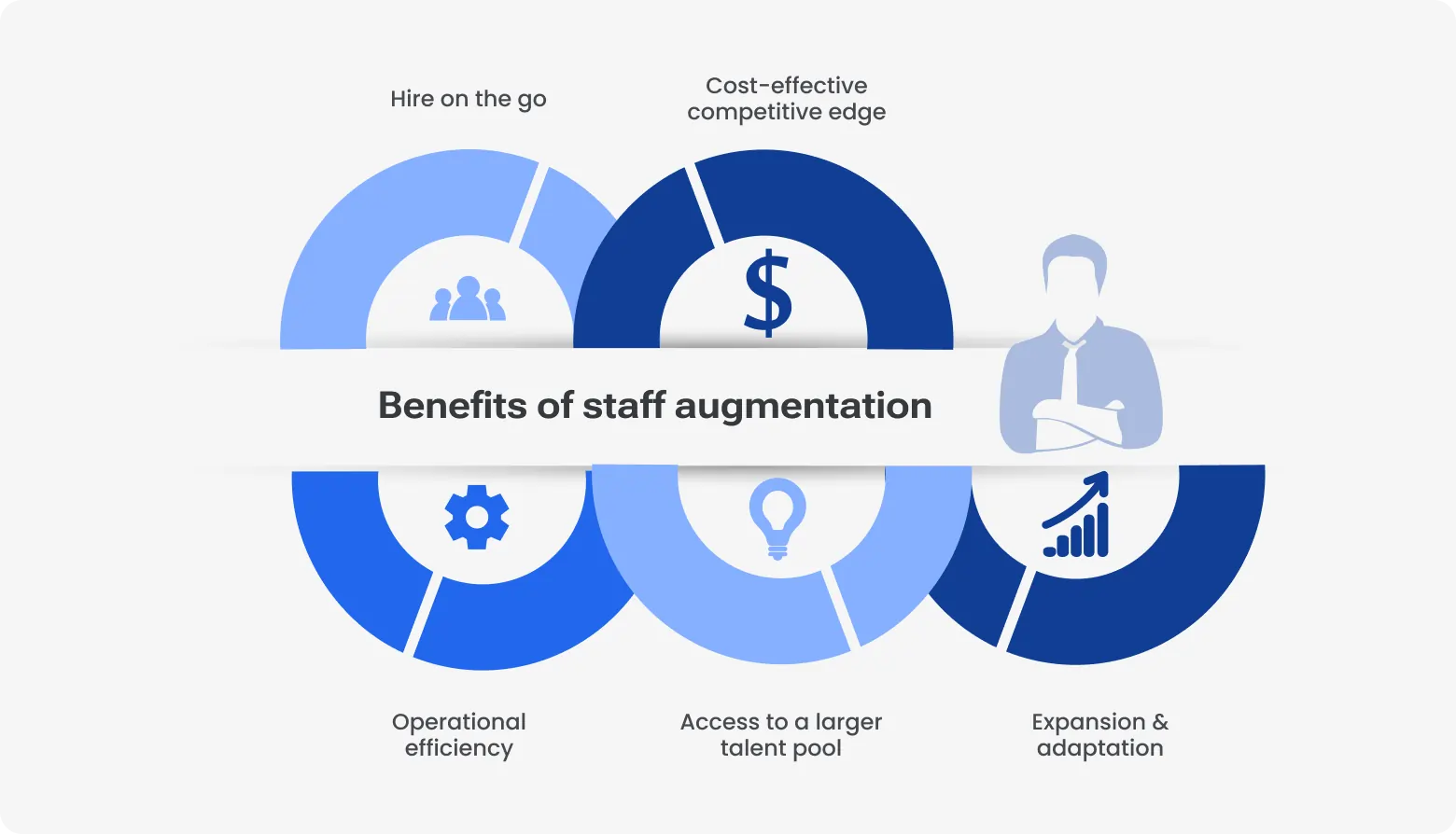
Benefits of staff augmentation
So, what does a good staff augmentation company help with?
They ramp up your team quickly, without you spending weeks recruiting and interviewing.
They bring hard-to-find expertise – those niche skills that would otherwise sit on your wish list. According to Global Growth Insights, 45% of companies adopt IT augmentation services because of specialized skill access, while 46% opt for it due to the opportunity to reallocate internal resources towards innovation and strategic initiatives.
They integrate, not just plug in. They learn your way of working and adapt, so your sprints don’t turn into chaos.
Finally, they keep an eye on quality, performance, and alignment, so you’re not constantly checking every line of code.
Working with a good partner is very beneficial: projects move faster, your internal team focuses on core tasks, staff augmentation risks are mitigated, and you have fewer headaches.
Staff augmentation for MVP development vs for scaling
A great staff augmentation company provides you with not just extra hands but capable minds that drive your business forward. You know the collaboration is efficient when delivery stays predictable, and you see almost no difference between managing augmented and in-house team members.
The costly illusion of ‘cheap rates’
Unfortunately, staff augmentation companies are not the same. Some are diligent and reliable; others bring more trouble than benefit. How do businesses get pulled into working with the latter? As a rule, everything starts with rates that look too good to pass up. When budgets are tight and delivery pressure is high, a cheaper staff augmentation offer often feels like a smart and even responsible decision.
The truth is that really competent IT professionals don’t agree to work for ‘bread and water’ only. When an offer is cheaper than the market average, there is a high likelihood of dealing with a junior-heavy team.
The worst thing is that clients of such bad staff augmentation partners usually cannot recognize the scale of a problem early on. There is nothing dramatic at first. Velocity just feels a bit off, releases slip, quality discussions come up more often, and management overhead quietly grows.
However, at a certain moment, the illusion finally breaks. It becomes obvious that while the hourly rate is low, the total cost is too
high because of constant rework, bug fixing, reviewing, delays, unpredictable delivery, lost market opportunities, and other hidden costs. We don’t like to generalize, but there is a clear pattern: developers at lower rates often create expensive problems.
It’s unpleasant to admit, but research shows that 40% of companies encounter hidden or unexpected costs in outsourcing engagements. Very often, these costs come from working with untrusted and unethical partners.
Motivated and focused experts for up to 60% less than locals, delivered in days, not months
Delivery delays that push your entire roadmap back
No one likes delays, but in projects we face them from time to time – such is life. But for bad staff augmentation partners, delays are the norm.
Usually, these delays slip in quietly. You know, a sprint that runs a bit longer, a release pushed back by a few days, a dependency that doesn’t land on time. On their own, these issues seem to be quite manageable. Yet, together, they pull your roadmap off track.
The most dangerous aspect is that it delays compounds. One slow sprint pushes the next, and buffers disappear. Finally, the roadmap you carefully planned no longer reflects reality. Work on the project eventually gets blocked as designers pause, a QA team stays idle, and PMs readjust plans instead of moving them forward. A vendor delay paralyzes the internal team.
And the consequences impact not only delivery. The opportunity costs – missed market windows, lost revenue, slower customer acquisition, or even a delayed fundraising round – cannot be measured accurately but can hit hard.
Code quality issues that multiply over time
Irresponsible staff augmentation partners may introduce poor engineering practices that affect code quality – cutting corners, skipping tests, treating architecture as an afterthought, etc. Over time, you face serious issues that cost you a lot. We’d like to point out some of them:
Growing number of bugs: Low-quality code contains a lot of defects that are hard to reproduce and resolve.
Focusing on bug fixing: Instead of developing new functionality, your team fixes and refixes issues, trying to eliminate the consequences of previous shortcuts and mistakes.
Fragile codebase: Duplicated logic, hidden dependencies, tightly coupled components, hard-coded configurations, and workarounds make a system vulnerable and hard to maintain. Consequently, refactoring becomes risky, and adding new features takes more time.
Hard-to-scale architecture: Wrong architecture decisions made at the project outset hinder future growth. The system resists changes, and, therefore, new features require huge effort, performance tuning becomes challenging, and scalability improvements turn into complete rewrites.
Higher QA costs: QA efforts rapidly grow, and testing cycles get longer while confidence drops.
Technical debt that slows future releases: Shortcuts taken today complicate tomorrow’s work. At a certain moment, even outstanding engineers slow down because the system fights every change.
A bad vendor doesn’t just deliver messy code but also leaves behind a product that’s hard to change, slow to evolve, and expensive to maintain. If you want to avoid staff augmentation problems, check and double-check every potential partner.
Lack of product ownership = slow progress
Some staff augmentation companies provide task-doers, not strategists. And that difference costs you time, energy, and progress.
Let’s say you ask for a new feature, and instead of thinking about the best way to implement it, developers follow instructions to the letter. At the end of the day, you get what you’ve asked for, but not what you actually need. That’s one of the most common developer outsourcing risks.
Without product ownership:
No proactive thinking: Engineers don’t flag a problem until it blows up and wait for instructions instead of suggesting improvements.
No planning: Work is executed sprint by sprint, day by day, with little structure or foresight. Dependencies are missed, and priorities keep shifting.
No responsibility for outcomes: If something goes wrong, engineers follow directions but don’t feel accountable for the fallout.
Low engagement with the business context: Augmented developers build features, but they don’t really understand why these features matter. Because of this, decisions become tactical, not strategic.
As a result, instead of collaborating with engineers, you manage them, constantly checking, clarifying, and redirecting. What should feel like teamwork turns into a cycle of instructions and follow-ups.
High management overhead and constant babysitting
Above, we discussed that a lack of product ownership and strategic thinking slows progress down. Yet, things can get even worse when those task-doers cannot work autonomously, even with adequate instructions in place. In this case, the burden of spoon-feeding lies on your internal team. Suddenly, leads, PMs, and CTOs find themselves doing things they shouldn’t:
Explaining the same task multiple times.
Realigning priorities because augmented team members misunderstood the last set of instructions.
Tracking missed deadlines instead of focusing on the roadmap.
Documenting every little step just to avoid errors.
Micromanaging day-to-day execution instead of guiding strategy.
All of these add up to hours or even days taken away from the work that actually drives your business forward. In reality, it’s not just wasted time. It misses opportunities to innovate, plan long-term, and lead your team effectively. Apart from delivering slowly, bad staff augmentation partners also force most senior people into babysitting and firefighting, which is far more expensive than the offered hourly rate.
No QA culture = more bugs, more regressions, more rework
In underperforming teams, quality is often seen as someone else’s job. Developers write code, push it, and move to the next task. Testing, in turn, is something QA will catch later, not a responsibility shared by the engineering team.
When there is no QA mindset, the same problems repeatedly show up:
Unit tests are skipped or written just to hit coverage metrics
Edge cases are ignored unless explicitly specified in the ticket
CI/CD discipline is inconsistent
Bug fixes are narrow and rushed, with no validation of related logic
Code reviews are rushed or ignored
Documentation is treated as optional
At first, this may feel fast. Code ships, tickets close, and everyone looks productive – there is nothing to worry about. In reality, a fragile system is created where every change comes with hidden risk. Features pass initial checks but break something a sprint later.
That’s when the hidden costs of staff augmentation creep in in the form of rework:
Developers keep returning to the same parts of the codebase
Regressions show up after ‘done’ features are already in production
New tasks get blocked by piled-up fixes
Sprints fill up with fixes instead of progress
When developers don’t treat quality as their job, bugs multiply, and the team spends more time fixing yesterday’s mess than building anything new. Every release feels risky, every change needs double-checking, and speed also drops, not because the product is hard, but because the team has to always clean up after itself.
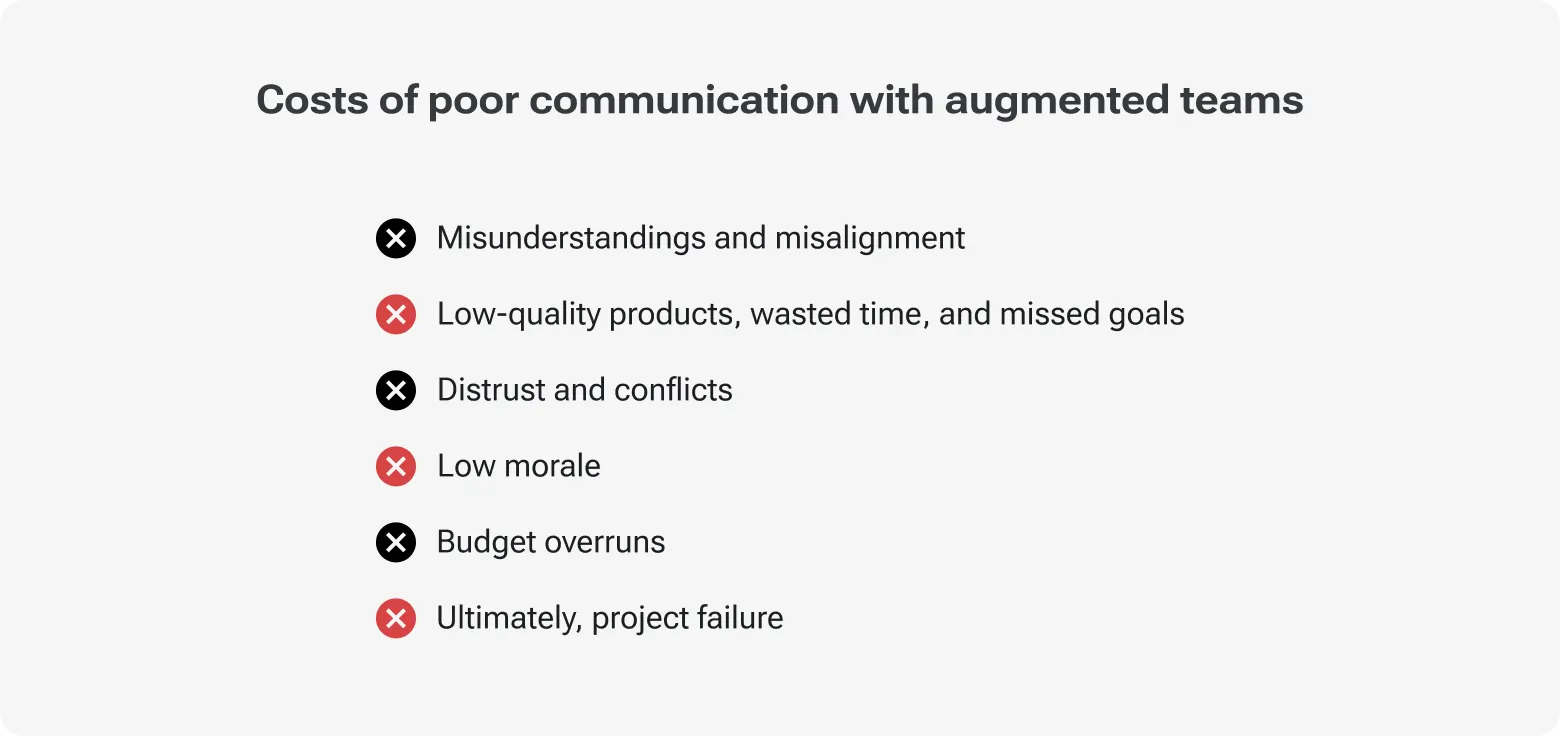
Poor communication that derails productivity
When communication is unclear, productivity quietly bleeds away. Many know it but forget it when the offered rates are too attractive. Later on, it brings serious staff augmentation problems that burn your budget. In fact, 50% of IT projects fail due to breakdowns in communication.
The key reason for inefficient communication is poor English. When developers have a limited command of the language, nuances get lost. Being afraid of sounding incompetent, people don’t ask clarifying questions about requirements, constraints, priorities, etc., and move forward with assumptions instead.
Another common reason is insufficient communication discipline. Updates are vague, blockers are voiced too late, and feedback loops are too long.
Consequently, there are a lot of misunderstandings, which lead to incorrect implementation. Fixes follow, and progress quietly slows.
To make it up, teams usually set up additional meetings. Sync calls multiply, and clarification sessions replace actual work. A task that should have been completed in a day takes a week, and much of it is spent explaining, re-explaining, and coordinating.
In distributed teams, things might be even worse because of async communication. Messages run across different time zones, replies may come hours later, and decision-making stays on hold. Context also gets fragmented across chats, tickets, and calls, making alignment harder.
Over time, trust weakens. Not relying on augmented developers, internal staff start double-checking every nuance. Communication transforms from collaboration to damage control.
The cost isn’t just slower delivery. It’s the ongoing productivity drain caused by misunderstandings and the need to over-communicate to keep the project moving.
Unstable teams and constant developer turnover
About 48% of businesses report a high attrition rate in augmented teams. Bad providers indeed switch developers frequently. Sometimes this happens because vendors treat engineers as interchangeable units, and sometimes because specialists go away seeking better conditions. Either way, this churn brings you troubles.
Every new developer requires 2–6 weeks to get up to speed, learning the codebase, adapting to your processes, and understanding past decisions. Meanwhile, your team slows down, explaining context, clarifying past decisions, and filling in the gaps left by departures
Finally, your project suffers from:
Knowledge loss: Key decisions, trade-offs, and insights vanish with people’s leave, forcing the team to rediscover what was already decided.
No ownership: Developers who don’t plan to stay rarely take full responsibility for outcomes, leaving issues for others to fix.
Broken team culture: Frequent changes affect collaboration, trust, morale, and cohesion.
Re-onboarding cycles: Internal leads spend highly paid hours onboarding each new developer.
Low speed: Sprints are focused more on ramping newcomers instead of shipping new features.
High turnover is an enemy of progress. Projects slow down, costs rise, and your team’s morale takes a hit. Once you notice such a tendency, it’s time to have a serious talk with your vendor. It’s better to handle developer outsourcing risks immediately.
Hidden contractual limitations and extra fees
A low hourly rate can be perceived as a big win. But don’t rush to celebrate it until you thoroughly examine all contract terms. Some staff augmentation vendors sneak in clauses that increase your costs. That’s one of the key staff augmentation risks.
Watch out for these tricks that unethical providers use:
Minimum monthly commitments: You may be obliged to pay for a specified number of hours regardless of whether you actually need them. In fact, it’s like buying a whole car when you actually need just a set of new tyres.
Change request fees: Want to adjust priorities, tweak requirements, or ask for minor scope changes? The vendor can add extra charges. With a partner of that kind, flexibility can break your budget.
Limited notice periods: Scaling down or ending cooperation may not be as easy and quick as you thought. Some contracts require weeks or even months of notice, keeping you paying for developers you don’t need anymore.
Overcharging for senior talent: Some staff augmentation companies may bill you at senior rates but actually provide mid-level engineers. Those ‘senior developers’ you hired may have the title, but not the experience and skills to match. In fact, 59% of IT outsourcing contracts face difficulties because of the inadequate technical experience of augmented staff.
Not to get tricked, you need to look for transparency. A trustworthy partner clearly explains what’s included in the contract and outlines all potential fees upfront. When everything is out in the open, you avoid staff augmentation problems, control your costs, and keep your project running smoothly.
How to spot bad staff augmentation partners – red flags
Finding a reliable staff augmentation partner isn’t a matter of luck but takes some legwork. Some providers may have impressive websites and sleek presentations. However, what looks good in words may cost you time, money, and mental wellness down the line in practice. Our advice: don’t take promises at face value.
To avoid developer outsourcing risks, watch out for these red flags:
Junior-heavy team presented as senior: Engineers deemed to be senior aren’t always senior in reality. Therefore, always ask for proof of expertise.
Vague CVs, no real project history: If past work cannot be explained and verified, be cautious.
No video call before hiring: A call with a developer is the best way to assess communication and competence. If a provider avoids or refuses to set it up, this is definitely a red flag.
No long-term references: A trustworthy partner is always ready to connect you with their long-standing clients for honest feedback.
No trial period: If a vendor doesn’t offer a PoC or a small pilot, you risk working with a company that cannot cover your needs.
High turnover in the first month: Frequent staff changes indicate instability, which, as we discussed, is a source of trouble and additional costs.
Adding more hours instead of solving the cause: If the vendor’s solution to every problem is more billed time, something is wrong. Your partner might be either incompetent or deliberately padding hours.
Poor documentation and lack of transparency: If you can’t see what you’re getting or understand how augmented staff work, issues pop up later.
If you spot one or a few of these red flags, dig deeper immediately. Detecting problems early saves you from endless fixes, missed deadlines, and other hidden costs of staff augmentation.
What good staff augmentation looks like
We talked about unreliable staff augmentation companies quite a lot and think that the other side – trusted partners – should be highlighted too. Collaboration with such vendors feels boring in the best possible way – predictable, efficient, smooth, and without any drama or extra costs.
Here are signs you are dealing with a service provider, collaboration with whom won’t result in staff augmentation problems:
1. Transparent hiring
You know exactly who joins your team and why. There are real CVs and interviews with each candidate (a few rounds of interviews if needed), making you confident in the suitability of the hired resources.
How to evaluate offshore engineers before hiring (complete checklist)
2. Balanced seniority
A team of seniors on paper and juniors in practice - that’s not how diligent vendors work. They mix senior, mid, and supporting roles intentionally, so work moves fast and in the right way.
3. Stable teams
Strong staff augmentation companies do their best to retain their engineers and don’t juggle them between different projects. As a result, context is preserved, ownership grows, and you don’t re-onboard every few months.
4. Clear development processes
Code reviews are standard, not optional. QA is built into development. Sprint rituals work well and bring value. Irrespective of the role, staff bring in best practices.
5. Regular reporting
Augmented engineers provide comprehensive reports so that you see progress, risks, and next steps and can make decisions promptly.
6. Ownership mindset
Engineers you bring in via a staff augmentation company don’t just perform tasks. They ask questions, point out risks, suggest better approaches, and genuinely care about outcomes and product success.
7. Security-compliant setup
Access control, data handling, and internal policies are taken seriously from day one – good vendors know how important security is, especially for regulated or enterprise environments.
8. Predictable delivery
You’re not caught flat-footed by missed deadlines or last-minute excuses because estimates are realistic and any slippage is discussed early.
9. Engineering leadership support
When things get complex, and an in-house team requires a fresh view or a consultation, the vendor’s leads are ready to step in to review architecture, challenge weak solutions before they become expensive problems, or share their expertise.
These are the standards we hold at Devico, taking care of the success of our clients and our own reputation.
Final thoughts – The real cost of a wrong choice
Hidden costs in staff augmentation don’t come from the model itself; they come from the wrong partner.
Low rates often hide real expenses: extra supervision, rework, delays, and lost momentum. In practice, total cost includes not only hourly fees but also the time your internal team spends managing, correcting, and compensating for poor delivery.
To avoid this, focus on fundamentals:
prioritize seniority and ownership over price
validate communication and processes upfront
look at total delivery cost, not just rates
When done right, staff augmentation accelerates delivery instead of slowing it down. Investing in a reliable partner with mature processes is often more cost-effective than fixing the consequences of a bad choice later.
At Devico, we build teams around experienced, autonomous engineers with clear communication and transparent costs, so staff augmentation risks go down, not up.
Great software starts with great people