Outsourcing to PolandJul 01, 2025
How to Choose a Software Development Company in Poland
A 2026 checklist for vetting Polish software vendors: registry and financial checks, IP transfer, B2B contractors, rates, security, contracts, and red flags.
Hire
Hire by role
Hire Front-end developers
Hire Back-end developers
Hire Full-stack developers
Hire Android developers
Hire iOS developers
Hire Mobile developers
Hire AI engineers
Hire by skill
Hire JavaScript developers
Hire React Native developers
Hire React.js developers
Hire .NET developers
Hire TypeScript developers
Hire Flutter developers
Hire Golang developers
Hire by country
Devs in Ukraine
Expirienced engineers with strong product focus and fast integration.
Devs in Poland
EU-based developers with reliable delivery and high standards.
Devs in Argentina
Senior engineers with strong technical depth and timezone alignment.

Summarize with:

Leave your email and we will inform you about all our news and updates
Czechia and Poland are neighbors with a lot in common. Both are in the EU and on Central European Time, both have strong technical universities, and both have long sold software services to Western companies.
The real differences are scale, cost, and legal detail. Poland's ICT industry employs about 325,000 people, while Czechia counts about 135,000 ICT specialists. Polish rates are typically 15–25% lower than Czech rates at comparable seniority. Czechia, in turn, offers a smaller, very stable market with high productivity and a strong engineering tradition, especially in Prague and Brno.
In short, choose Poland when you need to scale a team quickly or keep costs down. Choose Czechia when you need a mid-sized, highly stable team and are ready to pay a premium for it.
This guide compares the two on rates, talent, English, legal setup, collaboration, and long-term scalability.
Poland's IT outsourcing market is roughly 1.7 times the size of Czechia's. Statista projects IT outsourcing revenue of USD 4.11 billion in Poland and USD 2.42 billion in Czechia for 2025. Poland's wider IT/ICT market is valued at more than USD 31 billion in 2025 by PARP, Poland's enterprise development agency, and the country exported EUR 14.25 billion of IT services in 2023.
The talent pools differ mainly because the countries differ in size: Poland has about 38 million people, Czechia about 11 million.
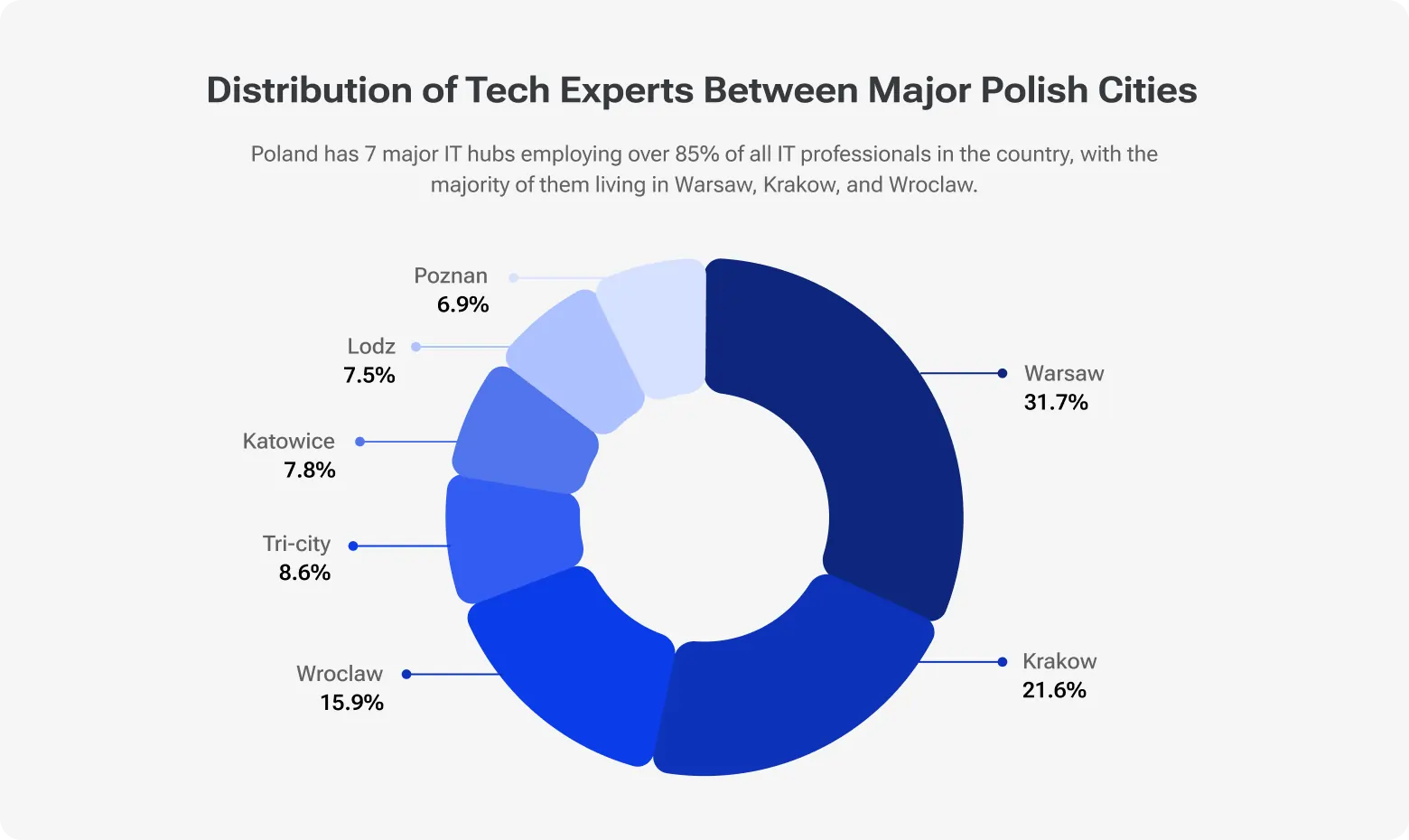
In Poland, talent is spread across seven major hubs, led by Warsaw, Kraków, and Wrocław. In Czechia, it is concentrated in Prague and Brno, with Ostrava as a smaller hub. For buyers, Poland offers more choice of cities and vendors. Czechia's concentration means a close-knit market where reputations travel fast.
Both countries have reliable, fast infrastructure. In Surfshark's 2024 Digital Quality of Life Index, Poland ranked 20th globally and Czechia 27th.


Czech engineers earn more than Polish ones, and Czech employers pay higher social costs. Czech ICT specialists earned an average of about CZK 100,000 gross per month in 2025, according to the Czech Statistical Office. Czech employers add about a third on top for social and health insurance, compared with roughly a fifth in Poland. As a result, vendor rates in Czechia are typically 15–25% higher than in Poland.
For a breakdown of Polish rates by role and tech stack, see our analysis of software development rates in Poland. For Czechia, read how much it costs to hire developers in Czechia.
Both countries produce strong engineers in mainstream stacks such as Java, JavaScript, Python, .NET, and C++, which is why many companies that hire software developers in Eastern Europe put them on their shortlist first. Poland's larger pool makes it easier to staff big teams and rarer specializations such as data, DevOps, and AI/ML quickly. Czechia's smaller market has lower turnover in many companies and a strong tradition in embedded systems, cybersecurity, and enterprise software, helped by the large engineering centers of international companies in Prague and Brno.
English is strong in both. Poland ranks 15th of 123 countries in the EF English Proficiency Index 2025 with a score of 600 ("very high"). Czechia ranks 23rd with a score of 582 ("high"). In practice, engineers at established vendors in both countries work in English every day.
Both countries are EU members, so GDPR applies directly and EU clients need no transfer mechanism for personal data. The differences are in the details:
If you plan your own center rather than outsourcing, our guide to setting up a software development center in Poland covers the legal steps, taxes, and hiring.
Czechia and Poland share Central European Time (UTC+1, or UTC+2 in summer). Both are in the same working day as Germany, France, and the Netherlands, one hour ahead of the UK, and six hours ahead of the US East Coast, which leaves two to three hours of overlap.
Both countries work well for UK companies: one hour ahead, a short flight, and strong English. UK clients often also compare them with Ukraine, which is two hours ahead and cheaper but carries war-related risks. Our comparison of Ukraine vs Poland for software outsourcing covers that choice.
Business cultures in both countries are direct and pragmatic. Engineers say openly when a requirement is unclear or a deadline is unrealistic. Czech teams tend to be informal and flat, with less hierarchy. Polish teams tend to be more process-driven and structured, which helps on large, multi-team projects.
Poland's main advantage is room to grow. With about three and a half times Czechia's population, seven major tech hubs, and a large outsourcing industry, it is easier to grow a team from five to fifty engineers there, or to add rare skills mid-project. Czechia suits teams that will stay small to mid-sized for years. There, the stability of the team and the depth of its domain knowledge matter more than how fast it can grow.
Poland is the better choice for most companies that need to scale, want a wider choice of vendors and skills, or are cost-sensitive. Czechia is the better choice for smaller, highly stable teams where a premium rate buys continuity and a close-knit engineering culture. Both give you EU legal protection, strong English, and Central European Time. Whichever country you choose, vet the vendor itself: its registry record, contracts, and the engineers who will actually join your project.
Devico, headquartered in Warsaw, builds engineering teams in Poland, Czechia, and other European countries. If you are deciding where to build your team, talk to our team about the setup that fits your project.
Poland is better for scaling, cost efficiency, and access to a large talent pool across seven tech hubs. Czechia is better for smaller, highly stable teams where you are ready to pay 15–25% more for continuity and a close-knit market.
Poland. Typical Polish vendor rates are USD 40–60 per hour for mid-level engineers and USD 60–85 for seniors. Czech rates are usually 15–25% higher, about USD 50–70 and USD 70–100.
Yes. Both use Central European Time (UTC+1, or UTC+2 in summer), the same as Germany and France and one hour ahead of the UK.
In Poland, copyright can be transferred in writing, provided the contract lists the fields of exploitation. In Czechia, economic rights cannot be transferred, so clients receive an exclusive license. Its scope should be unlimited and allow modification and sublicensing.
Both work well: they are one hour ahead of the UK, a short flight away, and have strong English. Poland offers a larger talent pool and lower rates. Czechia offers a smaller, very stable market.
Still have a question?
Talk to us