Whether you need to develop an MVP or expand the development capacity of an established product, staff augmentation can be an efficient move. Yet, the work at these two stages is done under very different conditions, and those differences make more impact than most teams expect.
At the MVP stage, you race against time and changing requirements. When scaling, you race against complexity, load, and internal bottlenecks. Pressure, expectations, and risks are different in each case. As a result, you should engage not just external specialists but external specialists with the right skillset and mindset for the stage you’re in.
In the article, we’ll highlight key differences between MVP and scaling that affect how you should approach staff augmentation to avoid pitfalls.
Staff augmentation for MVP development – what it actually requires
MVP development is a unique phase of the product lifecycle. It’s kind of an experiment. You test your assumptions under pressure, usually with a limited budget, time constraints, and a strategy that changes every few weeks or even days.
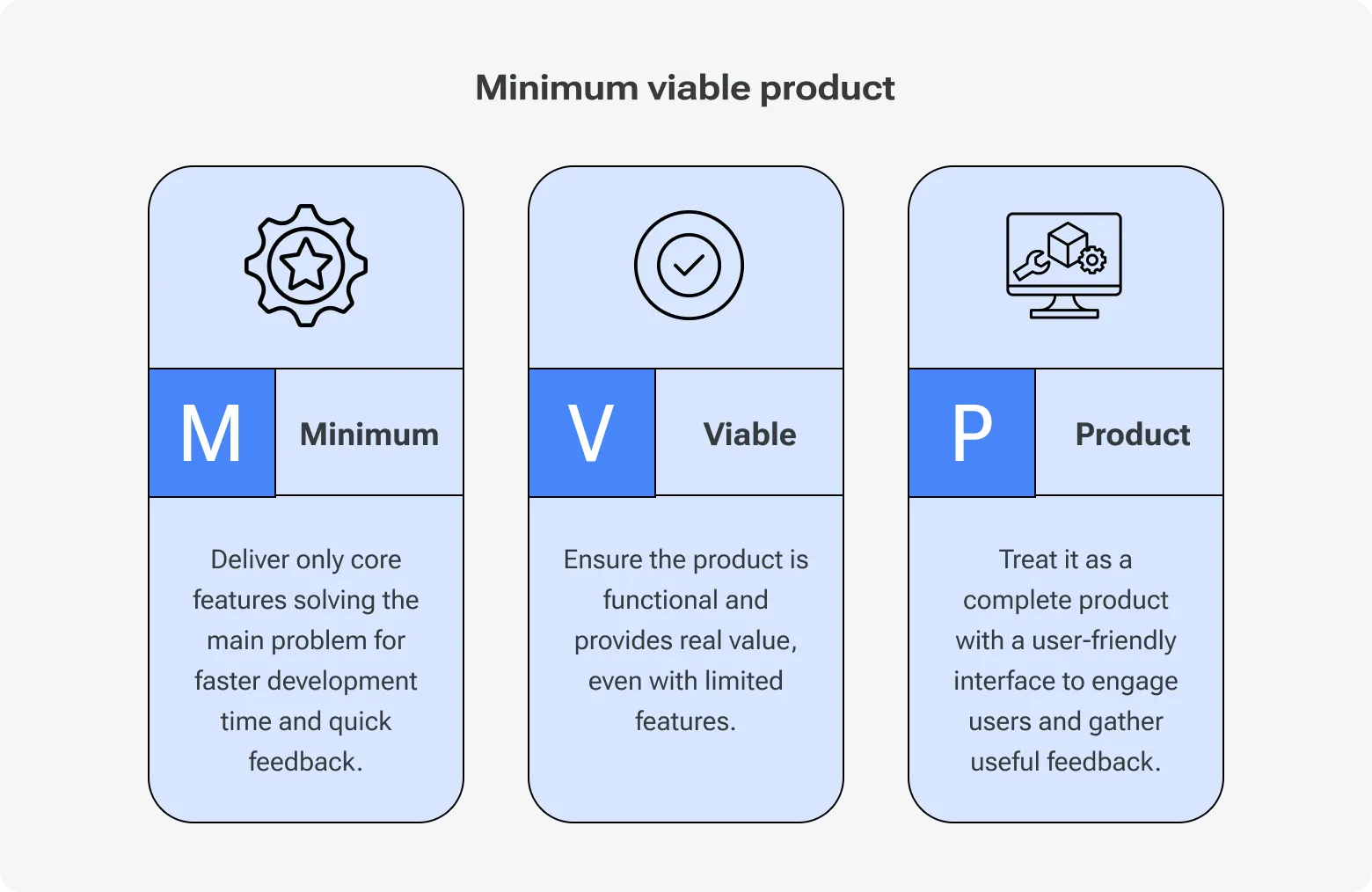
MVP explained
MVP development is inherently unstable: priorities shift weekly, and requirements evolve constantly.
To understand the nuances of MVP development team augmentation, let’s look at the nature of the work itself. MVP is developed under conditions that are completely different from working on established products.
Speed over perfection
The goal of any MVP is to check if a product concept really resonates with the target audience. That's why teams strive to release something functional quickly rather than to polish every detail. If a feature works well enough to collect initial feedback, the job has already been done.
Small teams
MVP development is usually handled by a tightly knit team, where communication is direct, and decisions are made quickly. 2-4 full-stack developers for an MVP are usually enough. Because fewer people are involved, iteration cycles are shorter, and coordination overhead is low.
Lack of structured processes
Far too often, MVP projects don't have clear workflows, requirements, and release routines at their outset. As a rule, teams set up processes as they go, adjusting them to whatever helps move the product forward as fast as possible.
Feedback-driven iteration
Early releases allow teams to learn from users. They track behavior patterns and collect feedback to adjust the product accordingly, often changing earlier made decisions. Development, therefore, moves in short cycles where learning is more important than feature volume.
Changing requirements
As we mentioned above, early user feedback continuously redefines the direction of product development. Features get modified, replaced, or even removed as a team learns what users want. Stats show that 10% of startups pivot two or more times before success.
Minimum documentation
Because the product is evolving very quickly, extensive documentation can become outdated in the blink of an eye. That’s why most MVP teams keep documentation light and practical – just to capture key decisions without slowing down development.
Based on these realities, companies should clearly understand what to look for when bringing augmented engineers into an MVP project.
Motivated and focused experts for up to 60% less than locals, delivered in days, not months
What does a good augmented engineer for MVP development look like?
The right engineer profile is half the battle for any project. Here is a portrait of a good augmented engineer to build an MVP:
Strong generalist. Hyper-specialization doesn’t make sense when building an MVP. Engineers who can wear multiple hats, touching backend logic one day and improving a user flow the next, bring far more value than narrowly focused experts.
Not obsessed with perfection. At this stage, polishing every little detail can slow development and distract from the main goal. When hiring developers for an MVP, look for practical thinking, creativity, and the ability to prototype quickly.
High adaptability. This ability is tied to the one mentioned above. When developing MVPs, priorities change fast, features get reworked, and new feedback or insights constantly impact the work. Engineers need to adjust without delays and frustration. In fact, 53.8% of developers admit that adapting to changing requirements is one of their biggest challenges. That’s why it’s vital to bring someone who can handle this calmly and proficiently.
Able to work autonomously. Augmented engineers should be able to work without supervision and make sound technical decisions independently while keeping the broader product goals in mind.
Product-aware rather than task-focused. The best MVP developers understand the business side of the product as well as the technical side. They pay attention to user needs and adjust their approach accordingly.
Ownership mindset. In small MVP teams, engineers often go beyond strictly defined responsibilities. They detect problems, suggest improvements, and take initiative instead of waiting for someone else to raise the issue.
Staff augmentation for scaling – very different requirements
Once a product proves its viability and starts gaining traction, the game changes. The chaos of the MVP stage gets replaced with structured growth.
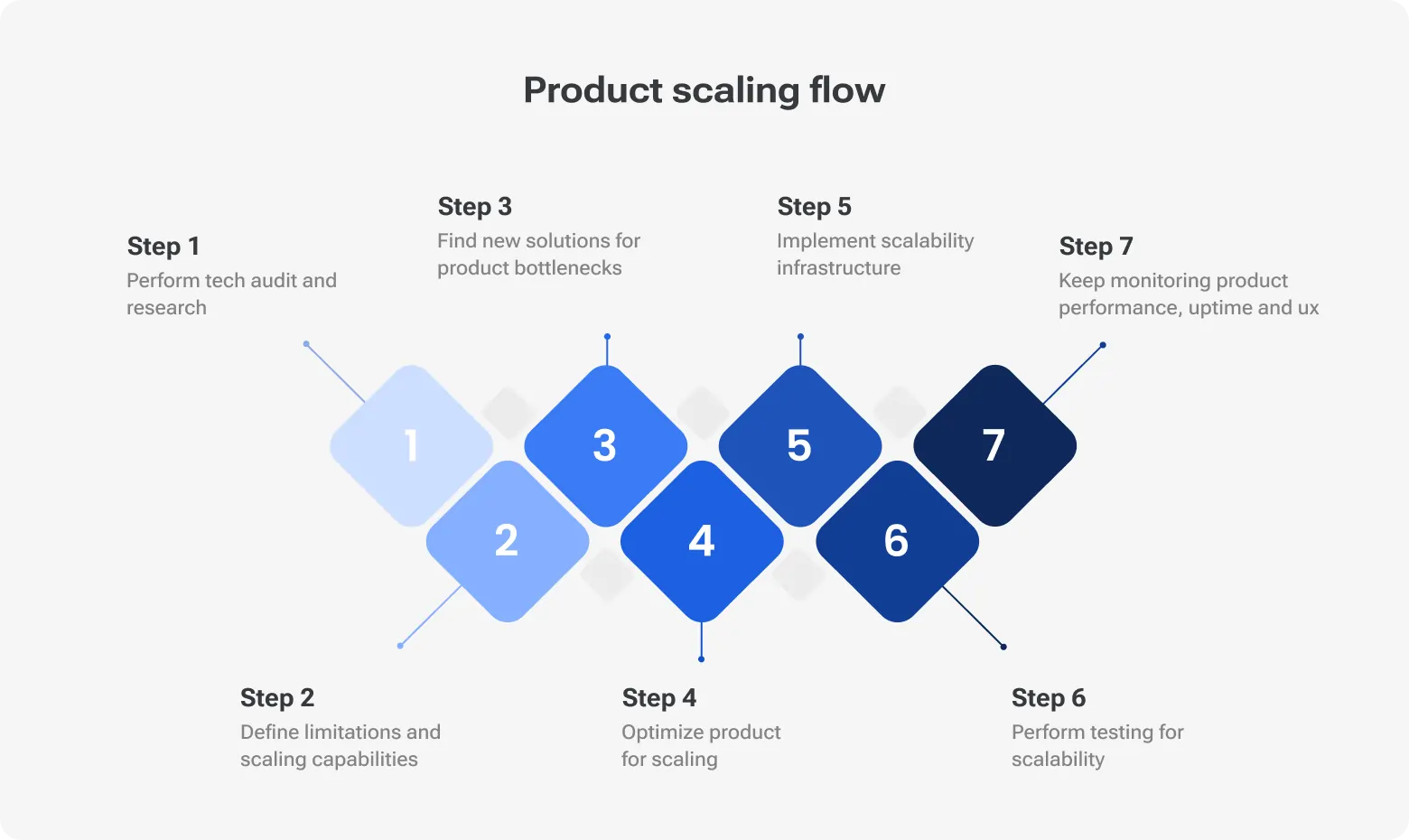
Product scaling flow: 7-step process from audit to continuous monitoring
Treating scaling like an MVP, i.e., moving fast without process, relying solely on generalists, or ignoring structure, is a way to accumulate technical debt and operational headaches.
This stage has a number of hallmarks you need to know.
Predictability over speed
Yes, speed is still important, but reliable and stable delivery becomes the main priority. The product scaling engineering team cannot afford rushed releases that may affect production or users' experience. At this time, seamless development cycles and stable releases become more valuable than rapid task completion.
Larger teams
Product growth always comes with the engineering team ramp-up. 5-15 specialists are the norm, and with more people involved, efficient coordination and communication are vital for preventing productivity losses.
Structural processes
At this stage, key workflows are usually set up, enabling smooth expansion. The best QA practices, CI/CD pipelines, and regular code reviews help teams meet deadlines and ensure high quality.
System complexity
As the number of users, features, and integrations grows, the product becomes more and more complicated. As a result, changes made in one of its modules can impact others. Thorough planning and profound knowledge of the architecture are needed to avoid such problems.
Clear responsibilities
The product and team growth requires a clear distribution of responsibilities. Each service or feature should have particular owners accountable for its development and maintenance. This prevents confusion as well as improves the speed of work.
Technical debt
During MVP creation, shortcuts are often unavoidable. Yet, when scaling begins, they quickly turn into technical debt, creating headaches and adding extra costs. Teams must implement efficient technical debt management to prevent slowing down or reliability issues.
Comprehensive documentation
Rapid scaling is impossible without structured knowledge sharing. Clear documentation helps onboard new engineers faster and ensures that system knowledge doesn’t disappear when someone leaves the team.
What does a good augmented engineer for scaling look like?
A profile of engineers for scaling engineering team augmentation is completely different. You need someone with a skill set suitable for adding capacity in a strategic way. Here’s what we recommend looking for when bringing in augmented staff during the scaling phase:
Scaling calls for deep expertise. Engineers specializing in a given domain – let's say backend, frontend, DevOps, performance optimization, or security – create much more value. This focused expertise lets teams solve tricky problems faster and build systems capable of handling rapid growth.
As discussed above, scaling environments usually have established engineering workflows. Therefore, augmented engineers should feel comfortable working with existing engineering practices, pipelines, and development standards. Processes should be treated not as bureaucracy but as a mechanism that protects product stability and speed.
Look for an engineer who can see your product as a system rather than a mix of features. They should know how different components interact, anticipate dependencies, and understand how modifications in one area may influence others. This skill helps avoid many headaches and problems along the way.
Knowledge sharing is gaining in importance during scaling. That’s why developers should be really good at explaining complex technical decisions and documenting system architecture and processes. With proper documentation in place, your newcomers will get up to speed faster, and critical knowledge won't be lost.
Scaling engineers always prioritize reliability over quick shortcuts by writing code that is easier to maintain and extend over time. Their focus on long-term stability helps the product grow without tackling the same technical problems all the time.
Avoid operational and HR hassle and the constant threat of attrition with your own R+D department from Devico
MVP team vs scaling team
An MVP team is a far cry from a scaling team. This affects staff augmentation, from the objectives you set to the type of engineer you engage.
We'd like to draw your attention to the key aspects:
Goal
MVP teams need to prove that the product concept makes sense and has real potential. The main focus is on speed and experimentation, delivering features fast enough to collect initial user feedback.
Scaling teams, in turn, strive to enable the product to grow smoothly. Stability and maintainability here are just as crucial as speed.
Risks
In MVP development, the biggest risk is building the wrong product or missing market fit. Technical shortcuts are the norm if they speed up learning.
Scaling teams face much more risk, including system failure, performance bottlenecks, and accumulated technical debt. Besides, mistakes at this stage are more expensive because the product already has a user base relying on it.
Team composition
MVP teams are usually pretty small. As a rule, they include:
Part-time DevOps - optional
Scaling teams grow pretty quickly. Often they consist of:
Team lead or delivery manager
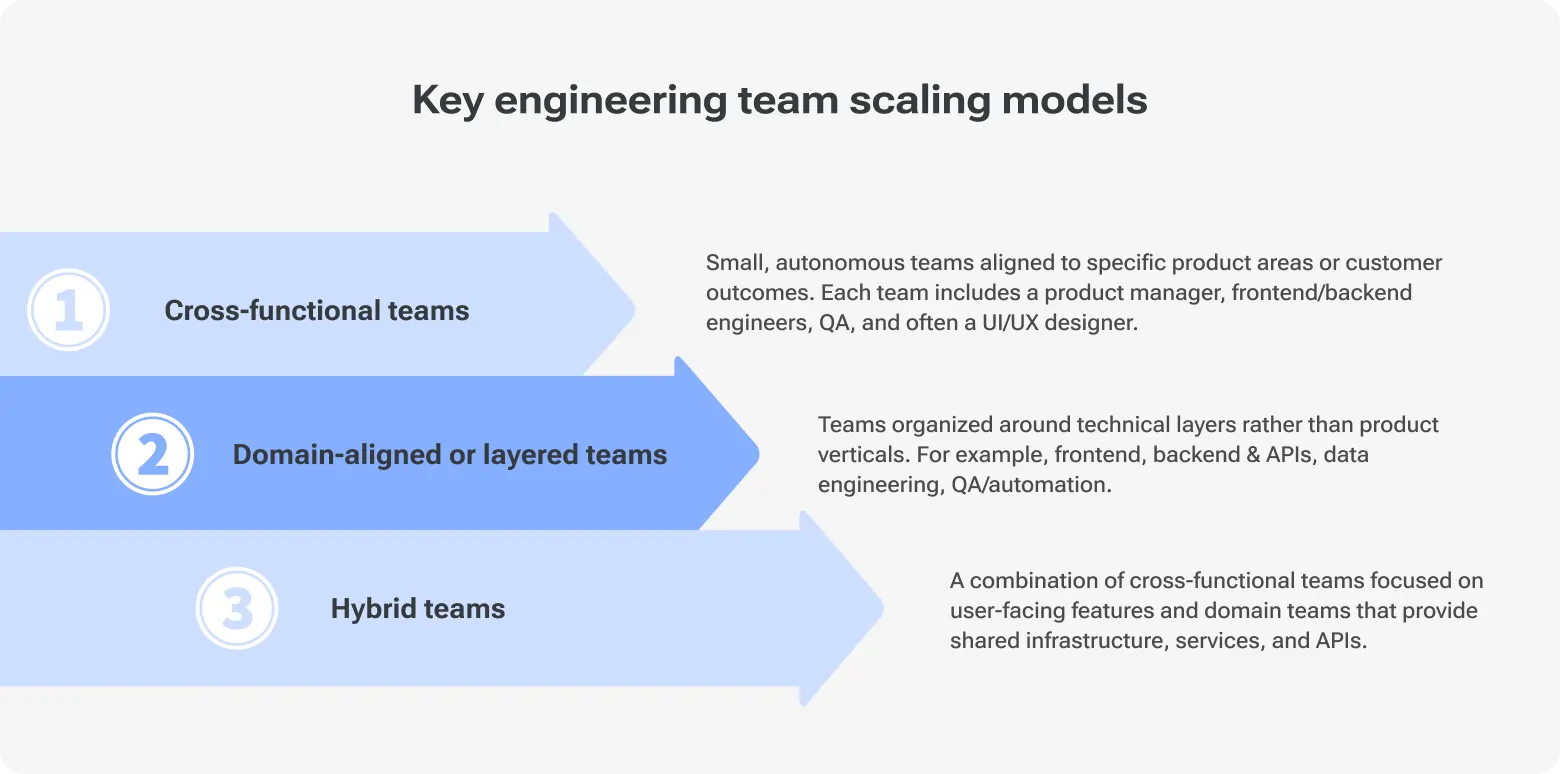
In general, during scaling, teams can be organized in different ways: cross-functional teams, domain-driven teams, or hybrid teams.
Key engineering team scaling models: cross-functional, domain-aligned, and hybrid team structures
Internal processes
Lack of structured processes is common for MVP teams.
You have all the chances to see the following:
Rapid clarification cycles
Using Slack or Loom instead of heavy documentation
No formal sprint cycles (or very light ones)
Scaling teams, on the contrary, depend on structured processes that keep everyone on track and ensure high quality and speed.
Here, you’ll observe:
Monitoring & observability
Documentation
Working on MVPs, teams capture only key decisions to be able to move faster without getting stuck with documentation.
For scaling teams, comprehensive documentation containing architecture diagrams, process descriptions, and knowledge-sharing records is a must. This way, continuity and faster onboarding are ensured.
Engineer profile
MVP teams usually benefit from generalists who can tackle different types of tasks, deal with ambiguity, and make autonomous technical decisions. In contrast, scaling teams thrive with narrow specialists who bring deep domain expertise, systems thinking, and a focus on long-term stability.
When you're still figuring out what the problem really is, broad expertise is helpful. But once the diagnosis is clear, precise specialization becomes necessary.
Contract duration and ownership
Staff augmentation for MVP development often involves short-term contracts, since the goal is to deliver results quickly. Engineers usually take flexible ownership and move across different tasks as needed.
When it comes to augmentation for scaling, it usually involves longer-term contracts. Engineers assume clear ownership over components or systems, contributing to the product’s ongoing evolution.
Quick comparison: MVP vs scaling staff augmentation
Dimension
Staff augmentation for MVP
Staff augmentation for scaling
Development acceleration and growth enablement
Delivery and operational risk
Structured with heavy automation
The better you know the stage your product is at, the better you can build the team to match it. Understanding the differences between MVP and scaling teams, you can approach staff augmentation strategically and bring in folks who will deliver the most value.
Using staff augmentation for software maintenance: Full guide
Risks of using MVP-style augmentation for scaling
One of the most common mistakes fast-growing startups make is continuing to function like an MVP team long after the product has started scaling. The same approach that helped the team move quickly at the outset can cause numerous problems once the user base grows and the system becomes more complex.
This often happens when companies keep on bringing in augmented engineers with the skillset and mindset suited for the MVP stage instead of adjusting the augmentation strategy to the needs of a scaling product.
This mismatch between the product stage and the staff augmentation style often leads to problems.
- Technical debt accumulation
Turning a blind eye to shortcuts may be okay during MVP development, where speed is more important than perfection. But during scaling, this is extremely risky. When teams apply this MVP-style approach, technical debt quickly piles up, slowing development, multiplying maintenance effort, and making even small changes difficult. Interestingly, 93% of respondents in a Gartner Peer Community survey reported experiencing technical debt in some form.
- Unscalable architecture
MVPs are built for speed, not long-term growth. That's fine, but if the team extends the system without optimizing the architecture for scalability, the product can hardly handle increasing traffic, integrations, and functionality. At a certain point, architectural refactoring becomes inevitable, as well as problematic and expensive.
- Bug-heavy releases
At the MVP stage, occasional bugs may be tolerated because quick learning from users is the top priority. But when your product scales and the user base grows, releases flooded with bugs quickly become a serious problem. Without stronger QA practices and structured development processes, which scaling engineers usually bring, the release quality can suffer.
- Unpredictable delivery
MVP-minded engineers are capable of working in a kind of chaotic environment with minimal processes, making decisions on the fly and quickly adjusting to changing requirements. While this works for small teams, it becomes harder to manage as more engineers join the project. When developers work without a clear strategy and refined processes, delivery timelines become less predictable, planning becomes more difficult, and coordination between team members may break down.
- Slow onboarding
Working efficiently with minimal documentation isn’t a problem for a small MVP team. However, for growing teams, this is a real bottleneck. Without proper documentation and knowledge-sharing practices in place, onboarding of new developers takes weeks, affecting productivity and morale. Yet, according to a BPTrends survey, only 4% of companies always document their processes. To avoid problems when you scale, you need to engage engineers who prioritize documenting as they would any other development task.
- Unclear ownership
At the MVP stage, engineers often juggle tasks and features depending on where their help is needed. This flexibility enables quick development, which is so important at this stage. However, as a product scales, teams need clear ownership over each system component or service. Otherwise, some critical software parts may lack proper long-term maintenance.
Red flags: When NOT to use staff augmentation
Risks of using scaling-style augmentation for MVP
Bringing in scaling-oriented engineers too early is as harmful for MVP development as engaging MVP-minded specialists for product scaling. A team of highly specialized, process-driven engineers may fail to adapt to the fast-moving, experimental nature of early-stage product development, creating a lot of challenges.
Let’s review the main risks of using scaling-style staff augmentation at the MVP phase:
- Slow iterations
Scaling engineers are used to working in structured environments with clear workflows, and in MVP projects, where speed and experimentation are critical, their process-heavy mindset can turn quick prototyping into a complicated and slow process.
- Overengineering
MVPs need functional solutions, not meticulously designed systems. Engineers who prioritize long-term planning may introduce patterns or features intended for future-proofing. Yet, at this stage, this approach often becomes a distraction that adds time and cost but delays feedback collection.
- Reduced flexibility
Engineers working on scaling projects usually have clearly defined roles and responsibilities. Therefore, in small and fluid MVP teams, with everyone jumping between tasks depending on current priorities, they may struggle to adapt to this dynamic setup. Outsourcing for MVP development should consider this.
- Higher costs
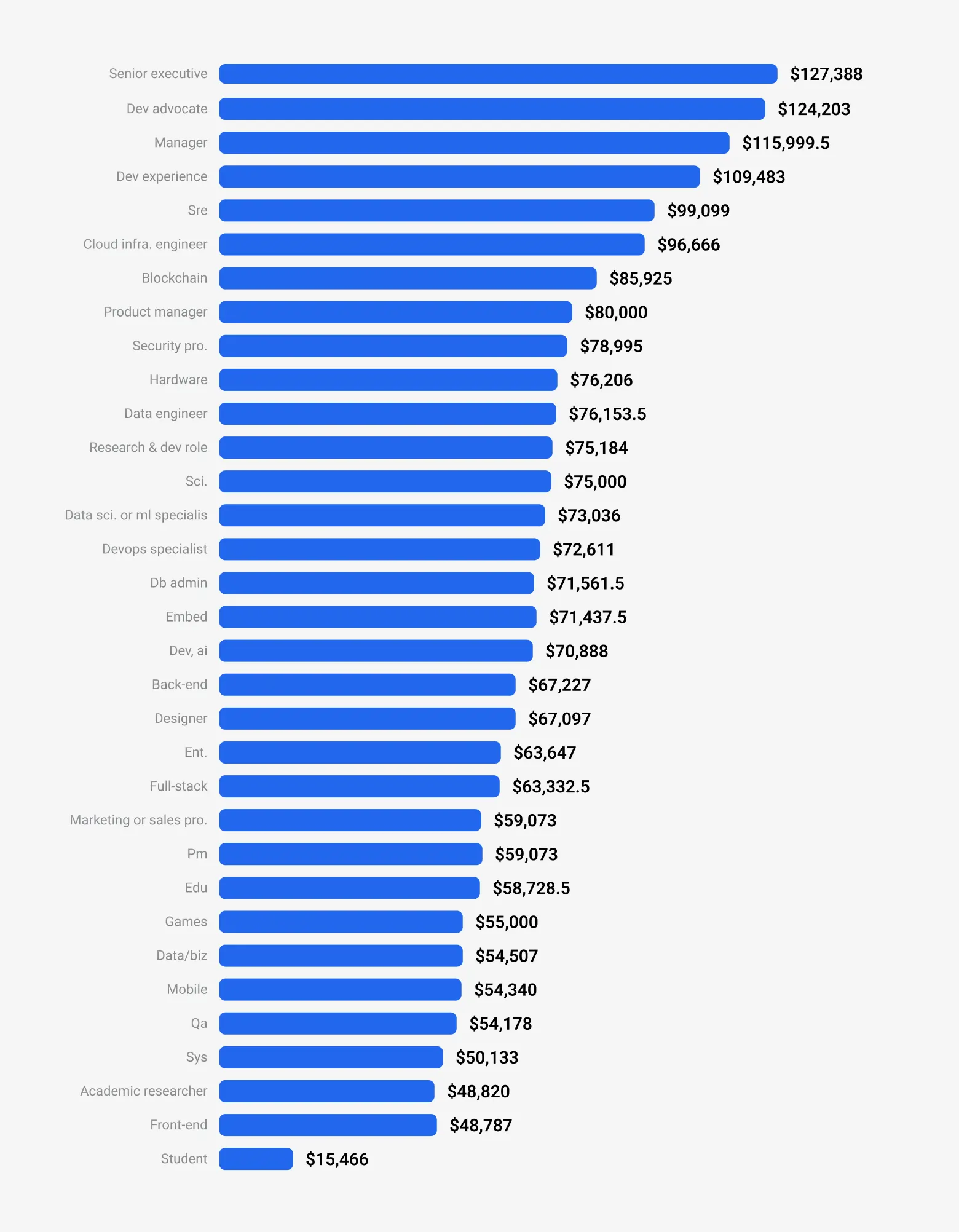
As you might know, specialized engineers like DevOps, backend, security, or data experts often have higher rates than full-stack developers. For MVPs with limited budgets and uncertainty about the future, this can increase costs without providing proportional value.
Medium yearly salary by developer type
Source: Stack Overflow
- Risk aversion
Engineers predominantly working on scaling projects may avoid risky or novel solutions, prioritizing reliability by default. For MVP development that succeeds via experimentation, even when it involves occasional failure, this can be a problem. Overly cautious engineers can hamper innovation and slow down validation of the product concept.
🎧Listen to The Devico Breakfast Bar episode with Mohan Rao, the Chief Product and Technology Officer at Knownwell, talking about how to drive innovation in a startup
- Process friction
Scaling engineers often have a temptation to introduce structured processes, documentation, and QA pipelines too early. While these practices are essential for scaling, at the MVP stage, they can reduce speed, increase bureaucracy, and slow the feedback loop that fuels learning.
Final thoughts
Staff augmentation benefits are attractive for both teams developing MVPs and teams scaling their products.
A good staff augmentation vendor can provide generalists who will ensure speed and flexibility for MVP projects. Equally easily, you can hire narrow specialists from them to guarantee predictability and quality during scaling.
Devico is such a vendor. Over the years, we’ve supported teams at different stages. If you're planning to develop an MVP or preparing to scale, we can help you choose the right team structure and augmentation approach.
Great software starts with great people