TypeScript

Node.js with TypeScript: Best Practices
Oct 21st 26 - by Devico Team
This guide to Node.js with TypeScript covers the architecture, runtime validation, testing, and observability a production-grade backend actually needs.
Hire
Hire by role
Hire Front-end developers
Hire Back-end developers
Hire Full-stack developers
Hire Android developers
Hire iOS developers
Hire Mobile developers
Hire AI engineers
Hire by skill
Hire JavaScript developers
Hire React Native developers
Hire React.js developers
Hire .NET developers
Hire TypeScript developers
Hire Flutter developers
Hire Golang developers
Hire by country
Devs in Ukraine
Expirienced engineers with strong product focus and fast integration.
Devs in Poland
EU-based developers with reliable delivery and high standards.
Devs in Argentina
Senior engineers with strong technical depth and timezone alignment.

Staff augmentation
June 23, 2026 - by Devico Team
Summarize with:
78% of employers have hired technically brilliant candidates who later underperformed because of poor soft skills.
The opposite happens just as often — someone collaborative, organized, and easy to work with who simply can't deliver on the technical side.
Both are expensive mistakes. And in remote teams, you don't get the warning signs in time.
Here's what most hiring guides get wrong: they treat technical skills and soft skills like they're competing. They're not. Asking which matters more is like asking whether a car needs an engine or wheels. The question doesn't make sense.
What does matter — and what almost nobody talks about — is calibration. The right balance looks different depending on the role, the team, and how you work.
That's what we're going to figure out in this guide.
Almost every article written on this topic mentions the well-known statement that 85% of job success depends on soft skills and the other 15% comes from hard skills. However, if you check the origins of this idea, you might have doubts about its reliability.
This theory is rooted in a research study on engineering education conducted by Charles Riborg Mann back in 1918. Later, the findings were reinterpreted, simplified, and repackaged in career-development literature, HR training materials, and soft-skills advocacy content.
In fact, the theory is partially true. Recent studies do show that communication, adaptability, collaboration, and emotional intelligence foster professional success. The weak point is the assumption that there's a universal equation with soft skills outweighing technical capability.
In software development, this 85/15 logic actually quickly breaks down. A developer with poor coding ability won't become effective just because of outstanding communication skills. Below a certain level of technical proficiency, nothing else compensates.
Technical skills are the entry requirement in any case. But once hiring managers feel confident in the candidate's technical capability, they start thinking about operational reliability and assess communication, collaboration, mentorship, ownership, adaptability, etc.
As remote work has become more common, soft skills have received much more attention, which is explained by the fact that distributed teams highly depend on trust, clarity, and self-management. You can see this change in the hiring approach in the World Economic Forum's Future of Jobs Report 2025, which indicates that more employers now prioritize human-centered skills as well as technical expertise.
So, technical capability is still a must. What has changed is the attitude toward soft skills. You know, in a remote environment, communication issues quickly create bottlenecks. That's why hiring managers cannot make decisions based on technical skills only. Their remote developer hiring criteria should also include soft skills.
When working in an office, gaps in soft skills aren't desirable but still acceptable.
Someone who's not open to communication still naturally gets pulled into conversations. A teammate may overhear the confusion and jump in. A manager may notice uncertainty and give a tip. Insufficient documentation can also be handled through quick clarifications during a water cooler chat.
Remote work, in turn, removes most of these live interactions, which is why someone's poor soft skills aren't just a small inconvenience anymore but a source of problems affecting delivery.
Communication clarity
Clarifications happen informally
Ambiguity causes delays across time zones
Status visibility
Managers can monitor activity in real time
Silence leads to delivery risk
Collaboration
Questions get resolved quickly in person
Async dependency chains slow entire teams
Documentation writing
Knowledge spreads organically
Poor documentation creates long-term bottlenecks
Accountability
Office routines reinforce efficiency and responsibility
Self-management becomes essential
Cross-cultural communication
Tone is easier to read through live interaction
The chance of misinterpretation is much higher
There are a few reasons why soft skills for remote developers are so important. Let's review them:
In distributed teams, the ability to write clearly and completely is more than just a nice-to-have skill — it's part of the job itself. A developer who communicates well verbally but poorly in writing can unintentionally create ambiguities, blocking the work of their teammates across time zones.
Just feel the difference between the two updates:
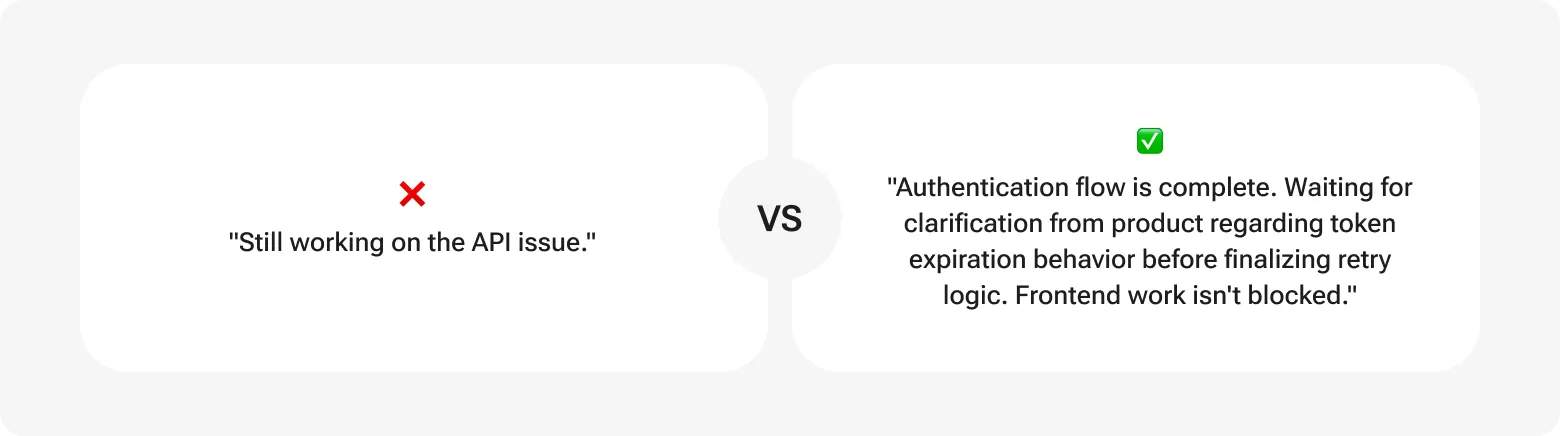
Technically, both developers may be similarly strong. Operationally, they are very different to work with remotely: one creates uncertainty while the other reduces it.
Working in an office, managers usually have passive visibility into what's going on. Remotely, they rely almost entirely on signals from people on the team. Developers who wait to be asked about blockers, risks, or delays create problems that may come to light too late.
This is why experienced remote managers care so much about proactive communication. They want developers to raise concerns when something starts drifting, not before the deadline.
In offices with their routines, peer visibility, and ambient accountability, it's easier for people to stay efficient. Without that structure, they must properly manage their own time, priorities, and blockers. Therefore, autonomy and accountability become foundational skills for remote developers who need to take responsibility not only for completing tasks but also for maintaining delivery flow around them.
Most remote engineering teams are international. As a result, developers have to constantly interact with different communication styles, levels of directness, expectations around feedback, and interpretations of urgency. A statement that sounds pretty neutral to one person may feel dismissive or even aggressive to another.
Issues like these usually don't happen during interviews but gradually emerge during day-to-day collaboration.
Knowledge sharing in remote teams mainly depends on the quality of documentation. Developers who write excellent code but fail to document their work create long-term operational risk. Over time, crucial information gets locked inside individual conversations, private messages, or someone's head. Eventually, teams become dependent on specific people who can explain how systems work and why certain decisions were made. This makes documentation proficiency one of the most important soft skills for a remote work developer.
Today, there is little doubt about the importance of soft skills. Experienced engineering leaders and managers have already seen the cost of underestimating them in distributed teams, which is why communication, ownership, collaboration, and documentation discipline are all taken into account during the hiring process.
Hiring remote developers — what to look for? Applying the same hard/soft skill balance to every developer role is a common hiring mistake.
A company may hire a backend engineer, a tech lead, a mobile developer, and a client-facing developer using almost the same criteria and then wonder why some hires perform flawlessly while others create friction despite looking strong during the interview process.
The thing is that the balance between technical and soft skills changes depending on the type of tasks the person will perform day to day.
A developer working mostly independently on clearly defined tasks doesn't need the same communication strengths as someone coordinating architecture decisions across multiple teams. In the same way, a highly collaborative tech lead may create far more value through alignment and mentorship than through pure coding output alone.
To avoid mistakes, find out how the balance varies across four key roles:
These developers usually work independently with a well-defined scope and limited real-time collaboration. Their performance is measured primarily through output quality, speed, and reliability.
In this role, technical capability carries more weight. The focus is on having someone who can solve problems independently and deliver without supervision.
Yet, it wouldn't be correct to say that soft skills are irrelevant here — the bar is simply set lower. Strong written communication and the ability to work clearly in asynchronous environments are usually enough. Charisma, high social energy, or a strong meeting presence are far less important.
Here, the balance changes considerably.
Developers working closely with other engineers spend a lot of their time on collaborative activities such as code reviews, architecture discussions, debugging sessions, planning conversations, and technical trade-off debates.
For this role, technical expertise is vital because a developer needs to do their job well and earn respect from coworkers to collaborate effectively. At the same time, communication quality impacts team performance too. A highly skilled engineer who cannot clearly explain their ideas and decisions slows down an entire team.
In this case, the best results are achieved when technical and soft skills are evaluated with roughly equal weight.
This is where soft skills have a great influence. A tech lead's job isn't limited to writing code only. They are responsible for team alignment, task assignment, mentoring, giving direction, and much more.
That's why explaining sophisticated tech concepts in a simple way is one of the defining qualities of senior engineers. At the end of the day, they don't just solve problems themselves but help teammates address them faster.
Obviously, soft skills are a must-have in leadership-heavy technical roles. A lead engineer who gives unclear direction, provides little feedback, or lacks the ability to mentor juniors will eventually slow the team down.
In roles like this, technical skills are the fundamental expectation. What about soft skills? Their weight is heavier here than in almost any other engineering role.
Developers working directly with clients, executives, or product stakeholders must translate technical concepts into business language. Also, they manage expectations, clarify ambiguity, explain trade-offs, and help non-technical people make smart decisions.
Even the most experienced developer will struggle in this role if they cannot communicate patiently and clearly with non-tech people. Without that skill, it's very difficult to build trust and productive relationships.
Different roles call for different skill balances. You need to consider this when evaluating candidates. The table below sums up the approach and lets you better understand what matters more when hiring a developer for a particular role.
Solo contributor on an async team
Independent work delivery
Technical skills heavier
Ability to work autonomously, code quality, reliability, documentation skills
Developer incorporated into a tight-knit engineering team
Collaborative engineering contribution
Balanced
Technical competence, great communication and collaboration skills, code review behavior, reaction to criticism
Tech lead or senior developer mentoring juniors
Team direction and engineering alignment
Soft skills slightly heavier
Mentorship skill, communication, conflict handling, judgment
Developer working with clients or non-technical stakeholders
Translating business needs into technical execution
Soft skills much heavier
Communication clarity, interactions with non-tech stakeholders, explaining complex things in a simple way
The way technical competency in software engineering is defined is steadily evolving.
AI-powered tools like GitHub Copilot, Cursor, Claude, and others have already changed what developers spend their time on. A great amount of their routine work — boilerplate code, repetitive syntax, basic function scaffolding, and parts of straightforward implementation logic — is no longer something they write from scratch.
Looking ahead, one of the emerging technical skills is knowing how to use AI efficiently. That includes understanding when to accept suggestions, when to question them, and when to discard them. It also includes the ability to translate vague human input into something an AI tool can work with and then validate the output against real-world constraints.
So, to use AI effectively, one needs to have skills sitting at the intersection of technical reasoning and human judgment.
From a hiring perspective, this impacts the structure of risk. The technical bar for many execution-level tasks got a bit lower than it was a few years ago because AI can now augment or accelerate them. But the soft skill bar hasn't been lowered at all.
A developer who cannot communicate clearly or think critically won't become high-performing even with access to AI tools. Moreover, weak judgment becomes more dangerous when combined with AI assistance.
That is why many engineering leaders are reconsidering how they evaluate technical proficiency. They care less about syntax memorization and more about reasoning. And they are looking for developers who can combine technical literacy with good judgement.
When it comes to hiring, there is a common habit of using one broad label like "senior backend developer" or "mid-level full-stack engineer" and then evaluating candidates against a standard checklist. This approach is often inefficient.
A better way is to define your expectations in terms of technical and soft skills for each particular role. The tech stack, type of work, autonomy level, amount of supervision, and involvement in team or stakeholder discussions should be taken into account.
Again, there is no need to treat soft and hard skills as competitors and decide which one is more important. They're just two equal forces. So look for candidates who meet the technical baseline and then use soft skills as a differentiator.
For a more structured hiring approach, we'd advise you to separate requirements into four categories:
These are the capabilities a developer must have from day one to complete assigned tasks. It's worth evaluating them thoroughly, not relying on CV claims or self-assessment.
To this category you can refer gaps in the candidate's technical expertise that are acceptable because they can be easily closed through mentoring or daily work.
These are the qualities required for this specific role to function efficiently. These can be, for example, asynchronous communication, ownership, or stakeholder clarity.
This category includes nice-to-have abilities. If they aren't in place, they can be developed over time if a candidate already has basic communication skills.
With this structure in place, hiring decisions become more grounded. Evaluation doesn't rely on general impressions anymore. Instead, close attention is paid to whether the candidate meets the technical threshold and whether they can operate effectively within the team. Also, it's clear which skill gaps create manageable risk and which ones are likely to turn into operational problems after onboarding.
Technical assessment is a familiar process for most companies. Soft skill evaluation, in turn, is far less straightforward, which is probably one of the reasons why attitudes drive 89% of hiring failures, while technical skills account for only 11%.
Indeed, it's not so easy to evaluate soft skills, especially in remote hiring. Video interviews are highly structured environments where most natural behavioral signals disappear. Because of that, hiring managers often assess candidates based on confidence, friendliness, or interview charisma, which can be misleading.
Some developers communicate exceptionally well in real work settings but get reserved during interviews. Others perform excellently on calls and then struggle with work collaboration.
A more reliable approach suggests looking beyond the interview itself. The following five methods can help you expose soft skill signals:
In remote teams, written communication is part of daily operations. That's why it makes sense to pay attention to how candidates write emails, answer pre-screening questions, or respond to asynchronous prompts.
A developer who writes vague, incomplete, or ambiguous messages during the hiring process will likely communicate the same way once they join a team.
Assessing digital correspondence first is a great way to understand candidates' written communication quality, which often predicts remote collaboration quality.
Most experienced candidates already have polished interview answers. As a result, the more useful signals usually show up in the follow-up questions.
For example, if you ask about a developer's experience working with a team in a different time zone, continue with questions like:
What broke down?
What would you handle differently today?
What did you learn from that situation?
This will help you reveal self-awareness, accountability, and adaptability rather than simple storytelling ability.
That's how to assess soft skills in technical interviews. While a take-home assignment alone mainly evaluates execution, a short demo session, where a candidate presents their work, also provides insight into soft skills.
It's a great opportunity to see how candidates explain decisions, discuss trade-offs, respond to questions, and handle disagreement.
Demo sessions shouldn't be overlooked, as they are the closest simulations of real remote collaboration available in a hiring process. They mirror how engineers communicate about actual work inside distributed teams.
The quality of a candidate's questions tells you a lot about how they think.
Thus, developers who ask thoughtful questions about workflows, communication structure, ownership boundaries, deployment processes, or team collaboration patterns usually think beyond assigned tasks. They try to understand how work actually happens inside the team.
Candidates who ask about salary, vacation policy, or schedule aren't weak hires by default. But if those are the only questions from them, it may indicate a lower level of engagement with the role itself.
Formal reference checks hardly ever uncover meaningful signals.
To get really valuable data about candidates, ask situational questions tied to remote work:
How did this person handle blockers when immediate help wasn't available?
Did they communicate issues proactively?
How strong was their written communication compared to verbal communication?
Could they work independently without constant follow-up?
Questions like these reveal work habits that stay invisible during interviews.
Finding a candidate who checks all boxes is rare in hiring. More often, hiring managers have to make trade-offs. The key is understanding which skill gaps are acceptable for a specific role and which ones introduce real risk.
Not to fail with hiring, it's useful to know situations where flexibility is reasonable and situations where it isn't.
When you can hire below the ideal technical level if soft skills are exceptional:
The role includes mentoring, collaboration, knowledge sharing, and other activities that require great soft skills.
The existing team is strong enough to cover short-term gaps as a developer grows.
The missing tech skills are learnable, not foundational.
The candidate showed fast learning in past roles.
When you shouldn't lower the technical bar regardless of soft skills:
The developer will work independently with very little peer review.
The role requires making immediate architecture decisions.
The team cannot provide mentorship or compensate for gaps due to a lack of bandwidth.
Technical requirements involve security, infrastructure, or compliance, where mistakes are too costly.
Get it right; we don't encourage you to compromise on technical skills. The idea here is that some gaps in technical skills are acceptable, while others aren't, and you need to understand the difference before making a hiring decision.
People love to debate soft skills vs. technical skills. It's the wrong debate.
Technical capability determines whether a developer can do the work. Soft skills determine whether they can do it without quietly breaking your team in the process.
You need both. Not one more than the other — both, calibrated to the role, the team structure, and what the project actually demands.
Hire below the technical bar and the product suffers. Ignore soft skill red flags because someone's code is clean, and the damage shows up later, when it's harder to fix.
This isn't a new insight. But most companies still don't hire this way.
At Devico, we do. Every developer we present clears a defined technical threshold and is evaluated on soft skills specifically tuned for remote work.
If you're building an engineering team and want developers who can both code and collaborate — let's talk.
TypeScript
Oct 21st 26 - by Devico Team
This guide to Node.js with TypeScript covers the architecture, runtime validation, testing, and observability a production-grade backend actually needs.
Staff augmentation

Oct 20th 26 - by Devico Team
Fixing your tech recruiting process one bottleneck at a time cuts time-to-hire and stops strong engineering candidates from accepting a rival's offer.
TypeScript

Oct 19th 26 - by Devico Team
A practical guide to TypeScript architecture for large applications. Learn design patterns, project references, modularity, and strict type safety.