73% of tech companies have difficulty trying to fill roles. Not to lose a promising candidate, many of them hire quickly.
This rush usually results in excessive reliance on a good-looking CV or a confident interview. A proper technical assessment, in turn, is often skipped. In many cases, this leads to mishiring that negatively impacts performance and budget. In fact, taking into account lost productivity, rehiring costs, and the damage caused, bad hires cost companies 3-5x their annual salary.
The knowledge of how to technically assess a developer before hiring can be of great help if you'd like to protect yourself from that kind of trouble. Read on to learn what to evaluate, which methods to use, and how to keep top talent engaged.
Why CVs and interviews alone don't work
Many companies mishire not because they lack a hiring process, but because they organize it incorrectly.
Quick CV screening in combination with formal interviewing is the most popular but not quite efficient approach. Though a well-written CV and a confident self-presentation create a good impression, they don't assure the level of expertise that you expect from a developer.
It's a common situation when companies bring in a software engineer who passed the interview with flying colors, but eventually they don't deliver the expected value. At first, limited knowledge of the project is an excuse for a newcomer, but then other reasons appear. Six months later, it becomes clear that the developer who seemed so capable isn't a good fit, and the new round of hiring starts.
The thing is that portfolios and formal interviews show candidates' ambitions, communication skills, and background, but a proper tech evaluation is the only way to see if they can tackle real tech challenges, vague requirements, and sophisticated logic.
With a structured technical assessment in place, you can build a competent and effective team, being absolutely confident in your hiring decisions.
What to define before assessing developers
It doesn't make sense to move forward with the developer technical interview process unless your expectations and needs are specified.
When the role is clearly outlined, you know how to test a developer before hiring. You prepare the right questions, assign more relevant tasks, and assess candidates against real criteria, not vague requirements.
Based on our extensive experience, we'd recommend you focus on the following facets:
Tech stack
Define your core stack – one that a newcomer will use on a daily basis. Let's say for your project, this is Nest.js, React, AWS, and GitHub. Build your assessment around those technologies to make sure the candidate has extensive experience with the stack you use.
Must-have vs. nice-to-have tech skills
Hardly can you find a person with all the skills you need currently and in the future. Therefore, you'd better separate vital skills from nice-to-have skills. During the hiring process, opt for a person who is proficient in core areas and can learn quickly, not for someone with basic knowledge across numerous tools.
Workscope
Make it clear what tasks your new hire will handle. This can be maintaining legacy platforms, developing new features, integrating third-party services, or creating a scalable architecture. Understanding a person's key duties, you'll know what skills you should look for.
Expected autonomy and speed
Depending on your team structure, mentorship availability, project complexity, and work pace, you may need a person with different degrees of autonomy and speed. Based on these two factors, you can actually define the needed professional level of a developer. And as there is a far cry between evaluating a junior engineer who needs direction and a senior specialist expected to make decisions independently, you need to frame your assessment accordingly.
Role level vs. assessment focus
Role Level
What to Prioritize
What to Deprioritize
Code fundamentals, learning ability, basic debugging
Code quality, autonomy, framework fluency, handling real tasks
System design, code review, architecture decisions, and trade-offs
Syntax-level trick questions
Architecture, tech direction choice, cross-team thinking
Your environment
Though a backend developer in a startup and one in an enterprise system may use the same tools, they work in completely different setups. One optimizes for velocity, while the other – for stability. Assessing them the same way is inefficient.
Therefore, taking into account your environment, prioritize:
Clean architecture vs rapid iteration
Independence vs collaboration
And of course, the results should be reflected in your assessment.
All in all, tech assessment needs to be role-calibrated, which requires some preparation on your side. Your efforts here will be rewarded with competent team members.
🎧Listen also to the Devico Breakfast Bar episode featuring Edward Tsinovoi, the co-founder and CEO at IO River, who talks about how to build a high-impact team for long-term success
Guide on how to evaluate developer skills before hiring
The assessment process is moving from quick scanning to deeper validation of promising candidates.
So, you start with basic checks and gradually move toward strategic discussions and coding tasks. Early steps help you filter out obvious mismatches and save your time. Later steps thoroughly assess technical knowledge, analytical thinking, and the ability to handle real-world challenges. Here is how it usually looks.
Stage 1. Portfolio and past work review
Checking candidates' CVs before getting down to interviews or coding sessions is a usual practice. Of course, a portfolio won't show you the full picture, but it'll at least give you a general understanding of a developer's experience.
At this stage, the goal is to get maximum data from each CV. In these terms, it's essential to pay attention to the following:
Range of projects: Check the size, complexity, domain, and duration of projects.
Tech stack: Make sure a developer has worked with your tools extensively, not on a basic level.
Responsibilities: Noticeable progress in task complexity and autonomy over time is a good sign.
Public activity: If a developer is active on Stack Overflow or similar platforms, you can pre-assess the clarity of their answers and the ability to offer non-trivial solutions.
GitHub profile: Commit history, code organization, documentation quality, and collaboration patterns can tell you a lot about a candidate.
During CV screening, it's paramount not only to find matches but also to spot red flags. For example:
Many unfinished projects
It's easy to start projects, but it's much more difficult to maintain and complete them. A strong engineering discipline is needed to handle the latter. Numerous abandoned projects may suggest that the candidate struggles with long-term ownership or loses interest when the project becomes more complex.
No public activity at all
Sure, many developers work in closed-source environments, which is why the lack of public activity isn't necessarily a problem. But it removes the visibility so important during hiring. In this case, you need to validate technical depth more carefully in later stages.
Code copied without attribution
Code reuse is the norm. The problem shows up when a person can't explain how that piece of code works and why it is used in this particular situation. This points to poor understanding, which is risky when debugging or scaling a system.
If you notice any of these red flags, there's no need to swipe a candidate left immediately. However, it's worth noting them and preparing follow-up questions for the next stages.
All in all, unless the mismatch is obvious, portfolio review isn't a decision-making point but a direction-setting phase. It lets you understand what to ask, what to validate, and where to dig deeper.
Stage 2. Technical interview
An online or offline interview lets you get acquainted with a candidate and evaluate their technical expertise and problem-solving skills in the course of conversation.
Here, you don't assess how fast developers can write code. Instead, you try to understand how they think, approach problems, make decisions, and address ambiguity.
As a rule, a technical interview takes the form of a structured engineering discussion. Our advice here is not to turn it into a quiz but to use system design discussions, whiteboard sessions, behavioral interview questions, etc.
Another important aspect is adjusting the conversation to the level of responsibility and seniority.
With junior talent, keep the conversation straightforward. For example, ask how they would approach a bug, how they understand a certain piece of logic, or how they would structure a small feature. Don't expect a perfect answer here. Rather, check whether a candidate can think things through step by step and stay on track.
When interviewing mid-level engineers, you can raise the bar. Thus, you can offer a real-world challenge with more than one solution or ask how they would approach feature development, what they would prioritize, and what could go wrong. Here, you need to make sure a candidate can work independently.
When it comes to senior engineers and tech leads, your focus should shift from solutions to decisions. Bringing in system design questions is spot on. For instance, ask how they would design a notification system or build a scalable messaging service.
At this stage, your role is to listen more than you talk.
Your questions matter, but how you follow up is even more important. Don't move on too quickly – go deeper into candidates' answers. Ask "why" to break surface-level replies.
During the discussion, pay attention to whether the engineers:
clarify the problem before solving it – in real life, asking is always better than assuming.
think in trade-offs, explaining when and why something works.
structure their thinking so that you can follow their reasoning without effort.
communicate decisions clearly, outlining what they would do and why.
While it's better to arrange a separate round of interviews for coding tests, at this stage, a brief code review can also be included as a part of the conversation. If you are limited in time, it will let you go a bit deeper without adding another round.
Give the candidate a small, anonymized piece of code – something close to what your team works with – and ask them to review it.
This is useful because most real work isn't writing code from scratch but working with existing code. Code review shows how a candidate reads, evaluates, and improves someone else's work, which is something traditional interview questions don't capture.
Less experienced developers focus on low-hanging fruit, like naming, formatting, and minor improvements. That's expected.
More experienced engineers usually go deeper into structure, maintainability, and potential risks.
Code review is relevant across all levels, but especially valuable for senior roles, where improving and optimizing existing code is as paramount as writing new code.
Stage 3. Coding tests and problem-solving tasks
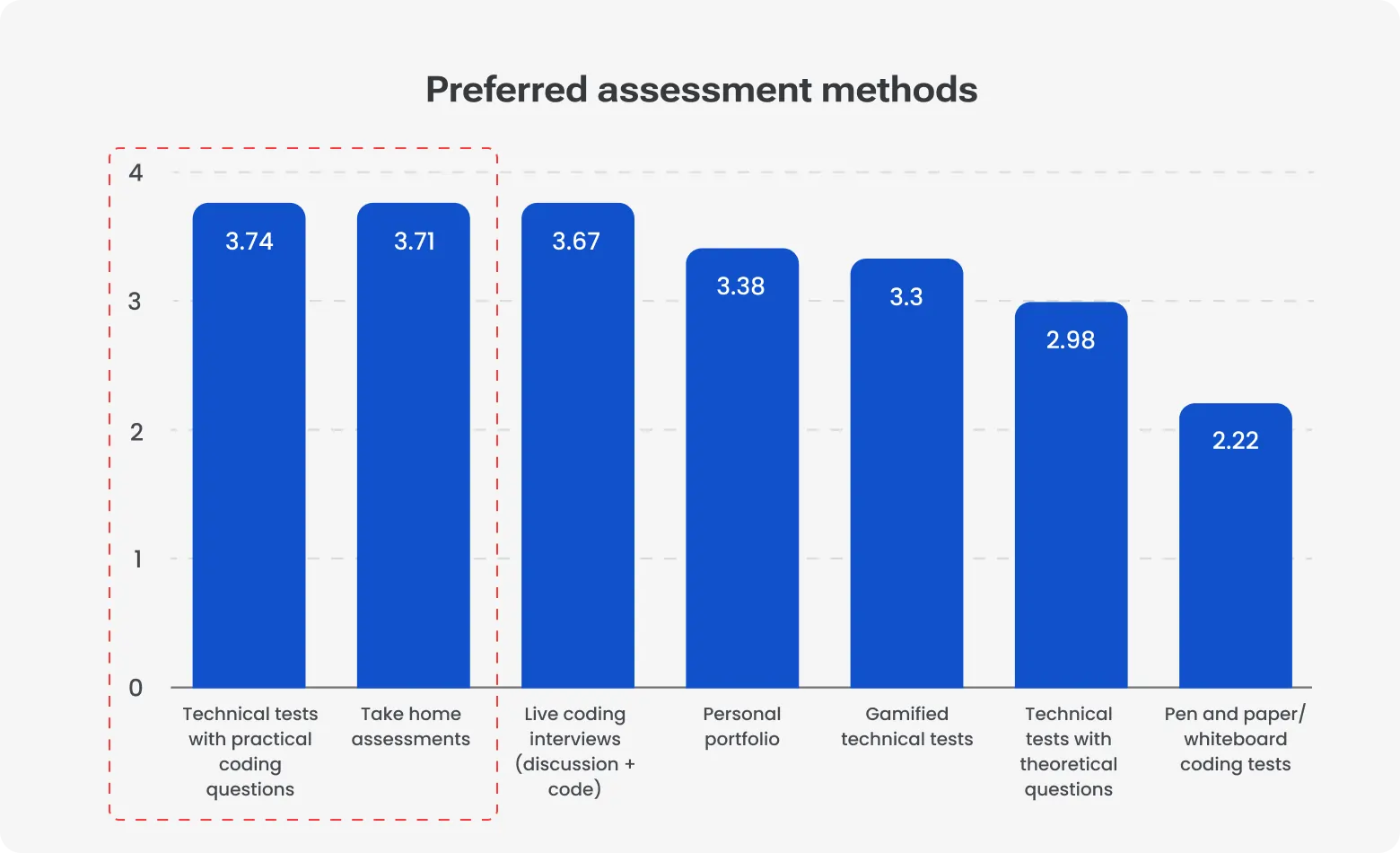
This stage is the simulation of day-to-day engineering work in the assessment process. Coding tests and problem-solving tasks aren't perfect, but they are still more reliable than any discussions.
Depending on what exactly you'd like to validate, you can use different software developer assessment methods at this stage.
This can be a task related to extending an API, fixing a bug in an existing codebase, or developing a small feature. The key thing is that it should be as close to real work as possible. This format gives candidates time for thinking, structuring their solution, and writing code without any time pressure.
This way, you see how an engineer can solve the problem when no one is watching. You can assess how they structure code, name things, address edge cases, and take care of readability and maintainability.
The downside of take-home tasks is that candidates may use external help or spend more time than you expect.
A test of that kind is more about the engineer's thinking process, which is why candidates are encouraged to think out loud. You see how they approach a problem in real time, how they break it down, what questions they ask, and how they act when they get stuck.
Due to visibility and time pressure, live coding is quite stressful for candidates, but it demonstrates a plethora of their hard and soft skills.
This approach mimics actual collaboration in a team. Instead of tackling a task on their own, the candidate works with another engineer. This co-working shows how they communicate, explain decisions, respond to feedback, and adapt their thinking midway.
This format is especially advantageous for roles where teamwork and shared ownership are important.
These are smaller tasks focused on logic. On their own, they rarely tell you enough because solving a small, well-defined problem is very different from working in a real system.
Yet, they usually work well as an initial filter when you need to process a larger number of candidates.
Any coding assessment for software developers doesn't stop at task completion. You get real value when you walk through the solution with the candidate. So, when you plan a live session, add some time for discussion and schedule a demo call if you provide a take-home task.
It makes sense to ask your candidate to explain:
why they structured their solution that way
what alternatives they thought about
what they would change if they had more time
where they see potential issues
How to evaluate a developer's code quality before you sign a contract
Tools that help organize the assessment process
There is a wide variety of modern tools that help avoid setup troubles and keep coding tests well-structured.
Let's highlight the most popular options:
CoderPad – good for live coding with shared execution
Coderbyte – useful for structured coding assessments
HackerRank – a scalable testing platform with predefined tasks
Codeshare – a tool enabling collaborative coding for quick tests
While all of the above-mentioned solutions are of great help, don't overestimate their capabilities. A well-designed task on a simple shared editor is always better than a poorly designed exercise on a cutting-edge platform.
Red flags to watch for during tech assessment
During technical assessments, your goal isn't just to catch mistakes but to spot warning signs and interpret them correctly.
Therefore, we'd like to draw your attention to the most common red flags.
A task is completed, but a candidate can't explain how they got there
We've seen this many times when everything works, and the solution looks fine, but the candidate cannot explain it. Often, this indicates that the work wasn't fully understood or was compiled based on familiar patterns without deeper analysis. When it comes to take-home tasks, this can also point to outside help or over-reliance on external sources.
An engineer becomes defensive when challenged
Top developers never mind revisiting decisions and adjusting them. If a candidate shuts down or rejects feedback, that's a sign of rigidity, which can be a serious hindrance for a team. The ability to respond adequately to constructive criticism is essential for ensuring productivity.
Answers are given straight away without any clarifying questions
That's not confidence you might think about first. As a rule, this signals surface-level understanding, overconfidence, or a lack of engagement. Highly competent engineers always ask questions before they act to avoid rework.
A candidate can't describe portfolio projects in detail
You see a great CV with impressive projects, but when you ask a candidate to walk you through key decisions, trade-offs, or challenges, they get confused. This is why CVs aren't reliable evidence of experience but a foundation for further communication. During the interview, good candidates always stand behind what they've stated and explain it clearly.
Trade-offs are neglected
Every engineering decision has a cost: performance vs. simplicity, speed vs. reliability, scalability vs. complexity. Seasoned developers outline these trade-offs and explain why they've chosen one approach over another. If a solution is presented as absolutely correct, without downsides or alternatives, it usually implies that a candidate hasn't thought deeply enough, which is a critical gap at senior levels.
10 red flags in a developer interview you should never ignore
Technical screening process for developers provided by an outsourcing partner
One of the best things about working with an outsourcing vendor is that they handle most of the hiring work.
Trusted partners run candidates through a multi-stage technical evaluation before presenting them to you.
As a rule, that includes:
coding and problem-solving tasks
internal review and calibration
At Devico, for example, this kind of layered approach is standard. Developers go through several stages of technical validation before being introduced to our clients.
The mistakes teams often make are trusting the vendor blindly or re-running the entire hiring process. None of these approaches is practical.
What you need to do is conduct targeted validation. It can be in the form of a short technical conversation and a brief code review.
Your mission isn't to retest fundamental concepts but to confirm alignment.
So, verify whether:
the candidate owns experience described in a CV
their level matches how they were presented
they can easily integrate into your team's way of working
This way, you keep the process efficient without turning it into blind acceptance or unnecessary duplication.
As for the vendor, a reliable one should not only present a CV but also tell you how the candidate was assessed.
At a minimum, you should expect:
Technical interview notes
Code samples or task results
If a vendor provides this level of detail, you have a solid foundation and can focus on the nuances that are important for you.
How to make your assessment process attractive to top talent
During the hiring process, not only do you assess candidates, but they assess you too.
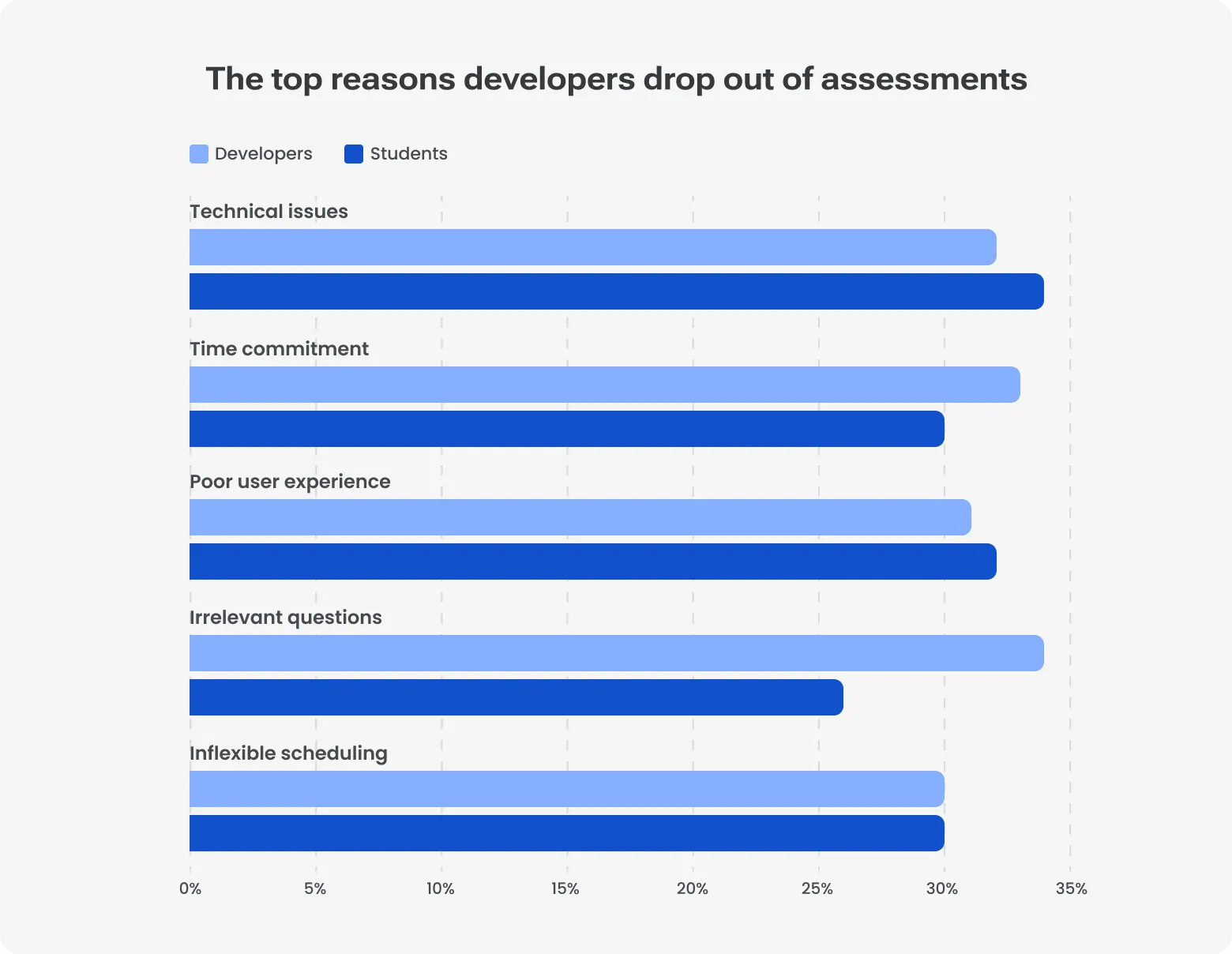
It's important to keep this in mind, as top developers usually apply for several vacancies simultaneously and compare not only salary but also companies' approach to assessment. And if your process is slow or confusing, they'll just go away. This affects not only your hiring speed but also your reputation. According to the Harvard Business Review, a bad reputation can increase hiring costs by 10%.
The top reasons developers drop out of assessments
Source: HackerRank Developer Skills Survey
Not to alienate top talent, structure your assessment process based on the following aspects:
Relevance to the role
Tasks and discussions should be aligned to actual work, and they should match the level of responsibility you're hiring for.
It's a bad idea to provide a senior with basic coding exercises or ask a junior developer high-level system design questions they're not expected to handle in the role.
When the level is mismatched, the process gets inefficient. Candidates either feel underestimated or set up to fail.
So, to keep candidates engaged, make your technical assessment for developers fair and relevant.
Clarity
Candidates should never have to guess what's going on. Let them feel that the process is well-organized by informing them about the following:
Respect for time
No one likes it when their time is wasted. Therefore, keep tasks time-bounded and realistic. Don't assign tests that require significant effort without clear value. If a take-home task goes beyond four hours, consider compensating for it. This isn't obligatory, but it shows respect and sets the right tone from the start. Also, avoid long pauses between stages. Silence is often interpreted as disinterest.
With all of this in place, a candidate-friendly assessment process usually looks like this:
clear stages from the start
realistic tasks tied to the actual role
reasonable time expectations
minimal waiting between steps
brief feedback after each round
When the assessment process is clear, relevant, and efficient, capable developers are far more likely to choose you over other options.
Conclusion
How to technically assess a developer before hiring? One single test won't help you. What you need is a staged and role-calibrated technical assessment that starts with a portfolio review and progresses through a technical interview and coding challenges.
Your goal is not only to pick developers that meet your requirements in terms of technical expertise, communication, ownership, and strategic thinking but also to make a good impression on candidates yourself. Companies that understand this hire better and retain longer.
Whether you're assembling an engineering team from scratch or extending your existing one, Devico can become your trusted outsourcing partner. Thanks to a multi-layered technical vetting process, we provide developers who tick all your boxes. If you're looking for quick, hassle-free, and successful hiring, we can help.
Motivated and focused experts for up to 60% less than locals, delivered in days, not months