Just pay attention to this: In just one year, Argentina has increased the number of domestic unicorns from 5 to 11. Great pace that puts it ahead of several Latin American peers in the tech space.
And well, among other reasons for such growth, we can also list US companies that nearshore software development in Argentina.
Alluring mix of skillful talent and adequate costs makes Argentina a top-of-mind destination in 2026.
But outsourcing to Argentina takes more than scanning hourly rate charts or checking boxes on Clutch, whether you plan to hire software developers in Argentina for your own team or hand over a whole project. You need a real-world understanding of how pricing works, what kinds of talent are available, how communication flows across time zones, and where the blind spots are:
-
How much it costs to hire Argentinian developers (and why it fluctuates — yep, you read it right)
-
What makes the talent pool attractive
-
The time zone and cultural fit factors
-
The challenges you need to prepare for and how to actually avoid them
-
How to set up outsourcing to Argentina and vet a vendor
Ready? Read carefully.
Senior Argentine engineers with strong English, matched to your stack
Why choose Argentina for software outsourcing?
Argentina offers top tech talent, U.S. time-zone alignment, and strong English skills, making it a smart outsourcing choice.
Tech talent you can count on
Understanding the importance of software for the future, Argentina implemented several nationwide tech disciplines and is now reaping the benefits.
Argentines have an established renown in custom development, artificial intelligence, blockchain, and consulting in these niches. About 27,000 new tech graduates enter the market every year, feeding a talent pool of roughly 167,000 software developers, the third largest in Latin America after Brazil and Mexico.
Local tech universities rank among the top 10% best:
University of Buenos Aires (UBA): Ranks 1st in Argentina and 71st globally as per QS World University rankings.
Buenos Aires Institute of Technology (ITBA): Has strong engineering programs and international partnerships.
Universidad Nacional de La Plata (UNLP): Offers over 100 degrees across 17 faculties and has advanced programs in Artificial Intelligence and Data Science.
As a side note, Argentina has 5 Nobel Prize winners, two of them in the Medicine/Physiology niches.
Time zone alignment with North America
GMT-3 closely aligns with US Eastern Time (GMT-5). This offshore time-zone difference overlap creates convenient conditions for real-time collaboration and effortless coordination with US-based teams during regular business hours.
Cultural compatibility and English proficiency
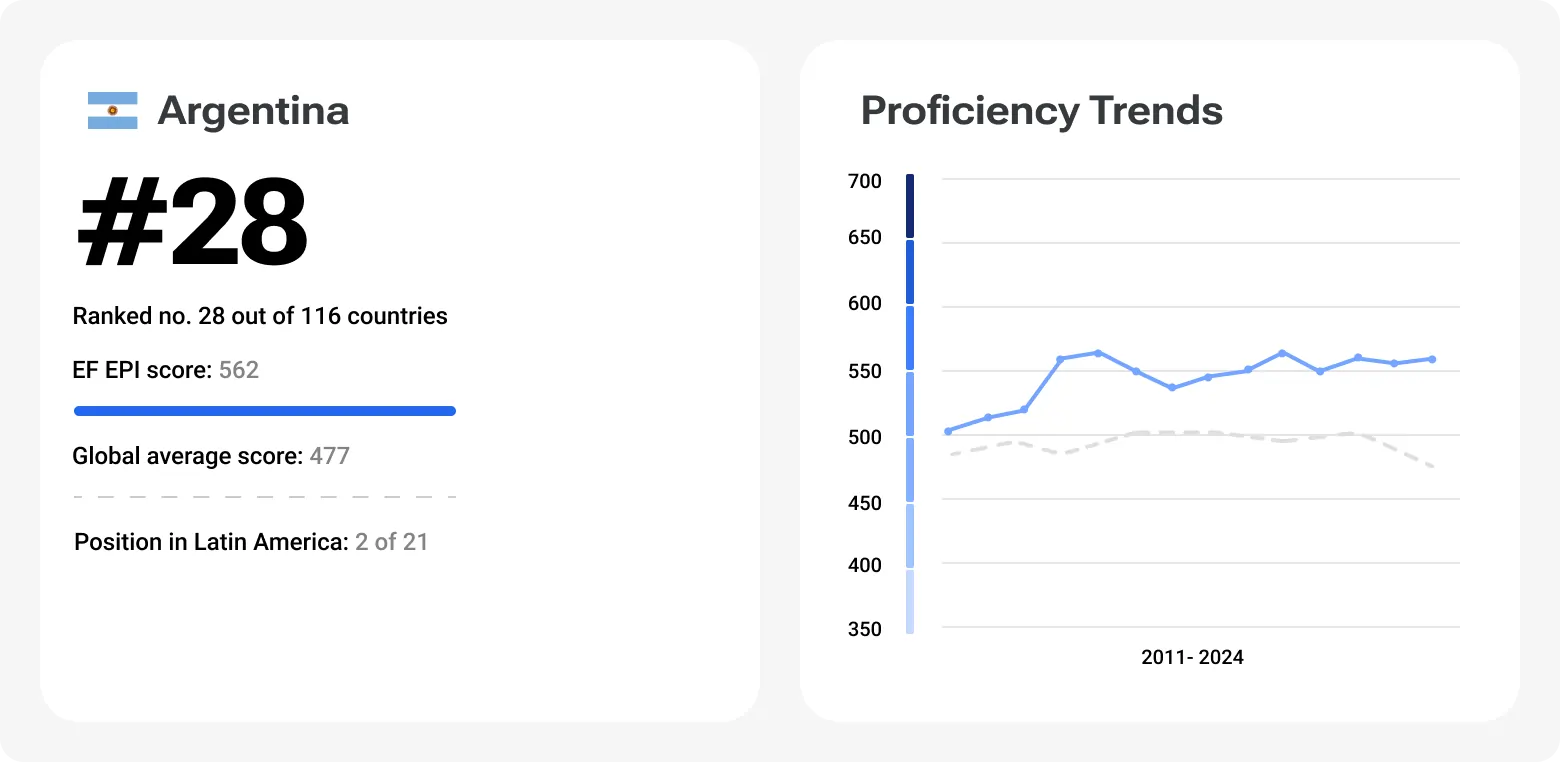
Argentina has the best English in Latin America: it ranks 26th of 123 countries in the EF English Proficiency Index 2025, the only country in the region in the "high" band. Strong English eases project management and reduces misunderstandings, which is one reason it often wins in a comparison of Argentina vs India for US companies.
Government support for the tech industry
The most relevant program for outsourcing clients is Argentina's Knowledge Economy Law (Laws 27,506 and 27,570). It gives software and IT service exporters income tax reductions, a tax credit based on employer contributions, zero export duties on promoted services, and fiscal stability through 2029, provided promoted activities make up at least 70% of a company's revenue. These benefits lower vendors' costs and help keep export rates competitive. Thanks to this support and strong universities, Buenos Aires, Córdoba, Rosario, and Mendoza have become established tech hubs, and Buenos Aires hosts offices of Microsoft, Amazon, Meta, and other global companies.
Understanding software development costs in Argentina
The cost of software development in Argentina isn't as low as in India, but compared with the US and Western Europe it is attractive, especially given the quality of the output. Through a vendor, mid-level developers typically cost USD 35–55 per hour and seniors USD 65–85, below Mexico, Brazil, and Chile.
Outsourcing rates by experience level
Level
Outsourcing rate (USD/h)
Full-time monthly cost
Junior
$20–30
$3,400–5,000
Mid-level
$35–55
$5,900–9,200
Senior
$65–85
$10,900–14,300
Most vendors and contractors invoice in US dollars, so client prices no longer follow the peso. For a detailed breakdown, including contractor rates, salaries, and team budgets, see our guide to software developer rates in Argentina, and for a regional comparison, the cost of hiring software developers in Latin America.
Balancing cost and quality
Not the lowest rates globally, indeed. But the combination of high-quality talent, cultural alignment, and time zone compatibility offsets the monetary matter. This balance means better project outcomes and long-term cost savings.
Nearshore advantages, reducing operational costs
Usually, a 1-2 hour difference comes across as just a communication matter. Like, it’s convenient to have daily/weekly standups or to throw messages in Slack, assured you’ll get a quick answer.
Yet, a similar time zone also reduces travel expenses and simplifies legal/contractual processes. Eventually, this leads to lower operational costs when nearshore software development in Argentina.
Choosing the right engagement model when outsourcing to Argentina
Once the engagement model question is on the table, it’s time to look at the practical options. Different models address different needs like dedicated software development teams are designed for long-term, stability-driven projects, while others like staff augmentation services are more flexible and cost-oriented. Understanding these distinctions helps align Argentina’s outsourcing potential with your business priorities.
Dedicated teams: for stable and depth-required projects
Usually, long-term and product-led initiatives choose this model because under it, tech people, PMs, and designers dive into the product, gaining deep domain knowledge and regularly collaborate with the client.
Pros: Full team alignment, smoother onboarding, consistent codebase quality and organized knowledge transfer.
Cons: Higher commitment, higher costs, less flexibility if project scope shifts (but it depends).
Best for: Mid‑sized startups and established companies building scalable products.
Why Argentina for Software Development (2026)
Staff augmentation: For flexibility-required projects
You have a team. You have thoroughly balanced its skills, the quality, and the cost of its output. But you feel like it’s insufficient. This is where staff augmentation comes in. It adds specific skills to your existing team, such as a senior backend engineer or DevOps specialist.
Pros: Quick ramp-up, precise skill coverage, kept internal control.
Cons: You manage onboarding and coordination, limited long-term cohesion.
Best for: Teams with in-house tech leadership with an urgent need to bridge skill gaps.
Project-based outsourcing: For the transmit-and-reap approach
If you want to hand over a particular scope or project completely, this option is for you. Vendor handles full delivery from design to deployment. You outline a specific SOW and lock the price.
Pros: Predictable costs and timelines, minimal internal overhead.
Cons: Less flexible mid-project, risk of misaligned expectations.
Best for: Short-term, well-defined projects: MVPs or feature builds.
Freelancers vs. agencies
Freelancers: Often cost-effective and agile for specific tasks. Serve best for small builds or UI tweaks. Have a higher risk for large-scale solutions, including sensitive information and IP.
Agencies: Contract, “official” workers with a defined structure and typical workflow. They cover many directions at once, from full-stack developers to automation QA engineers. Better suited for enterprise-grade products with long-term roadmaps.
Managing key risks when outsourcing to Argentina
The state and peculiarities of the current market form future Argentina’s IT outsourcing trends, as the demand should be processed properly. So, what are the nuances of the current specialization and jobs here?
High demand for AI, data, and fintech roles: Local market is strong in software engineering. Here, you have higher chances of finding an appropriate machine learning engineer or blockchain developer. Yet, rates for specialized roles are typically 20% higher.
Frontend and generalist backend roles are even easier to fill, but specialized roles require proactive sourcing and competitive compensation.
Challenge: Skilled developers are in demand across Argentina’s growing tech scene.
Solution: Team up with agencies; they offer resource stability via bench reserves.
Managing currency volatility and inflation
Argentine inflation has fallen sharply but is still high by international standards. Annual inflation peaked at about 289% in April 2024, dropped to 31.5% by December 2025, the lowest since 2017, and stood at 33.5% in August 2026, with monthly inflation down to 1.7%. Contract in US dollars, which is standard for vendors and contractors, and agree in advance on when and how rates are reviewed, for example once or twice a year against a published index.
Legal and compliance framework
Use NDAs and work-for-hire contracts to secure IP.
For European clients: Argentina has an EU adequacy decision, so personal data can be transferred from the EU without standard contractual clauses. Still include a data processing agreement in the contract.
Look for ISO/IEC 27001 certified companies locally (via IRAM or ISO bodies)
Request documentation showing alignment with Argentina’s Ley 25.326 (Personal Data Protection Act).
Include audit rights and breach notification timelines (72 hours) in contracts.
Bridging work culture differences
Argentinians favor direct, respectful communication with humor and relationship-building.
Don’t be shy to ask open-ended questions, but avoid micromanagement, and schedule regular casual check-ins.
Argentina vs. India: Which outsourcing destination works better for US companies?
How to set up outsourcing to Argentina
The success of outsourcing to Argentina largely depends on choosing the right vendor, one with proven expertise by case studies, strong references, and cultural compatibility. Knowing where to search for such partners is just as important as knowing how to engage them.
Where to look for proper vendors
Agencies: Hop on Clutch and GoodFirms and narrow candidates by reviews and case studies.
Freelance marketplaces: If you are a small business, choose Fiverr or Upwork and filter by rating, regional preference, and verified work samples.
Local tech communities: For SMEs and enterprises, it’s worth attending Buenos Aires Ruby, Data Science meetups, or similar industry events for direct referrals — one of the cheapest ways to hire Ruby developers in the region.
How to check technical expertise
Require case studies or GitHub repos from past work. Use technical take-home assignments or live coding sessions relevant to your stack.
To avoid suspicious schemes:
Use time-boxed live coding through shared IDEs (e.g., VS Code Live Share), and ask candidates to explain their code live to make sure they didn’t use AI.
Follow up with a post-test code walkthrough call. AI tools can’t properly articulate reasoning or trade‑offs.
Additional checks you want to implement
Test English in a real conversation rather than a formal exam: ask each candidate to walk you through a past project and note clarity, vocabulary, and how they handle follow-up questions.
Rate interaction quality: Native-like idioms are not expected, but clear, project-focused communication is essential.
Confirm regular pen-testing, vulnerability scans, and SOC 2 or local equivalents.
Ask if the company has completed a GDPR audit under ISO-IEC 27001 Annex A and can provide a summary.
Scalability and support capability
Ask if the vendor can scale a team by 20-50% within 3-4 weeks. Ensure long-term support with defined SLA, bug-fix turnarounds (e.g., 24-48 hours), and dedicated support.
Conclusion
The country is making headway as a top-of-mind destination for software development. Argentina has everything for this: skilled devs, a wide range of specialities, a convenient time zone, and English fluency.
Indeed, the cost of software development in Argentina is not the lowest worldwide, but still one of the most adequate in terms of cost-value balance.
If you are weighing Argentina against other countries in the region, our guide to software development outsourcing in Latin America compares the main destinations. Whether you are a small business or an established company, Devico builds teams in Argentina and across Latin America. Talk to our team to find out how we can help.
Planning a team in Argentina? Get a free consultation on team setup, rates, and timeline
FAQ
Yes, especially for US companies. Argentina combines a senior-heavy talent pool of about 167,000 developers, the best English in Latin America, a time zone one to two hours ahead of New York, and rates below Mexico, Brazil, and Chile.
Through a vendor, mid-level developers typically cost USD 35–55 per hour and seniors USD 65–85, or about USD 10,900–14,300 a month for a full-time senior engineer.
Inflation and currency volatility, competition for senior engineers in AI, data, and fintech, and public holidays that reduce billable days. USD contracts, agreed rate reviews, and a vendor with a bench of engineers address most of them.
Yes. Argentina has an EU adequacy decision, so personal data can flow from the EU without additional safeguards such as standard contractual clauses. A data processing agreement is still recommended.
Dedicated teams suit long-term product work, staff augmentation suits teams that need specific skills fast, and project-based outsourcing suits well-defined scopes such as MVPs. Many companies start with staff augmentation and grow into a dedicated team.